



TL;DR:
- Hiring skilled HVAC technicians and licensed plumbers is challenging due to ineffective recruitment approaches. Industry-specific recruiting targets trade expertise, credentials, and networks, significantly improving candidate quality and retention. Emphasizing trade knowledge and direct outreach helps contractors build stronger, more reliable teams efficiently.
Hiring skilled HVAC technicians and licensed plumbers is harder than most mechanical contractors expect. You post a job, collect applications, and end up sorting through candidates who barely meet the basic requirements. The problem is not effort. It is approach. More applicants don’t translate to better hires in skilled trades. That is exactly where industry-specific recruiting changes the equation. This article explains what industry-specific recruiting means, why it matters for HVAC and plumbing roles specifically, and how mechanical contractors can apply it to build stronger, more reliable teams.
Table of Contents
- Understanding industry-specific recruiting
- Why industry-specific recruiting is essential for HVAC and plumbing roles
- How industry-specific recruiting differs from general recruiting and staffing
- Practical advantages and application of industry-specific recruiting for mechanical contractors
- Why the typical hiring approach for skilled trades in mechanical contracting is often backwards
- Enhance your workforce quality with Petra Talent’s industry-specific recruiting services
- Frequently asked questions
Key Takeaways
| Point | Details |
|---|---|
| Definition clarity | Industry-specific recruiting focuses on targeted hiring within a defined niche using specialized knowledge and language. |
| Quality over volume | More applicants don’t guarantee better hires; industry recruiting prioritizes fit and relevant experience. |
| Deep industry connections | Successful recruiting taps trade networks, referrals, and passive candidates not found on generic boards. |
| Distinct from staffing | Recruiting firms specialize in technical roles with curated candidate pools, unlike broader staffing agencies. |
| Strategic application | Nesting recruiting efforts improves hiring alignment, reduces wasted effort, and shortens time-to-fill. |
Understanding industry-specific recruiting
To grasp why more applicants are not always better, let us start with a clear definition. Industry-specific recruiting is a targeted hiring approach focused on sourcing talent within a defined niche using industry language and workflows rather than recruiting broadly. In practical terms, it means the recruiter or hiring process is built around the specific trade, not adapted from a general template.
For mechanical contractors, this looks different from posting a job on a broad platform. It involves:
- Using correct trade terminology in job descriptions (EPA 608 certification, Section 608, journeyman licenses, NATE credentials)
- Knowing which credentials are legally required versus preferred in each state
- Tapping candidate pools that exist within trade schools, union halls, and manufacturer networks
- Screening for technical competency, not just employment history
- Understanding compensation benchmarks specific to HVAC and plumbing labor markets
The contrast with general recruiting is significant. A generalist recruiter writes a job description, posts it widely, and filters by keyword matches. A specialist understands that a commercial HVAC project manager and a residential service tech require completely different backgrounds, and screens accordingly. This is the core of the industry-specific recruitment definition: depth of focus over breadth of reach.
Why industry-specific recruiting is essential for HVAC and plumbing roles
Now that we see what industry-specific recruiting entails, let us explore why it is particularly crucial for HVAC and plumbing hiring.
Qualified HVAC technicians and plumbers are in short supply across the United States. The pipeline from trade schools is not keeping pace with the retirement rate of experienced professionals, and mechanical contractors feel this gap directly on job sites. General job boards generate volume, but the quality rarely matches the need.

Effective HVAC recruiting combines referrals, industry networks, and direct outreach rather than relying on volume from general job boards. This matters because the best candidates, those with 10 or more years of field experience and supervisory ability, are rarely browsing job listings. They are already employed and reachable only through trusted industry channels.
Here is a direct comparison of the two approaches:
| Factor | General job board recruiting | Industry-specific recruiting |
|---|---|---|
| Candidate quality | Variable, often mismatched | Pre-qualified for trade requirements |
| Time to qualified shortlist | Slow due to volume filtering | Faster through targeted outreach |
| Credential verification | Manual and inconsistent | Built into the screening process |
| Access to passive candidates | Limited | Strong through trade networks |
| Understanding of licensing requirements | Minimal | Deep and state-specific |
Pro Tip: Contact local plumbing and HVAC supply houses. Counter sales staff interact with working technicians daily and often know who is looking for a change before anyone posts a job listing.
HVAC and plumbing recruiting insights consistently show that mechanical contractors who rely solely on job boards extend their time-to-hire significantly and increase the risk of a bad placement.
How industry-specific recruiting differs from general recruiting and staffing
To fully appreciate the benefits, it helps to understand how niche recruiting stands apart from general recruiting and staffing.
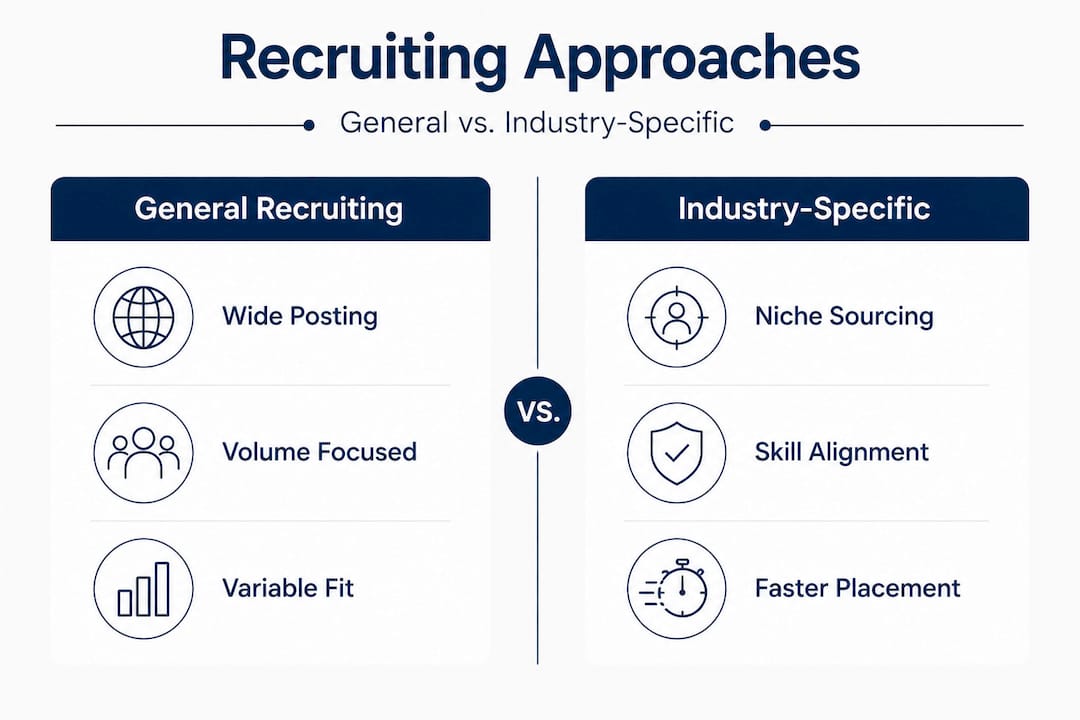
Many contractors assume that a staffing agency and a recruiting firm are the same thing. They are not. The distinction matters when filling technical roles that require licensing, trade experience, and long-term commitment.
Recruiting firms maintain segmented pools for specific fields with curated processes, unlike staffing agencies with broad, general candidate pools. Here is how the two approaches differ in practice:
- Depth of candidate vetting. A niche recruiter screens for EPA certifications, state-specific plumbing licenses, and field experience levels. A general staffing agency screens for availability and a matching job title.
- Candidate source quality. Industry recruiters draw from private networks, trade referrals, and direct outreach to employed professionals. General agencies post ads and wait.
- Understanding of role complexity. A specialist knows the difference between a service technician and an installation technician. A generalist may not.
- Placement durability. Because niche candidates are better matched to the role and culture, they stay longer. Turnover from a poor-fit placement costs contractors significantly more than the recruiter fee.
| Dimension | General staffing agency | Industry-specific recruiting firm |
|---|---|---|
| Primary focus | Speed and volume | Fit and quality |
| Candidate pool | Broad, multi-industry | Trade-specific |
| Screening criteria | Basic qualifications | Technical, credential, and culture fit |
| Best suited for | Temporary or general roles | Permanent, specialized, or leadership roles |
The recruiting firm vs staffing agency question is not about which is better in general. It is about which is appropriate for the role. A licensed master plumber or a field superintendent requires the precision of a niche approach.
Practical advantages and application of industry-specific recruiting for mechanical contractors
With the differences clear, let us review how contractors can apply industry-specific recruiting to build stronger mechanical contracting teams.
Understanding specialized recruitment is only useful if it translates to action. Here is what changes when contractors move from general to industry-specific approaches:
- Candidate alignment improves. Niche recruiting reduces waste by narrowing the candidate audience to those who self-select into relevant ecosystems, increasing alignment and retention. When a candidate already knows the environment, onboarding is faster and dropout rates drop.
- Employer brand strengthens. Contractors who recruit through trade networks signal credibility to candidates. Technicians talk. Being known as a company that understands the trade attracts better applicants over time.
- Leadership roles fill more reliably. General recruiting consistently underperforms for project manager, superintendent, and foreman roles in mechanical contracting. These require someone who already understands project sequencing, field crew dynamics, and trade-specific compliance.
- Interview quality improves. When interviewers understand the technical landscape, they ask the right questions. A recruiter who knows the difference between a boiler service call and a chiller commissioning will screen candidates with far more accuracy.
Pro Tip: When briefing a recruiting partner on an open role, go beyond the job description. Describe the type of jobs your company runs, the tools used, the licensing environment in your state, and the personality profile of your top-performing technicians. This context produces far better candidate matches.
Niche recruiting strategies for contractors work best when the recruiting partner has established relationships with working professionals in the trade, not just a database of resumes.
Why the typical hiring approach for skilled trades in mechanical contracting is often backwards
Having explored practical applications, here is a perspective that reframes how mechanical contractors should approach recruiting skilled trades.
Most contractors focus on the front end of hiring: writing job postings, setting up interview panels, reviewing resumes. They measure success by how many applications they receive. But the real measure is how many qualified candidates they actually reach and retain. Those are different numbers.
The differentiator in niche recruiting is building talent intelligence pipelines rather than simply advertising vacancies. This means maintaining active relationships with technicians who are not currently looking. The best HVAC foreman or master plumber you will ever hire likely has a steady job right now. They will consider a move for the right opportunity, offered by the right person, at the right moment.
Contractors who chase volume spend more time filtering bad applications and less time building those relationships. The result is a reactive hiring cycle that accelerates turnover because urgency forces compromises on candidate fit. A smart hiring perspective starts with building a pipeline before the role becomes critical, not after.
Speed matters too. When a strong candidate is available, the window to extend an offer is often days, not weeks. Contractors who run slow internal approval processes consistently lose their top choices. Industry-specific recruiting firms that maintain warm candidate relationships can act quickly because the vetting is already done.
The shift is from posting and waiting to identifying, nurturing, and offering.
Enhance your workforce quality with Petra Talent’s industry-specific recruiting services
Mechanical contractors who understand the value of industry-specific recruiting still need the right partner to execute it. Petra Talent specializes in sourcing and vetting HVAC and plumbing professionals for service, construction, and leadership roles across the United States.
Petra Talent’s HVAC recruiting services connect contractors with credentialed technicians, field supervisors, and project managers through established trade networks and direct outreach. The same depth of expertise applies to plumbing recruiting services, where licensing requirements and field experience standards vary significantly by state. Every placement goes through technical vetting, credential confirmation, and performance screening. For contractors ready to move beyond general job boards, Petra Talent’s industry-specific recruiting solutions offer a structured path to building a more capable and stable workforce.
Frequently asked questions
What exactly is industry-specific recruiting?
Industry-specific recruiting targets hiring within a defined niche using industry terminology and role-specific requirements, rather than broadly sourcing across multiple fields. It is designed for roles where technical knowledge, credentials, and trade experience are non-negotiable.
Why is industry-specific recruiting better for hiring HVAC and plumbing professionals?
Industry-focused recruiters leverage trade networks to access candidates not found on broad job boards, and they understand the technical requirements that separate qualified professionals from marginally relevant applicants.
How do industry-specific recruiters find candidates that other methods miss?
They use multi-channel sourcing including referrals, trade suppliers, distributors, and direct outreach. The most effective HVAC recruiting combines referrals, industry networks and direct outreach instead of relying on job board volume alone.
Can I use general staffing agencies for hard-to-fill technical roles?
General staffing often lacks the expertise needed for niche technical roles. Industry-specific staffing agencies specialize in niche roles and significantly reduce time-to-hire compared to generalists.
What should I look for when choosing an industry-specific recruiting firm?
Prioritize firms with deep field expertise and access to private talent networks. Successful niche recruitment relies on vetting agencies that understand key skills, competitors, and have strong passive candidate engagement.
Recommended
- Our Services – PetraTalent
- PetraTalent – Building the Future of HVAC Talent.
- Header Nine – PetraTalent
- Header Seven – PetraTalent
Related Posts

October 13, 2026
Recruiting Contract Terms: 10 Checks and Ready to Use Clauses
Define fee triggers, candidate ownership, guarantees, and compliance terms. Get a master agreement, short schedule,…

October 12, 2026
Offer Acceptance Rates: Segment Benchmarks, HVAC’s 3–5 Day SLA
See why a 78% to 82% offer acceptance benchmark can mislead, how role and source…

October 11, 2026
Bad Hires Can Cost Construction Firms 30% to 200% of Salary
Bad hires can cost construction firms 30% to 200% of annual salary. Calculate recruiting, rework,…

October 10, 2026
Construction Labor Forecasting for PMs: 7 Steps to Time Hiring
Learn when construction project managers should use WBS or simulation, track labor KPIs, and turn…