



The HVAC job titles hierarchy runs helper/apprentice, then technician/journeyman, then senior/lead technician, then supervisor or manager, then contractor or business owner, with controls, refrigeration, and commercial service branching off as specialist tracks. Jobseekers use this ladder to plan certifications and timelines; hiring managers use it to write job specs that attract the right experience level instead of a mismatched resume.
TL;DR:
- HVAC specialization in controls or commercial refrigeration typically leads to faster pay growth and higher earning potential.
- Achieving a contractor license or advanced certifications like NATE can unlock higher salary brackets and managerial opportunities.
- Entry-level roles require no independent work, but most technicians reach full independence and higher pay within 3 to 5 years.
- Geographic location and market demand significantly influence pay ranges, with high-cost metro areas offering the most financial opportunity.
- Accurate job titles and clear qualification requirements are essential for effective hiring and career progression in the HVAC industry.
Table of Contents
- What Are the Levels in the HVAC Job Titles Hierarchy?
- What Do the Most Common HVAC Job Titles Actually Involve?
- Which Certifications and Licenses Actually Matter?
- How Do Specialization Tracks Change an HVAC Career?
- What Are the Realistic Pay Ranges and Promotion Timelines?
- How Do You Move Up (or Hire Right) at Each Level?
- A Recruiter’s View on Where Hiring Goes Wrong
- Sources
- FAQ
What Are the Levels in the HVAC Job Titles Hierarchy?
Five broad levels cover almost every HVAC career, whether someone works residential service or commercial construction. Titles shift by company and region, but the responsibility bands stay consistent, and the HVAC Career Map taxonomy confirms the same pattern across residential, commercial, and technical-education tracks.
- Entry level (0 to 2 years): Helper, apprentice, HVAC trainee. These roles carry tools, assist on installations, and learn under direct supervision. No independent fieldwork yet.
- Skilled technician (2 to 5 years): Installation technician, service technician, journeyman technician. This is where EPA 608 certification and hands on troubleshooting become the baseline expectation.
- Senior/lead (5 to 8 years): Lead technician, senior service technician, commissioning technician. These workers train juniors, handle complex diagnostics, and often carry a specialty like controls or refrigeration.
- Supervisor/manager (8 plus years): Service manager, operations manager, project manager. Responsibility shifts from tools to people, scheduling, budgets, and client accounts.
- Contractor/owner: Business owner, general contractor, principal. This tier requires a state contractor license in most markets and full accountability for the company’s performance.
Movement between these levels rarely runs in a straight line. A residential service tech might jump into commercial construction as a lead installer, or a controls specialist might skip supervisory work entirely and out earn a service manager. The ladder is a map, not a mandate.
What Do the Most Common HVAC Job Titles Actually Involve?
Job titles vary by employer, so knowing the real duties behind each label matters more than the label itself. Here is what each role typically covers, along with what to check before hiring or accepting an offer.
- Helper. Assists technicians with material handling, basic wiring, and site prep. No certification required, though enrollment in a trade program is a good sign. Red flag: a “helper” job posting that expects unsupervised refrigerant work.
- Apprentice. Works under a licensed technician while completing structured training, often through a program listed on Apprenticeship. Look for enrollment proof and steady hours logged toward journeyman requirements.
- Installation technician. Installs new systems, ductwork, and equipment per manufacturer specs. Requires EPA 608 in most states and basic OSHA safety training, including lockout/tagout awareness.
- Service/journeyman technician. Diagnoses and repairs existing systems independently. Employers should verify EPA 608 Universal, a clean callback rate, and state journeyman licensure where required.
- Lead/senior technician. Handles the toughest diagnostic calls and mentors junior staff. Look for NATE certification and a track record of low repeat visits.
- Controls/BAS specialist. Programs and troubleshoots building automation systems. Must-have: hands-on BACnet or Niagara experience, since this skill set is hard to fake in an interview.
- Refrigeration specialist. Services commercial refrigeration and low-temp systems. Requires EPA 608 and often manufacturer-specific training on compressor and rack systems.
- Service manager/supervisor. Oversees technician schedules, quality control, and customer escalations. Vet for prior team-lead experience, not just technical skill.
- Project manager. Runs commercial installs from bid to completion, managing budgets, subcontractors, and timelines. Construction scheduling experience is a must-have, not a nice-to-have.
- Contractor/owner. Holds the business license, carries liability, and often still runs service calls in smaller shops. Confirm active state contractor licensure before any partnership or hire.
The best hiring signal at every level is a candidate who can explain a callback or a failed install honestly. Vague answers about “no complaints ever” are worth a second look.
Which Certifications and Licenses Actually Matter?
EPA Section 608 certification is the one credential that isn’t optional. Anyone who handles refrigerant must hold it by federal law, and most employers require the Universal classification so a technician can work across residential, commercial, and low-pressure systems without restriction.
Beyond that legal floor, credentials split into “required by the state” and “valued by the market.” State licensing rules vary widely: some states issue journeyman and master HVAC licenses through exams and logged hours, while others license only at the contractor level. Registered apprenticeship programs remain one of the most reliable ways to accumulate those hours while earning a wage, and completion is a strong predictor of faster advancement.
- NATE certification: Widely requested for service and senior technician roles; signals verified diagnostic competency.
- HVAC Excellence: Common in technical school pipelines and some commercial hiring specs.
- State contractor license: Mandatory for anyone operating or bidding work as a business.
The 425,200 heating, air conditioning, and refrigeration mechanics and installers employed in 2024 are projected to grow to 459,700 by 2034, roughly 8 percent growth, according to the Bureau of Labor Statistics. That growth means credential verification will only matter more as employers compete for a limited pool of qualified technicians.
How Do Specialization Tracks Change an HVAC Career?
Specializing changes both the title and the pace of pay growth. A generalist service technician can spend years topping out at a similar rate, while a specialist often moves faster because fewer people can do the work.
- Controls/BAS specialists work with BACnet, Niagara, and direct digital control (DDC) systems. Demand for this skill set consistently outpaces supply, which pushes pay above general service roles.
- Refrigeration and commercial HVAC specialists service supermarket racks, industrial chillers, and rooftop units. Titles here include commercial service tech, refrigeration mechanic, and commissioning technician.
- Engineering, estimating, and project management pull technicians off the tools entirely. A technician with strong blueprint reading and cost estimating instincts can move into estimating within a couple of years of steady commercial exposure.
Technicians who specialize in BAS or commercial refrigeration tend to out earn general residential techs faster, largely because scarce technical skill commands a premium in most metro markets.
Pro Tip: If you’re choosing a specialty, ask two or three local contractors which skill they struggle most to hire for. That answer changes by region and shifts every few years as equipment standards evolve.
What Are the Realistic Pay Ranges and Promotion Timelines?
Timelines vary by shop and market, but a common pattern holds across most contractors: 0 to 2 years as a helper or apprentice, 3 to 5 years to reach journeyman or full technician status, and 5 to 8 years before stepping into a lead or supervisory role. Contractor or ownership timelines depend heavily on capital, licensing, and business appetite rather than years of service alone.

With 425,200 HVAC mechanics and installers employed nationally and 459,700 projected by 2034, the BLS growth data points to sustained hiring demand at every level of the ladder, not just entry level positions. That demand shows up in wage pressure, especially in markets with union representation or heavy commercial construction activity.
Geography moves pay more than almost any other single factor. A journeyman technician in a high cost metro can out earn a service manager in a smaller market. Specialization, union status, and residential versus commercial focus all shift the range further, which is why CareerOneStop is worth checking for state and metro-level comparisons before setting a target salary or building an offer.
How Do You Move Up (or Hire Right) at Each Level?
For jobseekers, the path is sequential: enroll in a trade program or registered apprenticeship, earn EPA 608 Universal early, log verifiable field hours toward journeyman status, then pursue NATE certification once diagnostic skills are solid. Networking with local contractors and technical school instructors often surfaces openings before they’re posted.
For hiring managers, a tighter process prevents costly mismatches:
- Confirm EPA 608 classification and state licensing status before the interview, not after the offer.
- Ask candidates to walk through a real callback or failed install, not a rehearsed strength.
- Where possible, run a paid trial task, such as a diagnostic on a live unit.
- Check for career path clarity in your own job posting. Vague titles produce vague applicants.
Our guide on interviewing HVAC service techs breaks down specific questions for each experience tier.
Pro Tip: Post the actual level, not an inflated title. “Senior Technician” postings that pay apprentice wages generate the highest applicant drop-off rate we see across client accounts.
A Recruiter’s View on Where Hiring Goes Wrong
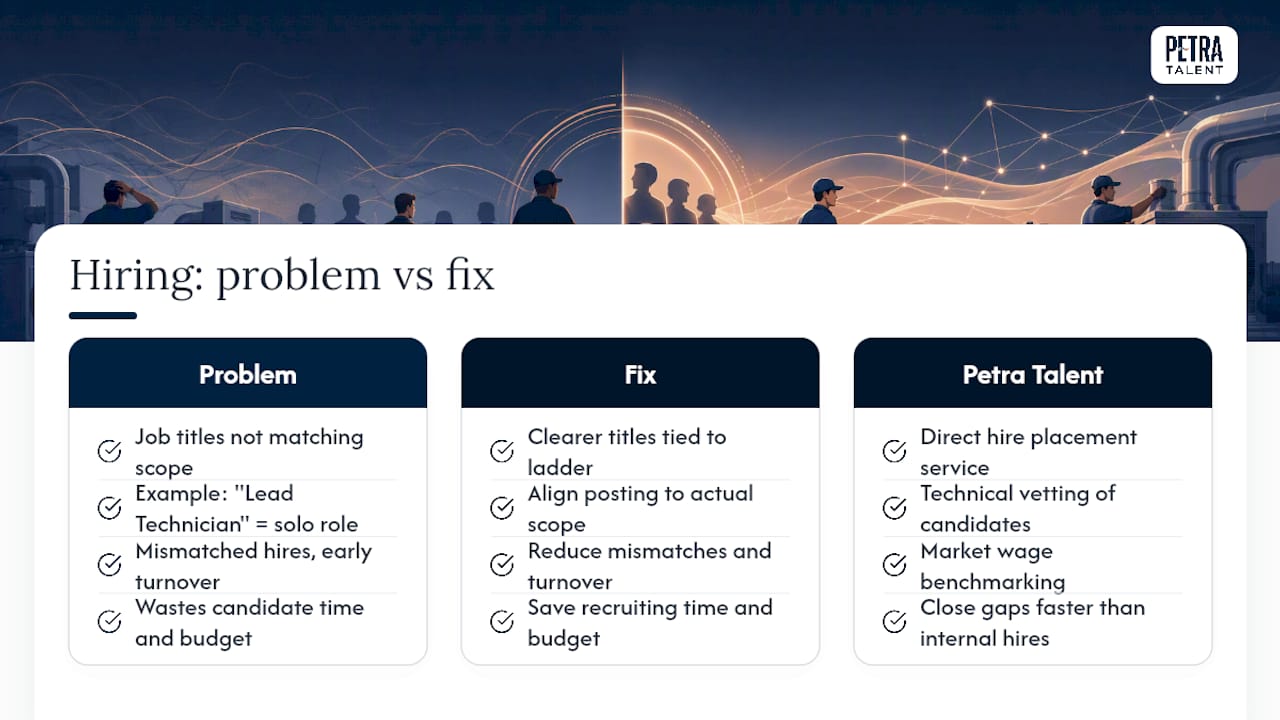
Petra Talent sees the same pattern across contractor clients: job titles that don’t match actual scope create mismatched hires and early turnover. A posting labeled “Lead Technician” that’s really a solo service role wastes both the candidate’s time and the contractor’s budget. Clearer titles, tied to the ladder above, fix that at the source.
Recruiter-backed data also shows HVAC project managers earning a median around $95,000, a figure many contractors underestimate when building offers. Petra Talent’s HVAC recruiting services handle direct hire placement, technical vetting, and market wage benchmarking for contractors who want to close these gaps faster than an internal hiring process typically allows.
— David
Sources
- Heating, air conditioning, and refrigeration mechanics and installers — Bureau of Labor Statistics
- Section 608 Technician Certification — U.S. EPA
- Apprenticeship
- HVAC Career Map
FAQ
What Are the Ranks in HVAC?
The standard ranks run helper/apprentice, technician/journeyman, senior/lead technician, supervisor/manager, and contractor/owner, with specialist branches like controls and refrigeration layered on top.
What Are Some Common HVAC Job Titles?
Common titles include HVAC helper, installation technician, service technician, journeyman technician, lead technician, controls/BAS specialist, refrigeration specialist, service manager, project manager, and contractor.
Do HVAC Technicians Make Six Figures?
Senior technicians, specialists, project managers, and contractors can reach six figures depending on market and specialization; Petra Talent’s own reporting shows HVAC project managers averaging around $95,000 in median pay.
Can HVAC Workers Make $100,000 a Year?
Yes, particularly in high-demand specialties like controls/BAS or commercial refrigeration, in high-cost metro markets, or once a technician moves into project management or ownership.
Recommended
Post a comment
Related Posts

September 21, 2026
Reach $2,700 per hire: HVAC hiring cost for U.S. contractors
U.S. contractors: use 2026 HVAC wage benchmarks to budget hiring. Compare agency fees (15%–25%), Petra's…

September 20, 2026
Construction Offer Letters for HR: Site Assignments, Certs, Petra Tips
HR ready construction offer letters: copy ready language for site assignments, certs, contingencies, and a…

September 19, 2026
Create E-Verify Cases by Day Three: U.S. HVAC & Plumbing Rules
E-Verify for U.S. HVAC and plumbing contractors: who needs I-9s, the three business day case…

September 18, 2026
72.5¢ Rate: Take Home Vehicle Policy for Employers and Agencies
Checklist and policy language for employers and agencies: apply the IRS 2026 mileage rate (72.5…