



For most plumbing contractors, a blended staffing model works best: keep a permanent core crew for steady revenue work, then layer temp-to-hire or subcontracted labor on top for seasonal spikes and short-term projects. Pure temp staffing wins when you need bodies on a job site by Monday. Direct placement wins when you’re building leadership bench strength. The right call depends on job duration, skill level, and how much compliance risk you can absorb.
TL;DR:
- Temporary staffing is best for short-term surges, but quality and retention tend to decline after assignment ends.
- Apprenticeships are slow to produce fully productive workers but offer the highest long-term retention and growth potential.
- Running an ongoing sourcing pipeline through multiple channels reduces recruitment delays and helps address labor shortages.
- Costs and time-to-hire vary significantly, with apprentices filling faster and cheaper than journeymen, but their ramp-up takes longer.
- Verifying licensing, insurance, and substitution policies before hiring prevents compliance risks and misclassification liabilities.
Table of Contents
- Common Plumbing Staffing Models Explained
- Weighing Speed, Cost, Quality, and Compliance Across Models
- How Do You Choose the Right Staffing Model?
- Building a Continuous Plumbing Recruitment Pipeline
- What Does Hiring Actually Cost, and How Fast Should It Happen?
- Onboarding and Retention Practices That Shorten Ramp Time
- A Practitioner’s Take on Staffing Plumbing Teams
- How Petratalent Maps to Every Staffing Need You Have
- Sources
Common Plumbing Staffing Models Explained
Every plumbing contractor eventually chooses from a handful of staffing structures, and each one shifts who controls payroll, licensing verification, and day-to-day supervision.
- Temporary/hourly staffing: A staffing agency employs the worker and handles payroll and workers’ comp; you direct the daily work. Best for service call surges or covering a sick crew member.
- Temp-to-hire: Same setup as temporary staffing, but with a built-in trial period before you convert the worker to your own payroll. Good for testing fit before committing to benefits and a permanent wage.
- Direct/permanent placement: You hire the person outright, own payroll and licensing compliance, and supervise directly. This fits journeymen, project managers, and leadership roles where retention matters most.
- On-prem/on-site staffing: An agency embeds a recruiter or coordinator at your shop to manage sourcing continuously, useful for contractors running high hiring volume across multiple crews.
- Subcontracting/crew hire: You bring in an independent crew or subcontracting firm that carries its own insurance and licensing. This works for specialty scopes or when your bid depends on capacity you don’t have in-house.
- Registered apprenticeships: You employ an apprentice under a structured, often state-registered program with defined wage progression and required training hours, building long-term bench strength from the ground up.
Service calls tend to favor temp or temp-to-hire. Bid-based construction projects often lean on subcontracting. Bench-building for the next five years points toward apprenticeships.
Weighing Speed, Cost, Quality, and Compliance Across Models
Every model forces a tradeoff, and the mistake most contractors make is optimizing for one factor while ignoring the other three.
- Temporary staffing: Fast to fill, moderate agency fees, but quality varies and retention is often weak once the assignment ends.
- Temp-to-hire: Slightly slower than temp staffing, but you get a working audition before paying full wage and benefits, which improves long-term fit.
- Direct placement: Slower to fill (weeks, not days), higher upfront cost, but the strongest retention and quality signal for critical roles.
- Subcontracting: Fast for capacity, but you inherit less control over quality and carry real liability if the sub misclassifies workers or lacks proper insurance.
- Apprenticeships: Slow to become productive, low direct cost, but the highest long-term retention when paired with a clear pay ladder.
Pro Tip: Before choosing speed over cost, run the math on a 90-day washout. A quick rehire without fixing the underlying screening gap can significantly increase your effective cost-per-hire, which often erases whatever you saved by skipping a slower, more thorough process.
Compliance risk climbs fastest with subcontracted labor, since misclassification and insurance gaps land on you if a sub cuts corners.
How Do You Choose the Right Staffing Model?
Match the model to the job before you match it to your budget. A three-week bathroom remodel and a two-year commercial buildout call for entirely different staffing logic.
- Define job duration first. Short-term work (under 90 days) favors temporary or temp-to-hire. Anything longer justifies direct placement.
- Match licensing requirements to the role. A licensed journeyman on a permit-pulling job needs verified credentials before day one, not after.
- Score the skill level needed. Apprentice-level tasks tolerate more ramp time; master-level troubleshooting doesn’t.
- Ask any provider for proof of background checks and license verification, not just a claim that they run them.
- Confirm insurance coverage in writing, including workers’ comp limits and general liability, before a subcontractor sets foot on a job site.
- Ask about substitution policy. What happens if the placed worker no-shows or quits in week two?
- Watch for red flags: vague answers on verification, insurance certificates that don’t match the scope of work, or a pattern of short-tenure placements the provider glosses over.
If a provider can’t answer question five with a document, not a promise, that’s your answer about whether to move forward.
Building a Continuous Plumbing Recruitment Pipeline
Reactive hiring, where you only start recruiting when a position opens, guarantees you’re always behind. Some contractors instead treat recruiting as a continuous channel program, running five sourcing channels at once rather than leaning on a single job board.
- Employee referrals, paired with a bonus tied to the new hire’s 90-day retention milestone, not just their start date.
- PHCC and UA partnerships for access to trained candidates already moving through structured trade programs.
- SkillBridge and veteran transition programs, which connect contractors with candidates who bring discipline and mechanical aptitude from military service.
- Career and technical education (CTE) school relationships, built through guest lectures or lab sponsorships rather than a single job posting.
- Adjacent-trade pivots, recruiting HVAC techs or electricians whose mechanical aptitude transfers with the right training investment.
Referral hires tend to convert faster and often cost less than job-board hires, but only when the bonus structure pays out promptly and ties to real retention, not just a signed offer letter.
Pro Tip: Publish your pay ladder somewhere apprentices can actually see it. Visible wage progression tied to mentor bonuses helps reduce apprentice churn compared to informal, word-of-mouth raises.
Start small: sponsor one high-school trade lab day this quarter, set a 90-day retention window for referral payouts, and commit to converting at least one apprentice cohort per year.
What Does Hiring Actually Cost, and How Fast Should It Happen?
Cost-per-hire varies sharply by role and model, and persistent labor shortages in the trades keep upward pressure on both wages and agency fees across the board.
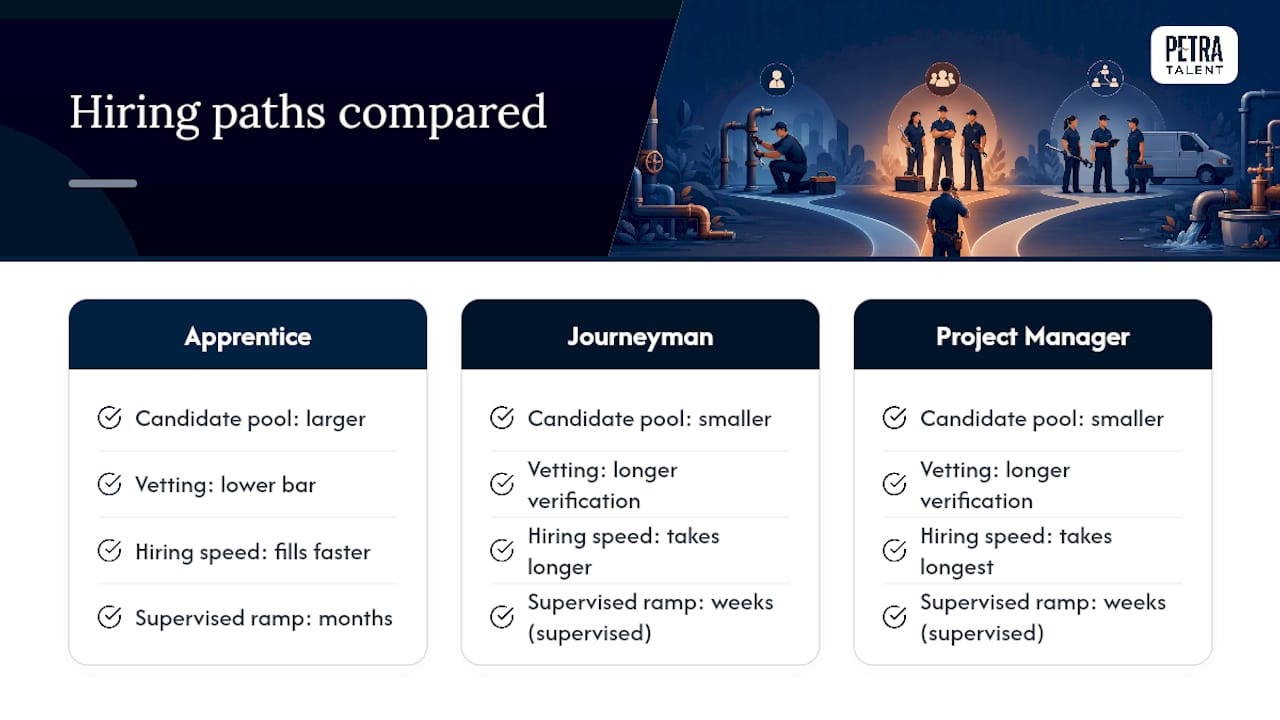
An apprentice hire typically fills faster than a journeyman search, since the candidate pool is larger and the vetting bar is lower. A licensed journeyman or a project manager search takes longer because the qualified pool shrinks and verification takes more time. Time-to-productivity follows the same pattern: an apprentice needs months of supervised ramp, while an experienced journeyman can often bill productively within weeks.
The number that quietly wrecks hiring budgets is the 90-day washout. Rehiring quickly after an early quit feels like progress, but it can double your effective cost-per-hire if you never fix the screening gap that caused the washout in the first place.
Back-office roles matter too. Many contractors cut dispatcher and CSR costs substantially by shifting those functions to a virtual assistant instead of carrying a full in-house salary, benefits, and overhead for a role that doesn’t touch a wrench.
Onboarding and Retention Practices That Shorten Ramp Time
Most turnover happens in the first 90 days, which means your onboarding structure matters more than your starting wage.
- Run a 30/60/90 onboarding checklist. Day 30 covers safety certification and tool familiarity, day 60 covers independent service calls under supervision, day 90 covers a performance review tied to the pay ladder.
- Use a paid working interview instead of a single unpaid trial shift. A two-stage screening process combined with a paid working interview helps reduce early turnover compared to hiring off a single conversation.
- Pay mentor bonuses and track teaching as a performance indicator. A senior tech who trains three apprentices to competency should see that reflected in their own pay, not just a pat on the back.
- Build safety training into week one, not month three. OSHA provides recommended practices for safety programs outline the core elements, hazard identification, training documentation, and management commitment, that reduce both injury risk and new-hire anxiety.
- Publish nonfinancial retention levers. A tool allowance, a defined PTO schedule, and a visible promotion path cost less than a wage war and often retain talent longer.
Pro Tip: Track mentor bonuses the same way you track billable hours. If teaching isn’t measured, it quietly stops happening once the schedule gets tight.
A Practitioner’s Take on Staffing Plumbing Teams
One contractor had cycled through four dispatchers in a year before realizing the role needed a completely different sourcing channel than their technician roles. Once they separated the two searches, both filled faster and stuck longer.
Three takeaways worth acting on this week: staff back-office and field roles through separate pipelines, pay referral bonuses on a retention milestone rather than a start date, and treat your apprenticeship program as a pipeline investment, not a favor to the local trade school.
— David
How Petratalent Maps to Every Staffing Need You Have
Petratalent is the alternative to juggling five separate hiring channels on your own. Instead of piecing together job boards, subcontractor referrals, and word-of-mouth, you get one partner who already runs the vetting, wage benchmarking, and sourcing legwork behind the scenes.

Direct-hire placement fits your journeymen and service techs; leadership search fits your project managers and superintendents; technical vetting confirms licensing and skill claims before you ever schedule an interview; and workforce consultation helps you decide, ahead of time, which of the models above actually fits your growth plan this year. An initial engagement typically starts with a conversation about your open roles, your timeline, and the compliance risks you’re least willing to carry. From there, Petratalent builds a sourcing plan around the specific mix of speed and permanence you need. Review the full range of services and start a conversation about your next hire.
Sources
- Successful tactics for finding new plumbing employees — Plumber Magazine
- Plumber hiring in 2026 — PipelineOn
- Axionis
- Plumbing industry staffing costs 2026 Guide — Stealth Agents
- OSHA: Recommended practices for safety programs
Recommended
Related Posts

September 20, 2026
Construction Offer Letters for HR: Site Assignments, Certs, Petra Tips
HR ready construction offer letters: copy ready language for site assignments, certs, contingencies, and a…

September 19, 2026
Create E-Verify Cases by Day Three: U.S. HVAC & Plumbing Rules
E-Verify for U.S. HVAC and plumbing contractors: who needs I-9s, the three business day case…

September 18, 2026
72.5¢ Rate: Take Home Vehicle Policy for Employers and Agencies
Checklist and policy language for employers and agencies: apply the IRS 2026 mileage rate (72.5…

September 17, 2026
Avoid Overtime Back-Pay: Job-to-Job Travel Pay for U.S. Technicians
U.S. employers: learn DOL/WHD travel-pay tests, a blended rate overtime example, state pitfalls, and Petratalent…