


The best hiring results come from combining a short written knowledge screen, verification of required credentials like EPA Section 608, and a hands-on performance check for any role touching refrigerant or complex diagnostics. Employers and recruiters should pilot a short written screen early, filtering candidates before investing in interviews or shop-floor evaluations. Certification alone does not confirm skill; performance verification closes that gap.
TL;DR:
- Conducting a short, 15-20 minute knowledge screen helps filter out unqualified HVAC candidates before investing in longer assessments.
- HVAC skill tests should target specific domains like refrigeration, electrical systems, or controls to match the role, rather than using generic exams.
- A minimum passing score of 70% on NCCER assessments is a good benchmark, but calibration with current staff performance improves reliability.
- Certification verifies compliance but does not guarantee troubleshooting ability; hands-on performance checks are essential for accurate skill evaluation.
- Employers should ensure consistent, role-specific testing conditions and document scoring procedures to stay within legal hiring practices.
Table of Contents
- What Do HVAC Skill Tests Actually Measure?
- Which Type of HVAC Assessment Should You Run First?
- Industry-Recognized HVAC Certification Tests and Credentials
- How to Build an HVAC Skill Test Into Your Hiring Workflow
- Where to Find Sample HVAC Skill Tests and Practice Materials
- How Petra Talent Applies Skill Testing in HVAC Recruiting
- Are HVAC Skill Tests Legally Safe to Use in Hiring?
- What Does It Cost to License or Build HVAC Skill Tests?
- Common Mistakes Employers Make With HVAC Skill Tests
- Let Petra Talent Handle Your Technical Vetting
- Sources
What Do HVAC Skill Tests Actually Measure?
A well-built HVAC skill test isn’t one exam, it’s a set of domains mapped to what a technician does on the job. Employers who understand the domains can pick tests that match the role instead of running a generic quiz that tells them little.
The core domains that show up across NCCER, NOCTI, and most vendor test libraries include:
- Safety and codes: lockout/tagout, PPE use, refrigerant handling rules
- Trade math: load calculations, CFM conversions, Ohm’s law problems
- Electrical systems: circuit troubleshooting, wiring diagrams, motor testing
- Refrigeration: superheat and subcooling calculations, identifying refrigerant families
- Controls: thermostat wiring, sequence of operations, low voltage troubleshooting
- Airflow and psychrometrics: duct sizing, static pressure, humidity calculations
- Brazing and soldering: joint prep, torch technique, leak testing
- Diagnostics: symptom to cause reasoning under time pressure
- Installation and maintenance: startup procedures, seasonal maintenance checklists
A service tech role leans hardest on diagnostics and refrigeration math. A controls tech candidate needs deeper wiring and sequence-of-operations knowledge, which is worth reviewing in a controls technician hiring guide before writing your test. Installers, by contrast, get tested more on brazing quality and code compliance than on troubleshooting speed.
Which Type of HVAC Assessment Should You Run First?
Not every hiring stage calls for the same test. Running a full hands-on evaluation on every applicant wastes shop time; skipping it entirely on a refrigerant-handling hire is a liability.
- Quick knowledge screen (15 to 20 minutes, closed-book, 20 to 30 questions): filters obviously unqualified applicants before you schedule an interview.
- Full-length knowledge assessment (60 to 90 minutes): goes deeper into electrical, refrigeration, and controls topics for candidates who pass the screen.
- Hands-on performance profile: has the candidate wire a control circuit, braze a joint, or diagnose a rigged fault on live or training equipment.
- Formal certification check: confirms EPA 608 or NATE credentials exist, but functions as a compliance gate rather than a skill measurement on its own.
Treat certifications as a floor, not a ceiling. A tech can hold every credential your job posting requires and still struggle to isolate a bad capacitor under time pressure. That’s what the hands-on step is for.
Industry-Recognized HVAC Certification Tests and Credentials
Four names dominate the HVAC assessment landscape, and each does a different job in the hiring process.
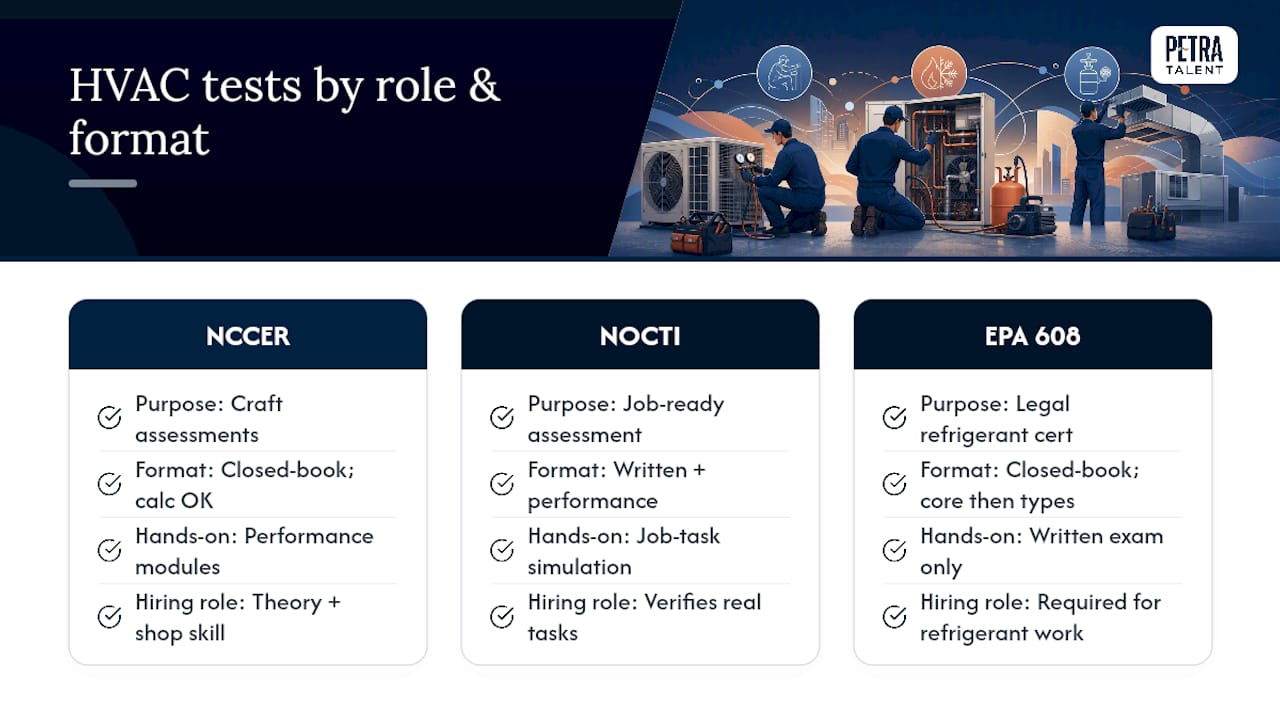
NCCER knowledge assessments are closed-book, often permit a basic-function non-printing calculator, and commonly use a minimum passing score of 70%. Many NCCER modules have a matching hands-on performance verification, which means you can test HVAC theory and shop skill against the same NCCER HVAC Technician Assessment framework. NCCER also maintains a broader HVACR craft catalog covering modules from basic electricity through heat pump systems.
NOCTI runs a “Job Ready” model that pairs a written assessment with a performance assessment simulating actual jobs, such as a gas furnace startup or refrigerant recovery. According to the NOCTI HVAC assessment blueprint, administration can span multiple sessions since the performance component requires equipment and proctoring time most written-only tests skip.
EPA Section 608 certification is a federal legal requirement for anyone working on stationary air conditioning and refrigeration equipment. The exam is closed-book, requires passing a core section before earning Type I, II, or III credit, and per EPA’s own certification requirements, no contractor can legally assign refrigerant work to an uncertified technician.
NATE and ACCA round out the picture as credential and training resources rather than direct skill tests. ACCA in particular maintains EPA 608 test prep and proctoring resources that contractors can point candidates toward before test day.
How to Build an HVAC Skill Test Into Your Hiring Workflow
A skill test only earns its keep when it’s slotted into a repeatable process, not dropped in as an afterthought after the interview.
- Short knowledge screen (day one, 15 to 20 minutes): eliminates candidates who lack baseline trade knowledge before you invest interview time.
- Targeted knowledge test matched to the role’s domain mix (electrical-heavy for controls, refrigeration-heavy for service).
- Hands-on simulation for finalists only, since it’s the most resource-intensive step.
- Credential verification, confirming EPA 608 and any state licensing tied to the role.
- Structured interview where you walk through test results with the candidate and ask them to explain their reasoning on missed items.
A reasonable starting benchmark for a screen is 70% correct, matching the NCCER passing standard, though you should calibrate that number against your own incumbent techs before locking it in. Missed items aren’t just a rejection signal, they’re a training prescription if you’re hiring for development rather than a fully seasoned tech. A candidate who fails every refrigeration question but nails electrical work might still be a fit for an installer track with mentorship.
Build in accommodation options for candidates with disabilities and keep test conditions consistent across applicants. If you run the screen online for some candidates and in-person for others, note that difference and interpret scores accordingly, since environment affects timing and performance.
Where to Find Sample HVAC Skill Tests and Practice Materials
Before you write a test from scratch, check what’s already published. Reinventing the wheel usually produces a worse wheel.
- Official EPA 608 study guides and ACCA’s certification prep resources give candidates a legitimate path to prepare, which reduces disputes over “unfair” test content.
- Vendor libraries claiming NCCER or NOCTI alignment should show their blueprint mapping and sample items before you buy access, per NOCTI’s own assessment overview.
- Run any new test on two or three incumbent technicians whose performance you already trust, then compare their scores to their actual on-the-job output before rolling the test out to applicants.
Piloting catches a test that’s too easy, too hard, or measuring the wrong thing entirely, before it starts filtering out good hires.
How Petra Talent Applies Skill Testing in HVAC Recruiting
Petra Talent builds role profiles first, since a service tech and a controls tech shouldn’t take the same screen. From there, candidates move through a short knowledge test, then staged hands-on checks reserved for finalists, then credential verification against EPA 608 and any state license requirements. This mirrors the workflow outlined in how to interview HVAC service techs, where test results become discussion points rather than pass/fail gates alone.
Communicating the process to candidates matters as much as the process itself. Explaining why a test exists, and what happens with the results, reduces dropout and builds trust before day one. Combining test scores with reference checks and a look at the qualities that separate top service technicians gives a fuller picture than any single test can.
Are HVAC Skill Tests Legally Safe to Use in Hiring?
Skill tests sit inside the same legal framework as any other pre-employment assessment. That means they need to be job-related and consistently applied, or they can expose an employer to discrimination claims regardless of intent.
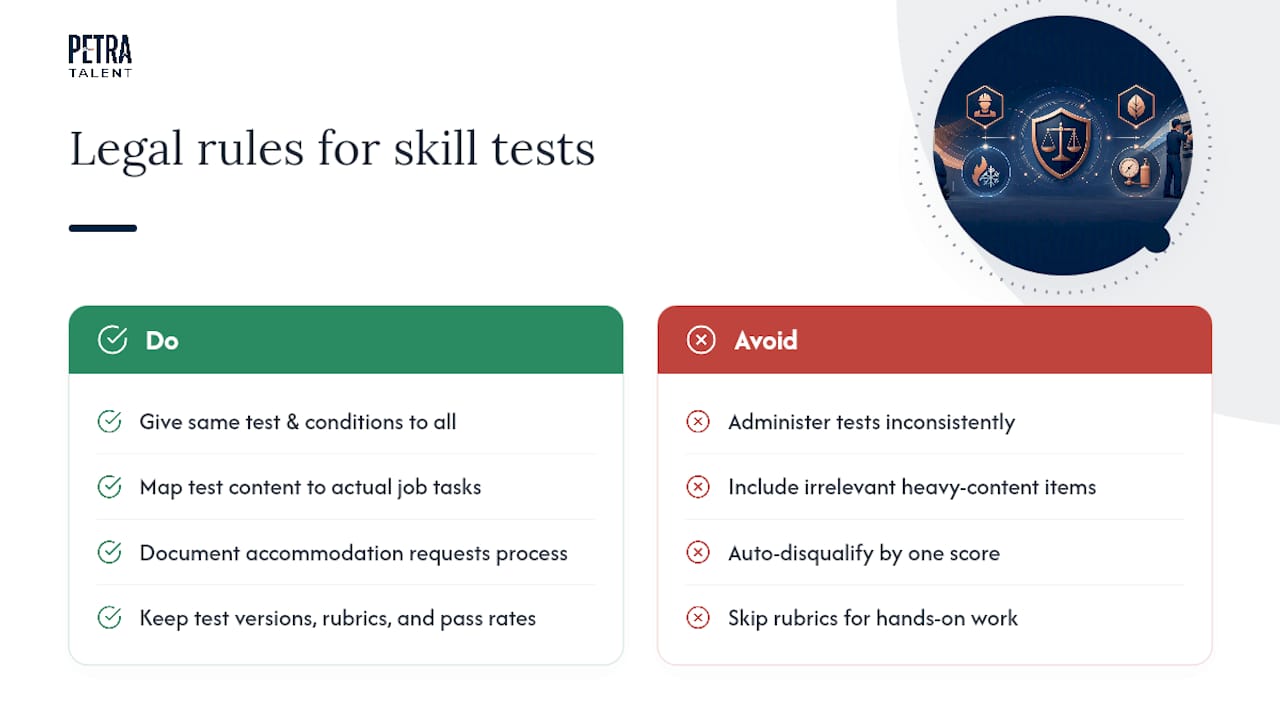
A few principles matter most. First, every candidate for the same role should take the same test under the same conditions, since inconsistent administration is one of the easiest things to challenge later. Second, test content should map directly to actual job tasks, which is exactly why domain mapping (covered earlier) isn’t just a testing nicety, it’s a legal safeguard. A written test heavy on trade math for a role that never touches load calculations invites scrutiny.
Accommodation requests need a documented process. Extended time, alternate formats, or an accessible testing environment should be available on request, not decided case by case under pressure. Employers should also be cautious about using a single test score as an automatic disqualifier without human review, particularly for candidates from underrepresented groups in the trades, since blanket cutoffs can produce disparate impact even when no one intended it.
Credential verification, like confirming EPA 608 status, carries less legal risk than skill testing because it’s a binary, government-defined requirement rather than a subjective judgment. Where things get murkier is hands-on performance evaluation, since scoring rubrics need to be consistent and documented across every candidate who takes them. Keep records of test versions, scoring criteria, and pass rates by demographic group where possible, so you can demonstrate the test works the same way for everyone.
What Does It Cost to License or Build HVAC Skill Tests?
Budgeting for HVAC skill testing depends heavily on whether you’re buying access to an existing vendor library or building tests internally.
Licensing an existing knowledge assessment library, including NCCER or NOCTI-aligned content, typically involves a per-seat or per-test fee structure rather than a flat annual cost, since usage volume varies widely between a five-person shop and a fifty-tech contractor. Employers should ask vendors directly for current per-assessment pricing rather than relying on outdated public figures, since these rates shift with contract volume and support level.
Hands-on performance verification carries additional cost beyond the test license itself. You need equipment, a proctor’s time, and a space where a candidate can safely braze, wire, or diagnose without disrupting active work orders. For a contractor running frequent hiring, this often means designating a fixed testing bay rather than pulling a bay off the schedule each time a candidate is evaluated.
Building tests internally instead of licensing them saves the per-seat fee but shifts cost into staff time; someone experienced enough to write valid trade math and refrigeration questions isn’t cheap to pull off billable work for a day. Most contractors land on a hybrid: license a knowledge assessment for the written portion and build a lighter, role-specific hands-on check internally using existing shop equipment.
Whatever the split, budget for periodic revalidation. A test that was accurate two years ago may be outdated if your equipment mix or refrigerant requirements have shifted since then.
Common Mistakes Employers Make With HVAC Skill Tests
The biggest mistake I see is treating a multiple-choice score as proof of hands-on ability. It isn’t. Skipping the hands-on step, or confusing a credential like EPA 608 with actual troubleshooting skill, lets weak hires through. Fix it by piloting your test, combining written and hands-on formats, and requiring EPA 608 wherever refrigerant work happens.
— David
Let Petra Talent Handle Your Technical Vetting
Petra Talent gives contractors a faster path to qualified hires than building an internal testing program from scratch, since technical vetting, credential verification, and structured screening are already built into every placement search.

Instead of writing test items, sourcing proctors, and calibrating pass scores on your own, Petra Talent’s technical vetting and workforce solutions handle the screening layer before candidates ever reach your interview stage. That means fewer wasted interview slots and less risk of a credential-only hire who can’t actually troubleshoot a rigged fault under pressure. Contractors also avoid the ongoing cost of licensing and revalidating test content internally, since Petra Talent’s vetting process gets refreshed as industry standards shift.
If your current hiring process is producing too many technicians who look good on paper but struggle on the truck, visit Petra Talent’s services page to request a pilot vetting project and see how structured screening changes your shortlist.
Sources
- EPA — Section 608 technician certification requirements
- National Craft Assessment and Certification Program — HVAC Technician Assessment (NCCER)
- NOCTI — Heating, Ventilation, Air Conditioning (HVAC) assessment blueprint
Recommended
Related Posts

September 20, 2026
Construction Offer Letters for HR: Site Assignments, Certs, Petra Tips
HR ready construction offer letters: copy ready language for site assignments, certs, contingencies, and a…

September 19, 2026
Create E-Verify Cases by Day Three: U.S. HVAC & Plumbing Rules
E-Verify for U.S. HVAC and plumbing contractors: who needs I-9s, the three business day case…

September 18, 2026
72.5¢ Rate: Take Home Vehicle Policy for Employers and Agencies
Checklist and policy language for employers and agencies: apply the IRS 2026 mileage rate (72.5…

September 17, 2026
Avoid Overtime Back-Pay: Job-to-Job Travel Pay for U.S. Technicians
U.S. employers: learn DOL/WHD travel-pay tests, a blended rate overtime example, state pitfalls, and Petratalent…