



In MEP construction, “mechanical plumbing scope” refers to the defined set of systems, deliverables, and trade responsibilities assigned to mechanical and plumbing contractors on a commercial project, organized under CSI MasterFormat Division 22 (plumbing) and Division 23 (mechanical) and enforced through contract documents, SOW clauses, and bid clarifications. Getting this boundary wrong at bid time is one of the most reliable paths to change orders, crew conflicts, and schedule slippage.
Three actions to take before the next bid goes out:
- Declare the boundary in the SOW. State explicitly which systems each trade furnishes and installs, including condensate drains, gas piping, and controls final connections.
- Add a BIM coordination allowance. Price 3D clash detection as a line item, not an afterthought, before rough-in begins.
- Issue bid clarifications on ambiguous items. Compile a list of items not clearly assigned in the drawings and resolve them in writing before award.
Key Takeaways
Mechanical plumbing scope defines the trade boundaries, systems, and deliverables assigned under Division 22 and Division 23, and those boundaries must be declared in writing before bid day to prevent change orders and staffing gaps.
| Point | Details |
|---|---|
| Division 22 vs. Division 23 | Division 22 covers plumbing systems; Division 23 covers mechanical/HVAC. MasterFormat organizes specs, not trade assignments. |
| Declare scope in the SOW | State furnish vs. install splits, TAB, controls interface, and exclusions explicitly before award. |
| Require BIM coordination | Price 3D clash detection as a contract line item and tie the first payment to pre-mobilization sign-off. |
| Price underground work separately | Underslab piping carries excavation, shoring, and testing costs that must be line-itemed, not bundled. |
| Align hiring with scope award | Staffing decisions for licensed plumbers and pipefitters must follow scope clarification within days, not weeks. Petratalent sources and vets multi-trade mechanical candidates matched to your jurisdiction and timeline. |
Table of Contents
- What does mechanical plumbing scope mean in practice?
- Why scope boundaries shift from project to project
- Common coordination failures that produce claims and rework
- How to define and document scope before the bid goes out
- Estimating implications: what to price and where contingency belongs
- Staffing and jurisdiction: who you need and when
- Copy-ready scope checklist for bids and subcontracts
- A recruiter’s perspective on scope and staffing alignment
- Petratalent helps you staff the scope you win
- Sources
What does mechanical plumbing scope mean in practice?
The terms “mechanical” and “plumbing” describe two distinct but overlapping scopes on U.S. commercial projects. Division 23 covers mechanical work: HVAC equipment, ductwork, hydronic piping, chillers, boilers, air handling units, and building automation system (BAS) controls. Division 22 covers plumbing: domestic cold and hot water distribution, sanitary and storm drainage, plumbing fixtures, gas piping, and underground work including underslab piping and grease interceptors.
One critical point: MasterFormat’s division structure organizes specifications, not trade jurisdiction. A project can assign Division 22 work to a mechanical contractor, split it between two subs, or bundle it with Division 23 under a single MEP contract. The contract documents determine who does what, not the spec section number.
Where the lines blur
Several systems sit at the boundary and generate disputes on nearly every project:
- Hydronic vs. domestic hot water: Hydronic heating loops (Division 23) and domestic hot water recirculation (Division 22) use similar pipe materials and often run in the same ceiling space. Without a clear SOW, both trades may price it or neither will.
- Condensate drains: HVAC equipment produces condensate that must drain to a sanitary connection. Mechanical installs the unit; plumbing owns the drain line. The connection point is rarely defined in drawings.
- Fire suppression interface: Wet-pipe sprinkler systems (Division 21) tap off the domestic water main. Who makes that tap and provides the backflow preventer varies by contract.
- Controls wiring: BAS controls connect to mechanical equipment, but the final electrical connection often falls under Division 26. Specs that don’t assign this explicitly create a gap every time.
Why scope boundaries shift from project to project
MasterFormat is an organizational tool. It does not assign trade responsibility, and treating it as if it does is a structural cause of scope gaps and overlap. Three factors drive variation across projects:
- Contract type. Design-bid-build projects typically have separate mechanical and plumbing primes or subs with distinct scopes. Design-assist and design-build contracts often bundle both under one mechanical contractor, which changes self-perform vs. subcontract decisions.
- State licensing. Plumbing license requirements vary by state and sometimes by municipality. In some jurisdictions, a mechanical contractor’s license covers gas piping and hydronic systems but not domestic water or sanitary drainage, which must be subcontracted to a licensed plumber. This directly affects staffing decisions and hiring lead times.
- Specification quality. Incomplete or schematic-level drawings leave items unassigned. Fixtures may appear on architectural plans while pipe routing appears on separate mechanical-plumbing sheets, and specialty systems like medical gas or lab waste may be on their own drawings entirely.
Common coordination failures that produce claims and rework
Ceiling void conflicts are the most frequent source of field rework on commercial MEP projects. Ductwork, gravity drainage pipe, sprinkler mains, and structural members all compete for the same space, and 2D drawings rarely reveal the conflict until rough-in is underway. BIM coordination and 3D modeling catch these clashes before rough-in begins, and contractors who require a coordinated model before mobilization consistently reduce RFI-driven rework.
Beyond ceiling conflicts, four items generate disputes at mobilization on nearly every project:
- VFD responsibility. Variable frequency drives for pumps and fans are often specified under Division 23 but priced by the electrical contractor. Without an explicit assignment, both trades may exclude it.
- Field-mounted disconnects. Electrical disconnects for mechanical equipment follow the same pattern: mechanical specs call for them, electrical contractors price them, and neither confirms the other included it.
- Condensate drain routing. As noted above, the connection point between the HVAC unit and the plumbing drain is almost never drawn clearly.
- Insulation and hangers on shared pipe. When a mechanical contractor installs hydronic piping and a plumbing sub installs domestic water in the same chase, hanger spacing and insulation specs may conflict or be priced by both.
Pro Tip: Require a pre-mobilization clash resolution sign-off as a contract milestone. Tie the first substantial payment to completion of a coordinated 3D model reviewed by all MEP trades. This converts BIM coordination from a nice-to-have into a contractual deliverable with teeth.
How to define and document scope before the bid goes out
A repeatable bid-clarification workflow removes most scope ambiguity before award. Follow these steps:
- Review the full drawing set and specifications. Pull Division 22, 23, 21, and 26 specs together. Note every system that touches more than one division.
- Compile an ambiguous-items list. Flag condensate drains, VFDs, disconnects, controls wiring, fire suppression taps, and any specialty system not clearly assigned.
- Issue written bid clarifications. Send clarification requests to the GC or owner before bid day. Document responses in writing.
- Require an SOW clause in every subcontract. The SOW should state: furnish vs. install split for each system, TAB and commissioning responsibilities, controls interface scope, submittal requirements, and closeout deliverables.
A mechanical SOW should explicitly state which deliverables apply and clarify furnish vs. install responsibilities to prevent post-award disputes. The SOW is a living document during bidding; treat it as one.
- Include testing and balancing (TAB) as a named line item, not a general condition.
- State whether commissioning support is in scope and how many hours are included.
- Define the controls interface point: who provides the BAS point list, who wires the sensors, and who performs functional testing.
Pro Tip: Add a single sentence to every bid clarification letter: “This proposal is based on the scope described herein; items not listed are excluded.” That sentence alone has prevented more post-award disputes than any other contract language.
Estimating implications: what to price and where contingency belongs
Scope fragmentation across drawings is the primary source of plumbing estimating error, and the same risk applies to mechanical. Estimators should build line items by system, not by drawing sheet.
| Estimate Line Item | Common Assumption | Contingency Guidance |
|---|---|---|
| HVAC equipment | Per equipment schedule | Verify voltage/phase; add startup allowance |
| Ductwork fabrication and install | Linear footage by system | Add 10% for coordination routing changes |
| Hydronic piping | Per isometric or riser diagram | Separate from domestic water; confirm insulation spec |
| Fixtures and trim | Per fixture count on architectural plans | Cross-check against plumbing schedule |
| Underground and underslab piping | Per civil/plumbing plan | Carry excavation, shoring, and concrete cutting separately |
| TAB and commissioning | Specialty sub quote | Do not bundle into general conditions |
| BIM coordination labor | Hours per trade | Price as a discrete line item before rough-in |
Underground piping and grease interceptors add excavation, shoring, and testing costs that can materially shift a plumbing bid. Prevailing wage and Davis-Bacon requirements on public projects add another layer; confirm applicability before finalizing labor rates.
Staffing and jurisdiction: who you need and when
Whether a mechanical contractor self-performs plumbing work depends on contract scope and local licensing, and that decision has direct hiring implications. The table below maps common roles to responsibilities and critical-path timing.

| Role | Typical Responsibilities | Critical Path Timing |
|---|---|---|
| UA Plumber (Journeyman/Foreman) | Domestic water, sanitary/storm, fixtures, underground | Underground before slab; above-grade before drywall |
| UA Pipefitter | Hydronic piping, steam, process piping | Parallel with mechanical rough-in |
| SMACNA Sheet Metal Worker | Ductwork fabrication and installation | After structural steel; before ceiling grid |
| Controls Technician | BAS wiring, sensor installation, functional testing | After rough-in; before TAB |
| TAB Specialist | Testing, adjusting, and balancing | After controls; before substantial completion |
For plumbing construction roles specifically, hiring lead time runs 6–10 weeks for journeymen in most U.S. markets and longer for foremen and superintendents. When a mechanical contractor decides to self-perform plumbing scope after award, that decision needs to trigger a recruiting action within days, not weeks. HVAC workforce planning follows the same logic: scope award and headcount planning must happen in parallel.
For service-heavy scopes, field service dispatch tools can help coordinate technician scheduling across multi-trade crews once the project transitions to startup and warranty phases.
Copy-ready scope checklist for bids and subcontracts
Use these grouped items as a starting template. Adjust to match the project’s contract documents.
Inclusions (confirm each is in scope):
- Furnish and install all HVAC equipment per equipment schedule
- Furnish and install ductwork, diffusers, grilles, and registers
- Furnish and install hydronic piping, pumps, and expansion tanks
- Furnish and install domestic cold and hot water distribution
- Furnish and install sanitary and storm drainage above and below slab
- Furnish and install all plumbing fixtures and trim
- Provide TAB by a certified specialty contractor
- Provide commissioning support per owner’s commissioning plan
Exclusions (state these explicitly):
- Electrical power wiring to mechanical equipment (by Division 26)
- VFDs and field-mounted disconnects unless noted in equipment schedule
- Fire suppression systems (Division 21) unless specifically included
- Medical gas or lab waste systems unless listed in this SOW
Sample SOW snippets:
- “Contractor shall furnish and install all condensate drain piping from HVAC equipment to the nearest plumbing drain connection as shown on drawings. Connections to the plumbing drain system are included in this scope.”
- “Controls final connections, including low-voltage wiring from BAS panels to field devices, are included in this scope. Line-voltage power wiring to BAS panels is excluded.”
- “TAB shall be performed by a certified NEBB or AABC member firm and is included as a separate line item in this contract.”
Pro Tip: Phrase bid clarifications as affirmative inclusions, not just exclusions. “This bid includes X” is harder to dispute post-award than “This bid excludes Y,” because inclusions define the positive scope rather than leaving the boundary open.
A recruiter’s perspective on scope and staffing alignment
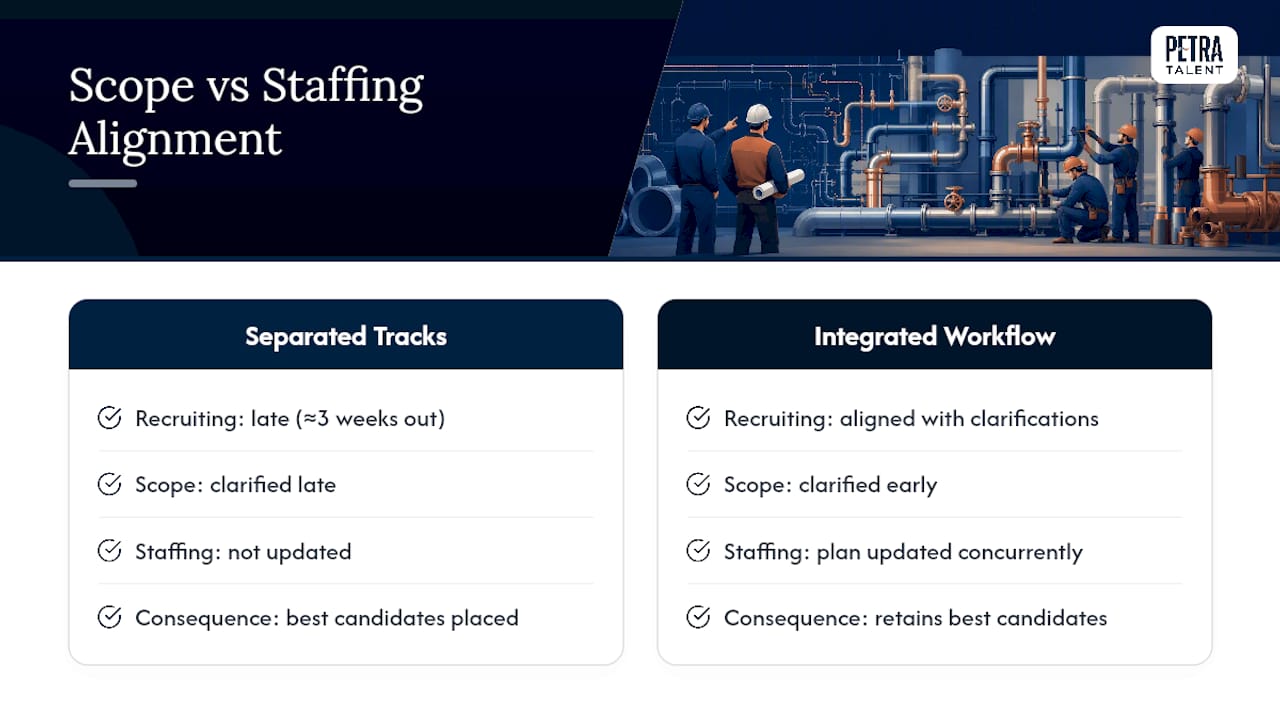
The most preventable hiring mistakes in mechanical contracting happen when scope decisions and workforce planning run on separate tracks. A project team awards a contract that includes self-perform plumbing, then calls the recruiting desk three weeks before mobilization asking for licensed plumbers. By that point, the best candidates are already placed.
The contractors who avoid this pattern treat scope clarification and headcount planning as a single workflow. When the bid-clarification list gets resolved, the staffing plan gets updated at the same time. That discipline, more than any single hiring tactic, is what keeps crews on schedule and change orders off the log.
Petratalent helps you staff the scope you win
Scope definition and workforce planning are two sides of the same decision. Once the SOW is locked, Petratalent sources and vets the licensed plumbers, pipefitters, sheet metal workers, and controls technicians you need to execute it, with technical vetting and workforce solutions built specifically for mechanical and plumbing contractors.

Petratalent’s plumbing trade recruitment process matches candidates to your licensed scope requirements, jurisdiction, and project timeline, so you are not scrambling for crew after award. Contact Petratalent to align your next workforce plan with your contracted scope.
Sources
- The Complete Plumbing Estimating Guide for Contractors
- MEP construction: meaning and common coordination issues (Datagrid guide)
- Mechanical Contractors: Role, Responsibilities & Job Outlook | Procore
Recommended
Related Posts

October 14, 2026
HVAC Recruiter Fees: Contractors Weigh $10,000 Against Vacancy Costs
See how HVAC recruiter fees work for contractors, from 15% to 25% placement costs to…

October 13, 2026
Recruiting Contract Terms: 10 Checks and Ready to Use Clauses
Define fee triggers, candidate ownership, guarantees, and compliance terms. Get a master agreement, short schedule,…

October 12, 2026
Offer Acceptance Rates: Segment Benchmarks, HVAC’s 3–5 Day SLA
See why a 78% to 82% offer acceptance benchmark can mislead, how role and source…
October 11, 2026
Bad Hires Can Cost Construction Firms 30% to 200% of Salary
Bad hires can cost construction firms 30% to 200% of annual salary. Calculate recruiting, rework,…