


TL;DR:
- The technical screening process verifies candidates’ hands-on skills before involving senior technicians, reducing hiring risks. Implementing structured, role-specific tasks and standardized scoring improves prediction of on-the-job performance and filters out unqualified applicants early. Outsourcing screening to specialists ensures consistency, saves time, and helps contractors maintain a reliable, compliant hiring process.
The technical screening process is the early, skills-focused gate in your hiring funnel that verifies a candidate’s hands-on craft before any senior technician invests time in a deeper interview. For HVAC and plumbing contractors, the best practice is straightforward: use short, time-boxed, role-specific practical tasks that reflect the actual work a technician will do on day one.
Here is what a well-run technical screen accomplishes:
- Confirms a candidate can perform the core tasks the job requires, not just describe them
- Filters out unqualified applicants before they reach your lead tech or foreman
- Creates a documented, defensible record of each candidate’s demonstrated skill level
- Reduces the cost of a bad hire by catching skill gaps early in the process
Table of Contents
- Where does the technical screening process fit in your hiring funnel?
- What should you test in HVAC and plumbing technical screens?
- How do you design an effective technical screen?
- What logistics and compliance details do contractors need to plan for?
- What are the most common pitfalls in technical screening?
- When should you outsource technical screening?
- A ready-to-use checklist and sample rubric for HVAC and plumbing screens
- Key Takeaways
- What the field actually teaches you about screening
- Petratalent handles technical vetting so your senior techs don’t have to
- Useful sources and reference materials
Where does the technical screening process fit in your hiring funnel?
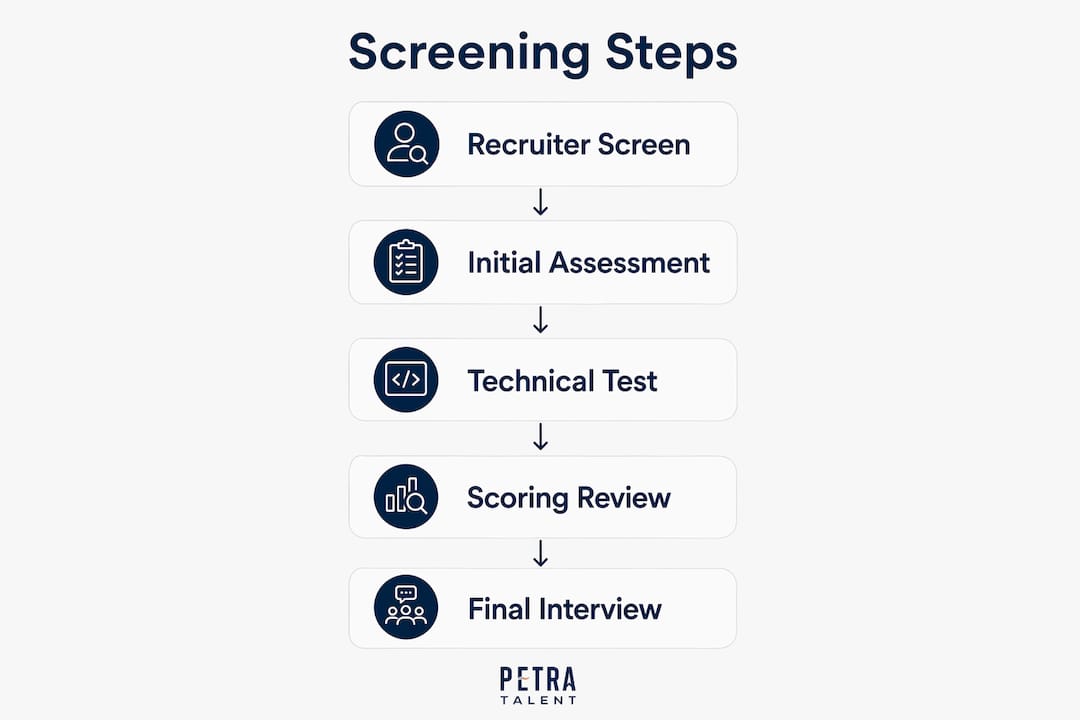
Technical screening follows the resume review and recruiter phone screen. It is the first true technical hurdle a candidate faces. The full sequence looks like this:
- Resume review: Recruiter checks credentials, experience, and licensing
- Recruiter phone screen: Confirms availability, compensation fit, and basic role alignment
- Technical screen: Candidate completes a structured, timed task or simulation
- Deep technical interview: Reserved for candidates who pass the screen
- Offer and hire: Based on combined screen results and interview feedback
Each stage has a clear owner. The recruiter handles the first two steps. A mid-level technician, a standardized assessment tool, or an external vetting partner runs the technical screen. Your senior tech or foreman only enters the process after a candidate clears the screen. That sequencing matters because structured screening protects senior staff time by filtering out candidates who do not meet baseline requirements before any expensive live evaluation takes place.
Pro Tip: Assign a single scorer to each screen session and rotate scorers across candidates to prevent one assessor’s preferences from skewing your results.
What should you test in HVAC and plumbing technical screens?
The screen must align with the concrete tasks of the job, not general trade knowledge. Testing craft means testing what the technician will actually do, not what they can recite.
Core HVAC skill categories to verify
- System diagnostics: identify a fault from symptom description or a live unit
- Thermostat and electrical troubleshooting: read a wiring diagram, trace a circuit
- Refrigerant basics: EPA 608 knowledge, handling procedures, leak identification
- Schematic and diagram reading: interpret manufacturer wiring or piping schematics
- Safe ladder and rooftop practices: describe or demonstrate correct setup and fall protection
Core plumbing skill categories to verify
- Pipe joinery: select correct fittings, describe or demonstrate joining method for the material
- Pressure and leak diagnostics: interpret a gauge reading, identify likely fault locations
- Drain and clearance troubleshooting: diagnose a blockage scenario from symptoms
- Code and licensing verification: confirm state journeyman or master license status
- Fixture installation basics: sequence steps for a standard fixture swap
Sample tasks by job level
- Junior technician: Given a wiring diagram for a split system, identify the low-voltage control circuit and locate where a broken wire would cause a no-cooling fault. Expected deliverable: verbal or written explanation completed within a reasonable, time-boxed period.
- Mid-level technician: Given a scenario where a residential system is short-cycling, list the diagnostic steps in order and identify the two most likely causes. Expected deliverable: written checklist completed within a reasonable, time-boxed period. This benchmark reflects the typical time a competent mid-level technician takes to reach a working answer.
- Senior technician: Same scenario, plus: explain how you would document the repair for the customer and what you would check to prevent recurrence. Expected deliverable: written summary with documentation notes completed within a reasonable, time-boxed period.
For performance-based screening in plumbing, apply the same level structure using pressure test scenarios, code-compliance questions, and pipe selection tasks.
How do you design an effective technical screen?
Format, timing, and scoring are the three variables that determine whether your screen produces reliable data.
Format options
- 30-minute on-site bench test: Best for installation and service roles where physical demonstration matters; requires a safe demo area and materials
- 45-minute remote simulation: Written or video-based scenario; works well for diagnostic and troubleshooting roles; easier to standardize across multiple sites
- 2–3 hour take-home project: Reserve this for senior or supervisory roles only; avoid long take-homes for field technician positions because they do not reflect on-site conditions and create false negatives for candidates who work better hands-on
Live technical interviews are highest-signal for judgment and collaboration but are the most expensive format. They belong after the screen, not before it.
Scoring rubric dimensions and pass thresholds

| Dimension | What to assess | Minimum to pass |
|---|---|---|
| Craft | Correct technique, sequencing, and tool/material selection | Adequate on all core steps |
| Safety | PPE awareness, hazard identification, correct shutdown procedure | No critical safety omissions |
| Problem-solving | Logical diagnostic approach, prioritization of likely causes | Reaches a viable solution |
| Communication | Clear explanation of approach and findings | Understandable without prompting |
Use a standardized scoring rubric with explicit strong, adequate, and weak descriptors for each dimension. A candidate who scores “adequate” or above on all four dimensions passes. One “weak” in craft or safety is a disqualifying result for field roles.
Pro Tip: Score each candidate’s screen before discussing results with other assessors. Blind scoring reduces anchoring bias and makes your hiring decisions easier to defend.
What logistics and compliance details do contractors need to plan for?
Running a screen well requires preparation on both the operational and legal side.
On-site screen checklist:
- Confirm a safe, insured demo area with appropriate PPE available
- Prepare all materials and tools the candidate will need before they arrive
- Assign one scorer and one timekeeper per session
- Collect and document the candidate’s state license number and EPA 608 certification before the screen begins
Remote screen checklist:
- Send scenario documents and instructions at least 24 hours in advance
- Specify the format for the deliverable (written, video, diagram)
- Set a firm submission deadline and communicate it clearly
For HVAC roles, verify EPA 608 certification through the candidate’s card or a quick check with the certifying body. For plumbing, confirm state journeyman or master license status through your state’s licensing board. Many states offer online license lookup tools that take under two minutes. For background-checked technician standards, the HVAC technician qualification process outlines what a thorough credential review covers.
Use standardized rubrics across all candidates for the same role. Applying the same criteria to every applicant is the most practical way to keep your screening process consistent and reduce the risk of bias-related claims.
This article provides general hiring guidance, not legal advice. Consult an employment attorney or HR professional for questions specific to your situation.
What are the most common pitfalls in technical screening?
Most screening failures trace back to a small set of avoidable mistakes.
Common contractor mistakes:
- Sending a take-home project to a field technician instead of a time-boxed on-site task
- Using different rubrics for different candidates in the same role
- Skipping the screen and going straight to a senior tech interview
- Writing vague instructions that leave candidates guessing what is expected
Red-flag candidate behaviors during the screen:
- Cannot explain their diagnostic approach, only states a conclusion
- Skips or dismisses safety steps when asked to walk through a procedure
- Gives evasive answers when asked about licensing status or certification dates
- Asks to skip the timed portion or requests significantly more time than peers
Process-level red flags:
- Wide variance in scores between two assessors reviewing the same candidate
- No calibration session held before the first screen of a new role
- Screen results never reviewed against 90-day performance data
The fix for most of these is the same: write clear candidate instructions, calibrate your rubric with two scorers before you start, and audit screen outcomes against first-year retention data at least once per year. Contractors who hire plumbers without a structured vetting process consistently report higher turnover in the first six months.
When should you outsource technical screening?
Running screens in-house works when you have a reliable mid-level assessor, a safe demo area, and enough volume to justify the setup. Outsourcing makes more sense when:
- Hiring volume spikes and internal assessors cannot keep up
- No qualified in-house technician is available to score screens objectively
- You need consistent rubrics across multiple job sites or regions
- Urgency to fill a role is high and a slow screen process is costing you revenue
A trade-focused recruiter brings pre-screened candidate pools, standardized assessments, and documentation that supports compliance. The result is faster time-to-hire and better first-year retention because candidates arrive already verified against role-specific criteria.
A mechanical contractor hiring for multiple HVAC installer positions across two states used a specialist recruiter to run standardized 30-minute screens for all candidates. The contractor reported that the structured vetting process cut the time spent on unqualified interviews and produced hires who were productive within the first 30 days, without requiring senior tech involvement until the final selection stage.
Pro Tip: When evaluating an outsourcing partner, ask specifically how they calibrate their rubrics across assessors and whether they provide documented screen results you can keep on file.
Vendor checklist for selecting a screening partner:
- Role-specific assessments for HVAC and plumbing (not generic trade tests)
- Documented rubrics with defined pass thresholds
- Compliance documentation support (licensing verification, EPA 608 checks)
- References from mechanical contractors in your region
A ready-to-use checklist and sample rubric for HVAC and plumbing screens
Step-by-step screen checklist
- Define the role KPIs and select a scenario that reflects the top two or three daily tasks
- Prepare all materials, tools, and the scoring rubric before the candidate arrives
- Set the timebox: 30 minutes for junior and mid-level roles, 45 minutes for senior
- Assign one scorer; brief them on the rubric before the session starts
- Run the screen; do not coach or prompt beyond the written instructions
- Score independently, then compare with a second reviewer if available
- Document the result and communicate the outcome to the candidate within 48 hours
Sample rubric: HVAC installer and service plumber (30–45 minutes)
| Dimension | Strong (3) | Adequate (2) | Weak (1) | Pass threshold |
|---|---|---|---|---|
| Craft | Correct technique, no errors | Minor errors, self-corrected | Incorrect technique or skipped steps | 2+ |
| Safety | All PPE and hazard steps addressed | One minor omission | Critical safety step missed | 2+ |
| Troubleshooting | Logical sequence, correct root cause | Reaches solution with prompting | Cannot identify root cause | 2+ |
| Communication | Clear, unprompted explanation | Explanation requires follow-up | Cannot explain approach | 2+ |
Pass threshold: Score of 2 or above on all four dimensions. A score of 1 in Craft or Safety is an automatic disqualification for field roles. For HVAC service tech interviews, apply the same rubric with scenario content drawn from the specific system types the role services.
Key Takeaways
A structured technical screening process is the most reliable way to verify hands-on craft, protect senior technician time, and reduce first-year turnover in HVAC and plumbing roles.
| Point | Details |
|---|---|
| Screen placement in funnel | Run the technical screen after the recruiter phone screen, before any senior tech interview. |
| Time-box the task | A competent mid-level technician should reach a minimum viable solution in about 30 minutes. |
| Four-dimension rubric | Score craft, safety, troubleshooting, and communication; a “weak” in craft or safety disqualifies field candidates. |
| Outsource when volume spikes | Use a specialist recruiter when internal assessors are unavailable or hiring urgency is high. |
| Petratalent’s role | Petratalent provides role-specific technical vetting, standardized rubrics, and compliance documentation for HVAC and plumbing contractors across the United States. |
What the field actually teaches you about screening
Most contractors who struggle with bad hires share one pattern: they skipped the screen or ran it inconsistently. A resume that lists five years of HVAC experience says nothing about whether that technician can read a wiring diagram under time pressure or identify a refrigerant leak from symptoms alone. The screen is where that gap becomes visible, before the candidate is on your truck.
The contractors who see the best results treat the screen as a non-negotiable step, not an optional add-on for senior roles. They write clear instructions, use the same rubric every time, and score before discussing results with anyone else. That discipline is what separates a screening process that predicts performance from one that just adds a step to the calendar.
Petratalent’s placement case studies consistently show that contractors who adopt structured, role-specific screens before the final interview stage report stronger first-year performance and fewer early separations. The rubric does not have to be complex. Four dimensions, a 30-minute timebox, and a clear pass threshold are enough to make a real difference.
Petratalent handles technical vetting so your senior techs don’t have to
Contractors who need consistent, role-aligned screening without pulling their best technicians off the job have a direct option: Petratalent’s technical vetting and workforce solutions handle the full screening process for HVAC and plumbing roles, from scenario design to scored documentation.

Petratalent builds role-specific assessments, applies standardized rubrics across every candidate, verifies licensing and EPA 608 certification, and delivers documented results contractors can keep on file for compliance. The HVAC and plumbing recruiting services cover direct hire placements, pre-screened candidate pools, and market wage benchmarking, so contractors get qualified candidates without the overhead of building a screening program from scratch. To see the full range of services or start a conversation about your next hire, visit Petratalent’s services page.
Useful sources and reference materials
- Technical interview process explained step-by-step — Covers funnel placement and the sequence from resume review to technical screen
- Technical Screening Tips: Best Practices and Pitfalls — Supports the case for structured screening and rubric-based scoring
- Technical Interview Guide for Hiring Managers (2026) — Source for minimum viable solution timing and take-home project guidance
- Conducting a technical screening: checklist and questions — Role KPI alignment and craft-focused testing principles
- Hiring Engineers: Technical Interview Guide 2026 | StackFYI — Rubric design, calibration, and debrief recommendations
- Technical Screening: How to evaluate developers — Guidance on reserving live interviews for candidates who pass structured screens
- Technical interview definition and context | SocialTalent — Clarifies the distinction between screening craft and behavioral assessment
- What is Technical Screening? | Oleeo — Covers automated and scalable screening options
- Technical Interviewing Guide – Career Hub | Duke University — Authoritative academic reference on technical interview structure and preparation
- What Is an HVAC Background Checked Technician | LC Heating & Air — Practical reference for credential verification standards in HVAC hiring
Bookmark these references and share them with anyone on your team who owns the screening or interview process. Consistent use of authoritative hiring standards is what keeps your process defensible and your hires reliable.
Recommended
Related Posts

September 20, 2026
Construction Offer Letters for HR: Site Assignments, Certs, Petra Tips
HR ready construction offer letters: copy ready language for site assignments, certs, contingencies, and a…

September 19, 2026
Create E-Verify Cases by Day Three: U.S. HVAC & Plumbing Rules
E-Verify for U.S. HVAC and plumbing contractors: who needs I-9s, the three business day case…

September 18, 2026
72.5¢ Rate: Take Home Vehicle Policy for Employers and Agencies
Checklist and policy language for employers and agencies: apply the IRS 2026 mileage rate (72.5…

September 17, 2026
Avoid Overtime Back-Pay: Job-to-Job Travel Pay for U.S. Technicians
U.S. employers: learn DOL/WHD travel-pay tests, a blended rate overtime example, state pitfalls, and Petratalent…