


A well-maintained candidate pipeline is the single most effective way to reduce time-to-hire, lower recruiting costs, and build a more reliable plumbing workforce. Rather than scrambling to fill a vacancy from scratch, contractors with active pipelines already have pre-vetted, engaged candidates ready to move forward. Companies using pipelines reduce hiring times significantly, a gap that directly affects job site productivity and revenue. The core benefits for plumbing contractors include:
- Faster hiring decisions backed by pre-screened, license-verified candidates
- Lower cost-per-hire through reduced reliance on job boards and staffing agencies
- Compliance confidence from early credential verification before interviews begin
- Better role matches that improve retention and reduce first-90-day turnover
- Workforce flexibility to handle seasonal demand spikes, retirements, and unexpected vacancies
These advantages compound over time. A contractor who builds a pipeline today is not just filling one role faster. They are building a recruiting system that runs in parallel with daily operations.
Key strategies to build an effective plumbing candidate pipeline
Building a pipeline requires consistent effort across multiple sourcing channels. No single tactic is enough, and the contractors who do this well treat candidate sourcing for plumbing as an ongoing process rather than a reaction to a vacancy.
Trade school partnerships are the most underused channel in the industry. Most plumbing businesses have never contacted their regional vocational school, yet these programs graduate apprentice-level technicians every semester who are actively looking for their first placement. A single call to a department coordinator and a willingness to offer apprenticeships puts a contractor on a shortlist that most competitors are not even aware of. Pair this with a documented apprenticeship-to-journeyman pathway, and loyalty builds before the first paycheck clears.

Structured referral programs consistently outperform other sourcing channels for plumbing businesses. Referral bonuses for hires who stay 90 days cost less than a single bad hire and deliver candidates who already understand the company culture. The program must be documented, the timeline must be clear, and payouts must happen on time. A referral program that misses a payout dies immediately.

Employer branding through social proof converts passive candidates before they ever see a job posting. Posting real job site videos, technician spotlights, and day-in-the-life content on Facebook and Instagram takes two to three months to build momentum, but it consistently produces higher-quality applicants than paid job board listings because candidates self-select based on fit.
Additional pipeline-building tactics that work in plumbing recruiting:
- Use a CRM system to segment candidates by license level, service area, and readiness to hire
- Send periodic updates to pipeline candidates, including company news and open roles, to keep them engaged
- Host “meet the team” events, virtual or in person, to build relationships before a role opens
- Maintain an active talent community where interested candidates can opt in to future opportunities
- Track candidate engagement metrics to identify who is warm and ready versus who needs more nurturing
Automation through ATS and CRM platforms scales these efforts without sacrificing candidate experience. Technology platforms that support home service company growth can also help contractors manage outreach, track pipeline stages, and maintain consistent communication across a candidate pool.
How candidate pipelines accelerate hiring and improve compliance in plumbing
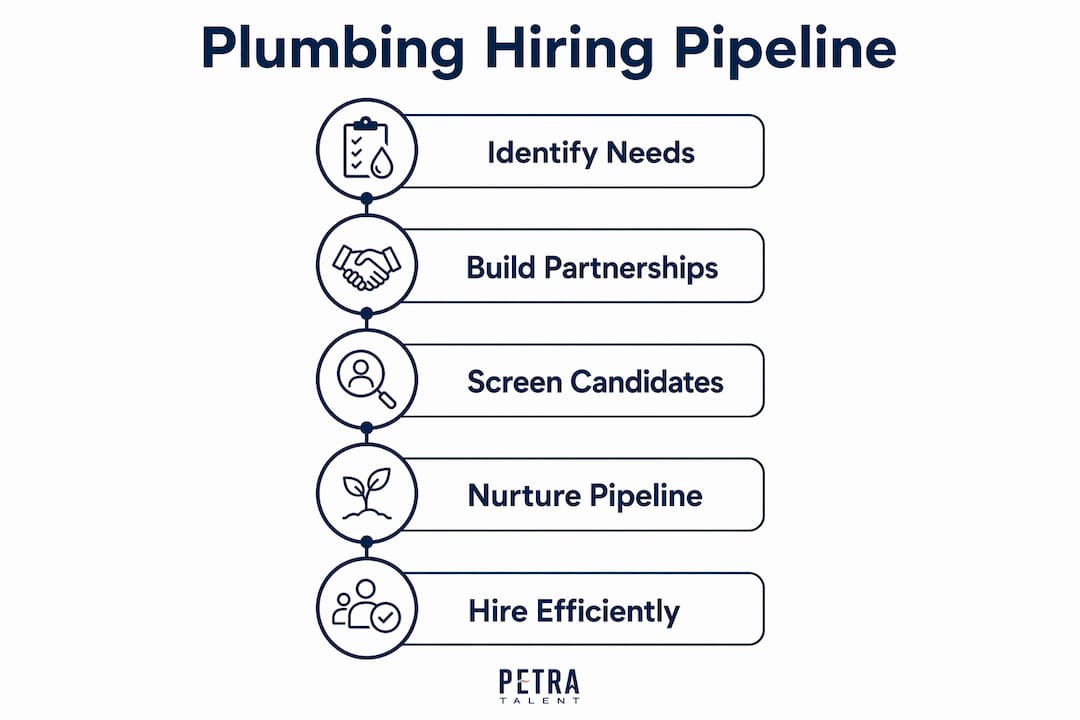
Speed and compliance are two areas where plumbing contractors feel the most pressure, and a well-structured pipeline addresses both directly.
Faster hiring comes from eliminating sourcing lag. When a role opens, contractors without a pipeline spend weeks posting, waiting, and screening from scratch. Organizations with well-maintained pipelines move directly to structured interviews and offer decisions because sourcing and initial screening are already complete. For businesses with a structured process, the timeline from posting to accepted offer runs three to six weeks. Without a process, the median stretches to eight to twelve weeks, and hiring quality drops because operators get impatient and stop screening rigorously.
Compliance is where many pipelines fail silently. A pipeline filled with candidates who lack the required licenses or certifications is not a pipeline. It is a liability. Early credential verification during a brief screening call prevents “phantom” pipelines filled with non-employable candidates, saving time and protecting contractors from compliance exposure. Gating license status, service area, and physical requirements before any interview investment keeps the pipeline clean and legally sound.
Statistic callout: Publishing compensation ranges in job postings removes approximately 30% of unqualified applications immediately, cutting screening workload before the pipeline even begins.
Technology integration strengthens both speed and compliance. Applicant tracking systems manage active applicants, while CRM platforms nurture long-term relationships with past, current, and future candidates. Together, they automate candidate communications, track pipeline stages, and flag credential gaps before they become hiring problems. Contractors who integrate workforce vetting processes into their pipeline management catch compliance issues at the sourcing stage rather than after an offer is extended.
Key compliance and speed benefits from a structured pipeline:
- License and certification status confirmed before any interview is scheduled
- Compensation expectations aligned in the first phone screen, eliminating late-stage surprises
- Automated reminders and follow-ups keep candidates engaged without manual effort
- Pre-recorded async video assessments allow recruiters to review candidates on their own schedule
- Pipeline analytics identify where candidates drop off, so the process can be adjusted
Long-term workforce stability benefits from candidate pipelines in plumbing
The most expensive hiring mistake in plumbing is not a bad hire. It is a reactive one. When a technician gives notice and there are no pre-vetted candidates ready, contractors are forced to compromise on qualifications, rush the process, or overpay to fill the gap quickly. A pipeline eliminates that dynamic.
The 3-to-5 rule is the practical standard for pipeline depth. Maintaining three to five pre-vetted, pipeline-ready candidates per role creates a buffer that prevents reactive, costly hiring decisions. For niche or senior positions, even one or two warm, qualified candidates in the pipeline represents a meaningful advantage over starting from zero. This buffer is especially valuable in plumbing, where the field is projected to grow 6% between 2023 and 2033, faster than average, meaning competition for qualified technicians will intensify.
Retention improves when candidates enter roles through a pipeline rather than a reactive hire. Pipeline candidates are familiar with the company before they start. They have been engaged, communicated with, and given realistic expectations about the role. That familiarity reduces the expectation gap that drives early turnover. Candidates who self-select based on culture and fit, rather than just compensation, tend to stay longer and perform more consistently.
Scaling becomes manageable when a pipeline is active. Seasonal demand spikes, new service contracts, and unexpected retirements all create sudden workforce needs. Contractors with a pipeline can respond in days rather than weeks. Those without one face the choice between turning down work or hiring someone who is not fully qualified.
Long-term workforce stability benefits from maintaining an active pipeline:
- Reduces dependency on staffing agencies, which often charge substantial placement fees
- Supports career pathing by identifying internal promotion candidates alongside external hires
- Builds employer brand reputation as candidates who were not hired this cycle remain warm for the next
- Provides line of sight into workforce gaps before they become operational problems
- Enables selective hiring rather than hiring out of desperation
Contractors who treat passive recruiting as a continuous activity rather than a periodic event build the kind of workforce stability that supports business growth and, ultimately, business value.
Structured candidate screening best practices to improve plumbing hires
A pipeline is only as good as the screening process that feeds it. Contractors who skip structured screening end up with a large database of unqualified candidates and a false sense of security. The goal is a clean, active pipeline of candidates who have already cleared the most important gates.
Stage one: the 10-minute phone screen. This call covers four specific questions: license status, availability, compensation expectations, and one scenario question that tests field experience. Anyone who cannot answer the scenario question clearly does not have the hands-on background the role requires. This screen also confirms the candidate’s compensation expectations against the published range, eliminating late-stage surprises.
Stage two: the paid working interview. Two to four hours on a real job alongside a senior technician gives far more signal than any traditional interview format. Structured two-stage screening with paid working interviews reduces first-90-day turnover by over 30% compared to interviews only. That reduction directly lowers the cost and disruption of early departures.
Publishing compensation ranges upfront is a prerequisite for a clean pipeline. Candidates who expect a rate outside the posted range will self-select out before any screening time is invested. This single step removes approximately 30% of unqualified applications immediately, cutting screening workload and keeping the pipeline focused on genuinely qualified applicants.
For contractors looking to apply performance-based screening at scale, integrating scheduling and field management tools into the onboarding process ensures new hires are ready to work from day one rather than spending their first week waiting for access and instructions.
| Screening practice | Impact on hiring outcomes |
|---|---|
| Publish compensation range in job posting | Removes approximately 30% of unqualified applications upfront |
| 10-minute phone screen with scenario question | Confirms license status, availability, and field experience quickly |
| Paid working interview | Reduces first-90-day turnover by over 30% vs. traditional interviews |
| Early credential verification in screen call | Prevents non-compliant candidates from advancing in the pipeline |
| Async video assessment for pipeline candidates | Allows recruiters to review multiple candidates in the time one phone screen takes |
Mobile-friendly async video interviews improve pipeline candidate retention by letting candidates complete assessments on their own schedule, which signals that the contractor values their time. That experience matters in a competitive market where qualified plumbers receive multiple offers quickly.
Additional screening best practices for plumbing contractors:
- Document the five most common job types as step-by-step checklists before posting any role
- Track 90-day retention rate quarterly and trace every early departure back to a specific point in the hiring process
- Use a 30-60-90 day onboarding plan to define clear milestones before the new hire’s first day
- Integrate screening data into the CRM so pipeline candidates carry their qualification history forward
- Review pipeline-to-hire conversion rate regularly to confirm that nurturing efforts are producing actual hires
Petratalent’s approach to plumbing subcontractor staffing incorporates these screening principles into a structured process designed specifically for mechanical contractors, reducing the time and risk associated with each hire.
Key Takeaways
A candidate pipeline built on structured screening, early credential verification, and consistent candidate nurturing is the most reliable way to reduce time-to-hire, improve compliance, and build long-term workforce stability in plumbing contracting.
| Point | Details |
|---|---|
| Pipeline reduces time-to-hire | Companies using pipelines reduce hiring times significantly by eliminating sourcing lag. |
| Publish pay to filter applicants | Posting compensation ranges removes approximately 30% of unqualified applications before screening begins. |
| Maintain 3–5 candidates per role | Keeping three to five pre-vetted candidates per role prevents reactive, costly hiring decisions. |
| Two-stage screening cuts turnover | Paid working interviews reduce first-90-day turnover by over 30% compared to traditional formats. |
| Early credential verification protects compliance | Gating licenses in the first phone screen prevents non-compliant candidates from advancing in the pipeline. |
Petratalent specializes in building and managing plumbing recruiting pipelines for mechanical contractors across the United States. From role-specific candidate sourcing and technical vetting to credential verification and workforce consultation, the team handles the pipeline work so contractors can focus on running their business. Explore Petratalent’s services to see how a structured recruiting partnership translates directly into faster hires, better retention, and a workforce built to scale.
Recommended
Related Posts

September 20, 2026
Construction Offer Letters for HR: Site Assignments, Certs, Petra Tips
HR ready construction offer letters: copy ready language for site assignments, certs, contingencies, and a…

September 19, 2026
Create E-Verify Cases by Day Three: U.S. HVAC & Plumbing Rules
E-Verify for U.S. HVAC and plumbing contractors: who needs I-9s, the three business day case…

September 18, 2026
72.5¢ Rate: Take Home Vehicle Policy for Employers and Agencies
Checklist and policy language for employers and agencies: apply the IRS 2026 mileage rate (72.5…

September 17, 2026
Avoid Overtime Back-Pay: Job-to-Job Travel Pay for U.S. Technicians
U.S. employers: learn DOL/WHD travel-pay tests, a blended rate overtime example, state pitfalls, and Petratalent…