



TL;DR:
- The plumbing labor market faces a significant shortfall of 550,000 workers by 2026 due to retirements and declining apprenticeships. Wages and benefits are essential for retention as regional wage gaps and strong benefits packages influence worker decisions. Continuous recruiting and proactive workforce planning are crucial for overcoming ongoing labor shortages.
Plumbing labor market trends are defined by the interaction between workforce supply, job demand, wage levels, and training pipelines that together shape hiring conditions across the United States. The industry faces a structural shortfall projected at 550,000 workers by 2026, driven by an aging workforce and collapsing apprenticeship enrollment. Understanding how these forces connect is the foundation of any effective workforce planning strategy. HR managers and business leaders who read these signals correctly gain a real advantage in recruiting and retaining skilled plumbers before competitors do.
What are the current demand and supply factors shaping plumbing labor market trends?
The Bureau of Labor Statistics projects 44,000 annual job openings through 2034, with the industry needing roughly 349,000 net new workers in 2026 alone. The majority of those openings come from retirements, not industry growth. That distinction matters: demand is not being created by new construction booms alone. It is being driven by the exit of experienced workers who cannot be replaced fast enough.

The supply side is equally constrained. Over 20% of construction workers are 55 or older, meaning a large wave of retirements is already in progress. At the same time, apprenticeship enrollment dropped 49% between 2020 and 2022, cutting off the primary pipeline for new skilled workers. The table below shows how these forces combine to create a persistent gap.
| Workforce Factor | Current Status |
|---|---|
| Workers aged 55 or older | Over 20% of the construction workforce |
| Annual job openings (through 2034) | 44,000 per year |
| Net new workers needed in 2026 | ~349,000 |
| Apprenticeship enrollment change (2020–2022) | Down 49% |
| Projected total shortfall by 2026 | 550,000 workers |
The gap between retirements and new entrants is widening each year. Contractors who treat this as a temporary hiring problem will consistently fall short of staffing targets.
How do labor market trends affect plumbing wages, compensation, and employee benefits?
Wage scarcity drives pay up. Compensation averages for 2026 sit at $20/hr for apprentices, $34/hr for journeymen, and a median of $80,053 annually for master plumbers. These figures reflect a market where qualified workers hold negotiating power. Contractors who do not keep pace with regional benchmarks lose candidates to competitors before the interview ends.
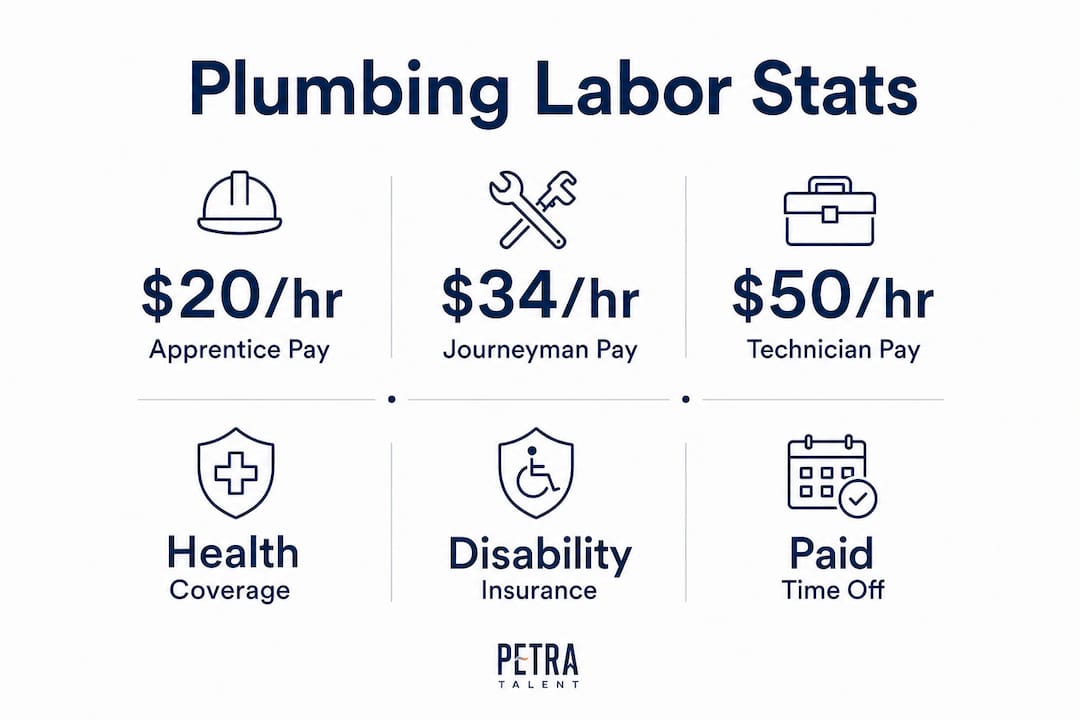
Benefits have become equally decisive. Experienced technicians compare benefits packages quietly and thoroughly, making health coverage, disability insurance, and paid time off critical retention tools beyond hourly pay. Physical trade demands make musculoskeletal care and disability coverage especially valued. A technician choosing between two similar wage offers will consistently pick the employer with stronger health and disability benefits.
| Role | Typical Hourly/Annual Pay | Key Benefits Valued |
|---|---|---|
| Apprentice | $20/hr | Health coverage, training support |
| Journeyman | $34/hr | Health, disability, PTO |
| Master Plumber | $80,053/yr (median) | Full benefits, pension, career path |
Pro Tip: Build a written benefits summary and share it during the offer stage. Candidates who see the full package in writing are more likely to accept and less likely to counteroffer.
Regional variation adds another layer of complexity. Illinois median plumber earnings reach approximately $96,200 vs. $49,630 in West Virginia. That nearly $47,000 gap shapes where workers choose to live and work, and it directly affects turnover rates in lower-wage markets.
What are the main causes of workforce instability in the plumbing labor market?
Workforce instability in plumbing is structural, not cyclical. The skilled trades shortage is accelerated by early retirements, reduced vocational training funding, and immigration policy shifts that limit the pool of available workers. These causes compound each other, making recovery slow even when economic conditions improve.
The primary instability causes are:
- Aging workforce: More than 20% of construction workers are 55 or older, with retirements outpacing new entrants.
- Apprenticeship decline: Enrollment dropped 49% between 2020 and 2022, shrinking the long-term supply pipeline.
- High training costs: First-year apprentice costs run approximately $48,000–$55,000 all-in, deterring smaller contractors from investing.
- Longer training timelines: Multi-year apprenticeship programs delay workforce entry, creating a lag between demand spikes and supply response.
- Rising technical complexity: Modern plumbing systems require proficiency in water treatment, gas systems, and code compliance, raising the skill floor for entry-level hires.
- Immigration policy shifts: Reduced labor mobility limits the ability to fill gaps through international recruitment.
Pro Tip: Track your own turnover rate by role and tenure. Most contractors discover that attrition peaks in the first 18 months, which points directly to onboarding and mentorship gaps rather than compensation alone.
70% of plumbing contractors report difficulty finding qualified plumbers in 2026. That figure reflects a market where reactive hiring no longer works. Contractors who wait for a vacancy to open a search will consistently lose to those who maintain an active candidate pipeline.
How can plumbing businesses effectively manage labor market challenges?
Managing plumbing labor shortages requires treating recruitment as a continuous capital investment, not a reactive task. Recruiting must be multi-sourced and ongoing, not triggered by a resignation. Contractors who build hiring pipelines before they need them fill roles faster and at lower cost.
The most effective workforce management techniques for 2026 are:
- Run continuous recruiting. Post roles and engage candidates year-round, even when fully staffed. A warm pipeline cuts time-to-fill by weeks.
- Prioritize employee referrals. Referrals close 4–8x better than paid job boards and produce candidates who already understand trade culture.
- Partner with training programs. Relationships with local trade schools and community colleges create early access to graduates before they enter the open market.
- Use military SkillBridge programs. These programs connect transitioning service members with skilled trades employers at no cost during the final months of military service.
- Publish a clear pay ladder. Technicians stay longer when they can see exactly how wages and responsibilities increase over time. Transparency reduces the appeal of competitor offers.
- Invest in frontline leadership. Empowered foremen and mentoring create work environments where technicians feel valued, which directly reduces voluntary turnover.
- Build apprenticeship capacity. Shops running strong growth maintain roughly 60% journeymen, 30% apprentices, and 10% helpers. That ratio requires deliberate investment in training infrastructure.
Understanding passive recruiting for plumbing contractors is one of the most underused advantages in this market. Passive candidates, those not actively job searching, often represent the highest-quality talent available.
How do labor market trends vary across regions and union vs. non-union contexts?
Geography and union membership create two separate labor markets within the same industry. Union plumbers earn 20–35% more than non-union peers in the same metro area, with unions also providing pension plans, healthcare, and continuing education benefits. That compensation gap makes retention significantly harder for non-union shops competing in the same local market.
Non-union contractors face a structural disadvantage in benefits and pay, but they can close part of the gap through transparent pay ladders and strong benefits design. The table below illustrates how regional and union factors interact.
| Market Context | Median Pay Range | Retention Challenge |
|---|---|---|
| Union, high-wage state (e.g., Illinois) | ~$96,200/yr | Lower; strong benefits package |
| Non-union, high-wage state | $65,000–$80,000/yr | Moderate; benefits gap vs. union |
| Non-union, low-wage state (e.g., West Virginia) | ~$49,630/yr | High; wage and benefits gap |
Understanding plumbing unions and their workforce impact helps non-union contractors identify exactly where their compensation packages fall short and where targeted improvements will have the most retention impact.
Key Takeaways
Plumbing labor market trends are driven by a widening gap between retiring workers and new entrants, making proactive workforce planning the single most effective response available to contractors and HR managers.
| Point | Details |
|---|---|
| Structural shortage is confirmed | A 550,000-worker shortfall by 2026 is driven by retirements, not just demand growth. |
| Wages reflect supply scarcity | Journeymen average $34/hr; master plumbers median $80,053/yr, with regional gaps near $47,000. |
| Benefits drive retention | Health, disability, and PTO coverage are decisive factors for technicians comparing offers. |
| Instability causes are compounding | Apprenticeship decline, aging workforce, and rising skill requirements all reduce supply simultaneously. |
| Continuous recruiting is required | Reactive hiring fails; referrals, trade partnerships, and SkillBridge programs build stable pipelines. |
What I’ve learned about reading plumbing labor market data
The number that most contractors miss is not the shortage figure. It is the apprenticeship enrollment drop. A 49% decline between 2020 and 2022 means the pipeline problem will not self-correct for at least five to seven years, regardless of wage increases or economic conditions. Wages attract workers who already exist in the market. They do not create new ones.
The contractors I see winning in this environment share one habit: they treat their workforce like a balance sheet. They know their journeyman-to-apprentice ratio, their average tenure by role, and their cost-per-hire. That data tells them where to invest before a vacancy becomes a crisis.
The other underrated factor is frontline leadership. A skilled foreman who mentors younger workers is worth more to retention than a 10% wage increase. Workers leave managers before they leave companies, and that pattern holds in the trades as clearly as anywhere else.
For HR managers, the practical takeaway is straightforward. Build a plumbing workforce planning process that runs year-round, not just when a seat is open. The contractors who do this consistently outperform their peers in both hiring speed and workforce stability.
— David
Petratalent’s approach to plumbing workforce challenges
The labor market conditions described in this article are not temporary. They require a recruiting partner who understands the plumbing industry at the role level, not just the industry level.

Petratalent specializes in plumbing recruiting services for mechanical contractors across the United States, sourcing and vetting candidates for service, construction, leadership, and technical roles. The process includes role-specific candidate sourcing, performance screening, and market wage benchmarking. Contractors working with Petratalent gain access to a pre-vetted candidate pool and a structured hiring process designed to reduce time-to-fill and improve workforce stability. For contractors ready to address skilled labor shortages with a structured approach, Petratalent’s skilled workforce staffing solutions provide a direct path forward.
FAQ
What is the projected plumbing worker shortage by 2026?
The U.S. plumbing industry faces a structural shortfall of 550,000 workers by 2026, driven by aging workforce retirements and a 49% drop in apprenticeship enrollment between 2020 and 2022.
Why do plumbing labor shortages happen?
Shortages result from retirements outpacing new entrants, declining vocational training investment, and rising skill requirements. The Bureau of Labor Statistics projects 44,000 annual openings through 2034, most driven by retirements rather than industry expansion.
How do plumbing wages fluctuate across regions?
Regional wages vary significantly. Illinois median plumber earnings reach approximately $96,200 annually, while West Virginia sits near $49,630. Union membership adds a further 20–35% wage premium over non-union peers in the same metro area.
What benefits matter most for retaining plumbers?
Affordable health coverage, disability insurance, and paid time off are the benefits technicians compare most carefully. These factors often determine offer acceptance when two employers offer similar hourly wages.
How can contractors manage plumbing labor shortages effectively?
Contractors manage shortages by running continuous recruiting, building referral programs, partnering with trade schools, and using military SkillBridge programs. Publishing a transparent pay ladder also reduces voluntary turnover by giving technicians a clear career path.
Recommended
Related Posts

October 14, 2026
HVAC Recruiter Fees: Contractors Weigh $10,000 Against Vacancy Costs
See how HVAC recruiter fees work for contractors, from 15% to 25% placement costs to…

October 13, 2026
Recruiting Contract Terms: 10 Checks and Ready to Use Clauses
Define fee triggers, candidate ownership, guarantees, and compliance terms. Get a master agreement, short schedule,…

October 12, 2026
Offer Acceptance Rates: Segment Benchmarks, HVAC’s 3–5 Day SLA
See why a 78% to 82% offer acceptance benchmark can mislead, how role and source…
October 11, 2026
Bad Hires Can Cost Construction Firms 30% to 200% of Salary
Bad hires can cost construction firms 30% to 200% of annual salary. Calculate recruiting, rework,…