



TL;DR:
- HVAC leadership hiring requires assessing management judgment, cultural fit, and strategic ability rather than technical skills alone. Structured processes, clear evaluation criteria, and culture-focused interviews improve success rates, preventing costly mis-hires. Promoting technicians without leadership assessment often leads to burnout and team performance issues.
HVAC leadership hiring is defined by the evaluation of management capability, strategic judgment, and cultural alignment rather than technical proficiency alone. HR professionals and executives who apply the same criteria used for technician hiring to supervisor and director-level searches consistently produce poor outcomes. Understanding how HVAC leadership hiring differs from technical hiring is the foundation of building a workforce that performs at every level. Guides from Darwin Recruitment, Atticman, and Bay Climate Control each confirm that leadership roles demand a separate evaluation framework entirely.
How HVAC leadership hiring differs from technical role recruitment
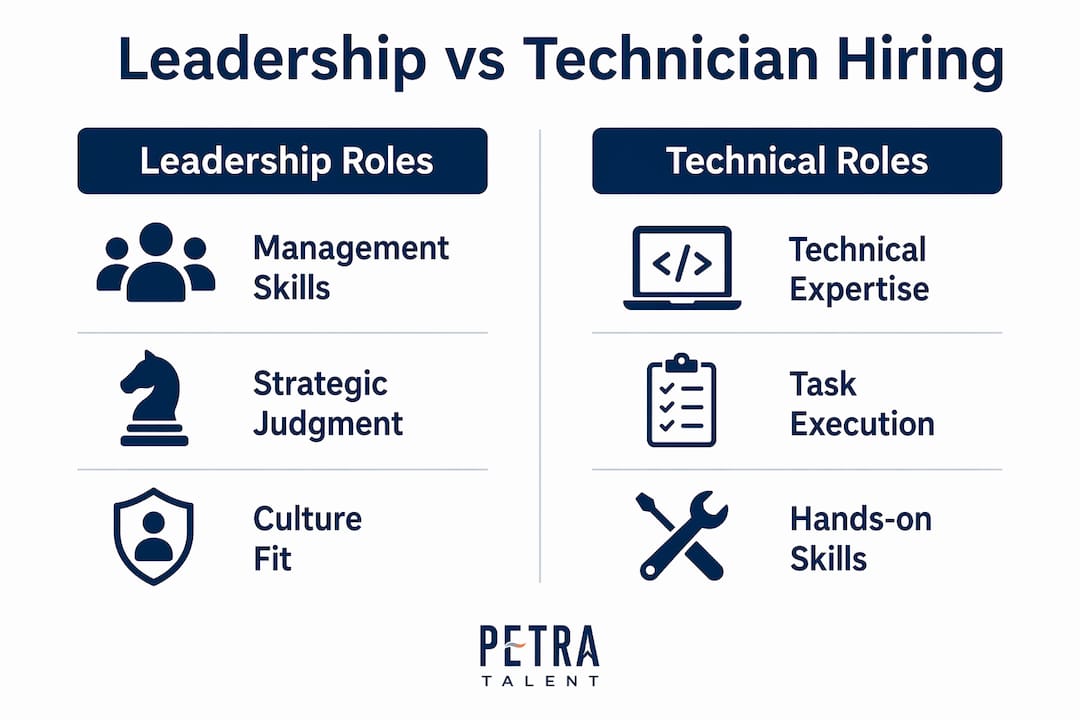
Leadership roles focus on managing team performance, safety, and operational decisions, while senior technicians lead hands-on work and technical mentoring. This distinction is not a matter of seniority on a single track. It represents two separate career paths with different competency requirements, interview structures, and success metrics. HVAC management recruitment that conflates the two produces supervisors who cannot lead and teams that stagnate.
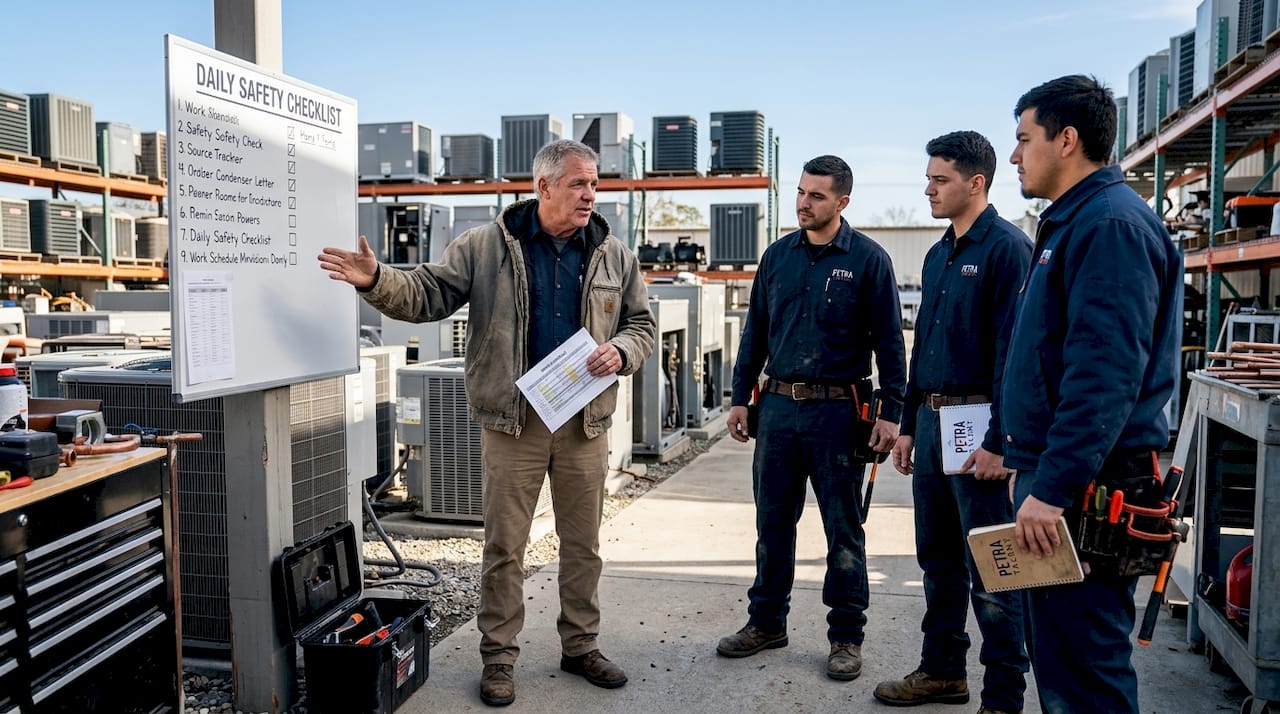
The core shift is from technical execution to organizational accountability. A senior technician with five or more years of field experience is measured by diagnostic accuracy, job completion, and mentoring junior staff. A supervisor or operations manager is measured by team output, retention, safety compliance, and alignment with company strategy. Leadership hiring demands business judgment and strategic acumen, not just operational background.
What competencies separate HVAC leadership candidates from senior technicians?
The competency gap between a senior technician and an HVAC supervisor is specific and measurable. Senior technicians require deep technical troubleshooting ability, project execution skills, and the capacity to mentor peers. Supervisors and managers require conflict resolution, team development, financial awareness, and the ability to make decisions under competing constraints like safety, productivity, and budget.
| Point | Senior technician | HVAC leadership role |
|---|---|---|
| Primary measure | Technical output and job quality | Team performance and culture |
| Decision scope | Job-level problem solving | Operational and strategic decisions |
| People responsibility | Peer mentoring | Hiring, coaching, accountability |
| Key skills | Diagnostics, installation, compliance | Communication, delegation, conflict resolution |
| Experience focus | 5+ years field execution | Leadership judgment and management training |
Testing leadership readiness means evaluating decision-making under constraints and coaching ability, not task competence alone. A candidate who excels at refrigerant diagnostics may have no instinct for managing a team conflict or holding a technician accountable for repeated lateness. These are separate skill sets, and the hiring process must treat them as such.
Pro Tip: Never promote a top technician into a supervisory role based on field performance alone. Assess their leadership aptitude through structured scenario interviews before any promotion decision.
How do HVAC companies structure recruiting differently for leadership roles?
Recruiting for leadership roles in HVAC requires a dedicated process with clear ownership, consistent candidate evaluation, and a structured candidate experience. Recruiting functions as a revenue driver when it is treated as a system with a dedicated owner and active pipeline development rather than a reactive response to vacancies. This is especially true for leadership searches, where a wrong hire costs far more than an unfilled technician position.
Bay Climate Control demonstrates what structured leadership onboarding looks like in practice. The company uses quarterly growth conversations and scorecards that align individual employee goals with company strategy, specifically for leadership roles. This approach creates accountability from day one and gives new leaders a clear development path rather than leaving them to figure out expectations on their own.
Key structural differences in HVAC leadership recruiting include:
- Dedicated recruiting ownership. Leadership searches require a single accountable person managing the pipeline, not a manager juggling hiring alongside field operations.
- Structured scorecards. Evaluation criteria for leadership candidates must be written down and applied consistently across every interview, covering values, judgment, and management competency.
- Longer candidate nurturing. Leadership candidates often require multiple touchpoints before committing. A passive pipeline built over time outperforms reactive job postings.
- Onboarding focused on culture and accountability. Technical onboarding covers tools and processes. Leadership onboarding must cover company vision, team expectations, and performance standards from the first week.
Pro Tip: Treat HVAC workforce trends as a planning input for leadership hiring. Workforce shifts in 2026 are creating new gaps at the supervisor and operations manager level that require proactive pipeline development.
What pitfalls do HVAC companies face when hiring for leadership roles?
The most common mistake in HVAC leadership hiring is promoting the best technician available into a supervisory role without evaluating leadership readiness. Leaders are measured by team performance and culture, not technical output. A technician promoted without management training frequently burns out, loses confidence, and either leaves or reverts to doing technical work instead of leading.
The following pitfalls appear repeatedly across HVAC companies attempting to fill leadership roles:
- Confusing seniority with leadership ability. Years in the field do not translate to people management skill. Seniority is a starting filter, not a qualification.
- Skipping scenario-based interview questions. Asking a candidate to describe how they would handle a technician missing a safety protocol or a scheduling conflict reveals judgment that a resume cannot show.
- Ignoring culture fit at the leadership level. A leader who does not align with company values will actively damage team culture, not just underperform individually.
- Failing to define the role before hiring. Many HVAC companies post supervisor roles without specifying whether the position is primarily field-based or office-based, which attracts the wrong candidates and creates confusion after hire.
- Relying on informal references. Leadership candidates require structured reference checks focused on management behavior, not just technical reputation.
Reviewing common HVAC hiring mistakes before opening a leadership search prevents the most expensive errors. Role-reversal interview techniques, where candidates are asked to evaluate a described management scenario from the perspective of the team rather than the supervisor, are particularly effective at revealing leadership readiness.
Pro Tip: Use role-reversal scenarios in leadership interviews. Ask candidates how a team member would describe their management style, not how they describe it themselves.
Why does culture fit matter more in HVAC leadership hiring?
Culture fit carries greater weight in leadership hiring than in technical hiring because leaders shape the environment that every other employee works in. A technician who is a poor culture fit affects their own performance. A supervisor who is a poor culture fit affects the entire team’s performance, retention, and morale.
Atticman’s approach to leadership hiring illustrates this directly. The company requires that every leadership candidate is interviewed by the owner first, with the interview focused on attitude and alignment before any manager assesses role-specific skills. A 90-day probation period then monitors work ethic, cultural compatibility, and attitude. This structure produces a 70% probation pass rate, which reflects a hiring process that filters for fit before commitment.
Early indicators that HVAC companies use to assess leadership culture fit include:
- How candidates describe past team conflicts and their role in resolving them
- Whether candidates reference team outcomes or personal achievements when discussing success
- How they respond to questions about accountability and feedback
- Their stated motivation for moving into or continuing in a leadership role
Values-based hiring consistently outperforms credential-based hiring for leadership roles in HVAC. A candidate with a strong resume but misaligned values will undermine the culture that technical staff depend on to perform well.
Key takeaways
HVAC leadership hiring requires a separate evaluation framework from technical hiring, centered on management judgment, culture alignment, and structured recruitment systems.
| Point | Details |
|---|---|
| Competency distinction | Leadership roles require conflict resolution, delegation, and team accountability rather than technical execution. |
| Structured recruiting | Dedicated ownership, scorecards, and active pipelines produce better leadership hires than reactive posting. |
| Culture fit priority | Owner-led interviews and probation periods, as used by Atticman, protect team culture at the leadership level. |
| Promotion risk | Promoting top technicians without leadership assessment causes burnout and team performance decline. |
| Onboarding difference | Leadership onboarding must address company vision and accountability standards, not just operational procedures. |
Why I think most HVAC companies are solving the wrong problem
After working in specialized HVAC and plumbing recruitment, the pattern I see most often is this: companies invest heavily in finding the right technician and almost nothing in defining what the right leader looks like. They treat leadership hiring as a faster version of technical hiring, just with a bigger salary attached.
The real problem is not a shortage of candidates. It is a shortage of companies that have defined what leadership success looks like in their specific operation before they start searching. Bay Climate Control’s use of scorecards and quarterly growth conversations is not a sophisticated HR program. It is a basic system that most HVAC companies simply have not built yet.
The companies that get leadership hiring right treat it as a separate discipline. They write down what good leadership judgment looks like in their context. They test for it in interviews. They build a probation structure that monitors the right behaviors. And they stop assuming that the best technician is the best candidate for a supervisory role. That assumption is the single most expensive mistake in HVAC management recruitment, and it is entirely preventable.
— David
How Petratalent supports HVAC leadership hiring
Petratalent specializes in HVAC leadership searches for mechanical contractors across the United States, with a process built specifically around the competency and culture requirements that distinguish leadership roles from technical positions. The team applies structured candidate evaluation, values-based screening, and market wage benchmarking to every leadership search.
For HR professionals and executives who need to fill supervisor, operations manager, or director-level roles without repeating the same costly hiring mistakes, Petratalent’s HVAC recruiting services provide a defined process and an active candidate pipeline. Explore the full range of workforce solutions to find the right fit for your leadership hiring needs.
FAQ
What makes HVAC leadership hiring different from technical hiring?
HVAC leadership hiring evaluates management judgment, culture alignment, and team accountability rather than technical skill. The criteria, interview structure, and onboarding process are distinct from those used for technician or senior field roles.
How do you identify HVAC leadership candidates effectively?
Use scenario-based interview questions focused on conflict resolution, team management, and decision-making under constraints. Combine this with structured scorecards and a values-based screening process before assessing technical background.
Why do promoted technicians often struggle in HVAC leadership roles?
Most HVAC leaders struggle after promotion because they lack training in people management, communication, and accountability. Technical excellence does not transfer automatically to leadership effectiveness.
What role does culture fit play in HVAC management recruitment?
Culture fit is the primary filter for leadership candidates because supervisors and managers directly shape team environment and retention. Companies like Atticman use owner-led interviews and 90-day probation periods to protect culture at the leadership level.
How should HVAC companies structure onboarding for new leaders?
Leadership onboarding must cover company vision, performance expectations, and accountability standards from the first week. Technical onboarding alone is insufficient for candidates moving into supervisory or management positions.
Recommended
Related Posts
October 13, 2026
Recruiting Contract Terms: 10 Checks and Ready to Use Clauses
Define fee triggers, candidate ownership, guarantees, and compliance terms. Get a master agreement, short schedule,…
October 12, 2026
Offer Acceptance Rates: Segment Benchmarks, HVAC’s 3–5 Day SLA
See why a 78% to 82% offer acceptance benchmark can mislead, how role and source…
October 11, 2026
Bad Hires Can Cost Construction Firms 30% to 200% of Salary
Bad hires can cost construction firms 30% to 200% of annual salary. Calculate recruiting, rework,…
October 10, 2026
Construction Labor Forecasting for PMs: 7 Steps to Time Hiring
Learn when construction project managers should use WBS or simulation, track labor KPIs, and turn…