



Quality of hire measures whether a new person actually improves project outcomes, not whether they accepted the offer. In construction, that means tracking safety records, schedule adherence, and rework rates, not just time-to-fill. The most reliable programs use a small set of four or five inputs rather than dozens of scattered KPIs. Contractors who apply this approach typically see stronger 90-day retention and fewer rework incidents within the first two quarters.
TL;DR:
- Focusing on safety records, schedule adherence, and rework rates can significantly improve hiring outcomes for construction roles.
- Using a small set of reliable metrics, such as 90-day manager ratings and early retention, provides a clear view of hire quality.
- Pre-vetting candidates with technical assessments and structured interviews reduces mis-hires and accelerates productivity.
- Tying quality metrics to operational goals like schedule, safety, and costs ensures the hiring process directly supports project success.
- Partnering with specialized recruiters that apply technical vetting improves the long-term performance and retention of hires.
Table of Contents
- What Quality of Hire Means for Construction and Skilled Trades
- Key Metrics That Actually Predict Field Performance
- Build a Simple QoH Scorecard With Four or Five Inputs
- Screening, Interview, and Onboarding Tactics That Raise Hire Quality
- Setting Benchmarks by Role: PMs, Superintendents, and Field Trades
- How Specialist Vetting Strengthens Quality of Hire
- Your First 90 Days: An Implementation Checklist
- Why Trade-Focused Vetting Changes the Math
- Where Petratalent Fits Into Your Hiring Strategy
- Sources
- FAQ
What Quality of Hire Means for Construction and Skilled Trades
Quality of hire (QoH) in construction is a composite measure of how a new employee performs against the outcomes that matter on a jobsite: safety, schedule, budget, and workmanship. It is not the same as recruiting efficiency. A contractor can fill a superintendent role in nine days flat and still take a loss if that hire triggers three safety violations and a blown schedule milestone.
Time-to-fill and cost-per-hire tell you how fast and cheap your recruiting process runs. They say nothing about whether the electrician you placed passes inspections on the first try or whether the project manager you hired keeps subcontractors on schedule. That gap is exactly why so many talent acquisition teams in construction hiring quality initiatives feel like they are flying blind. They have process metrics but no outcome metrics.
The financial exposure is real. A single mis-hire in a leadership role can delay a project by weeks, and rework from an underqualified trade hire eats directly into margin. Common QoH signals in general recruiting research include performance ratings, retention, and cultural fit, but construction adds its own layer of consequence: SHRM’s research on measuring quality of hire notes that many organizations set up hiring goals but never circle back to measure what happened after the start date.
For construction specifically, the risks compound fast:
- Rework from a skills mismatch can cost far more than the original placement fee.
- A safety incident tied to inadequate training can halt a jobsite and trigger regulatory scrutiny.
- Schedule slippage from a weak project manager hire ripples through every trade downstream.
Measuring hire success in construction means connecting the hiring decision to these operational realities, not just to a filled requisition.
Key Metrics That Actually Predict Field Performance
A functional quality assessment in hiring for construction roles rests on five recurring signals, each with its own timing and purpose.
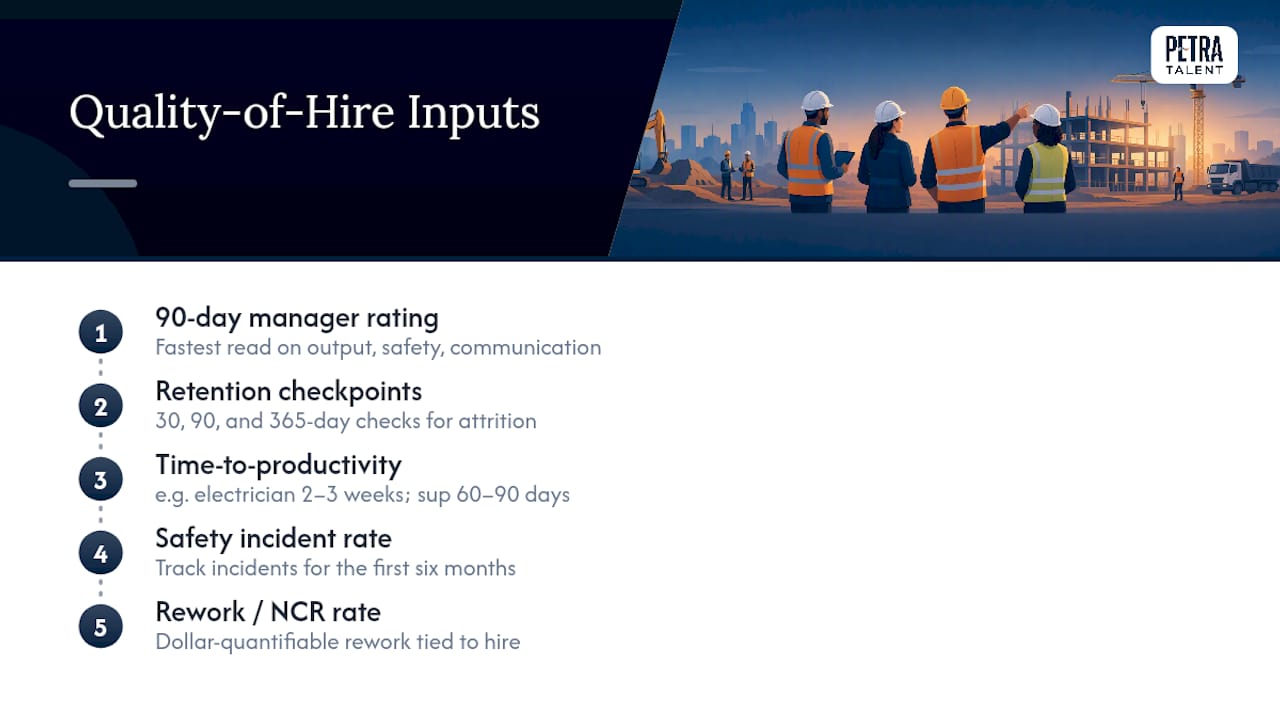
Manager performance ratings at 90 days. A short, structured rating from the direct supervisor is the single fastest read on whether a hire is producing. Ask about output quality, communication with the crew, and adherence to safety protocol.
Retention checkpoints at 30, 90, and 365 days. Early attrition (inside 90 days) almost always points to a hiring or onboarding failure. Attrition between six months and a year more often reflects fit, pay, or advancement issues.
Time-to-productivity. How many weeks before a new hire performs at the level of a tenured peer? This varies by role. A skilled electrician with the right license may hit full productivity in two to three weeks; a superintendent managing multiple subs may need 60 to 90 days.
Safety incident rate. Track incidents involving the new hire, or crews under their supervision, for the first six months. This is one of the clearest field-specific quality signals available.
Rework and non-conformance report (NCR) rates. Rework tied to a specific hire’s work product is a direct, dollar-quantifiable measure of skill mismatch.
Construction-specific frameworks recommend tying quality measures directly to schedule adherence, safety, and rework so the resulting score means something to operations and finance, not just HR. Construction recruiting benchmarks from iRecruit make the same point: a QoH number that never reaches a project manager’s desk will not change how anyone hires.
Pro Tip: Break every metric out by role family and project type before you compare numbers across teams. A rework rate that looks alarming for a residential remodel crew might be entirely normal on a complex commercial retrofit.
Cadence matters as much as the metrics themselves. Capture the 90-day manager rating once, automatically, at the 90-day mark for every hire. Run retention checks quarterly. Review safety and rework data monthly for field roles, since those numbers move fast and problems compound if left unaddressed.
Build a Simple QoH Scorecard With Four or Five Inputs
Effective hiring in construction does not require a data science team. It requires picking a handful of inputs you can actually collect consistently, then combining them into one number a hiring manager can glance at.
Treat quality of hire measurement like building a minimum viable product: start small, prove value, expand later. Crosschq’s research on quality of hire metrics recommends focusing on four or five reliable inputs rather than an exhaustive dashboard, because over-engineered scorecards collapse under their own data-collection burden.
Here is a practical starting structure:
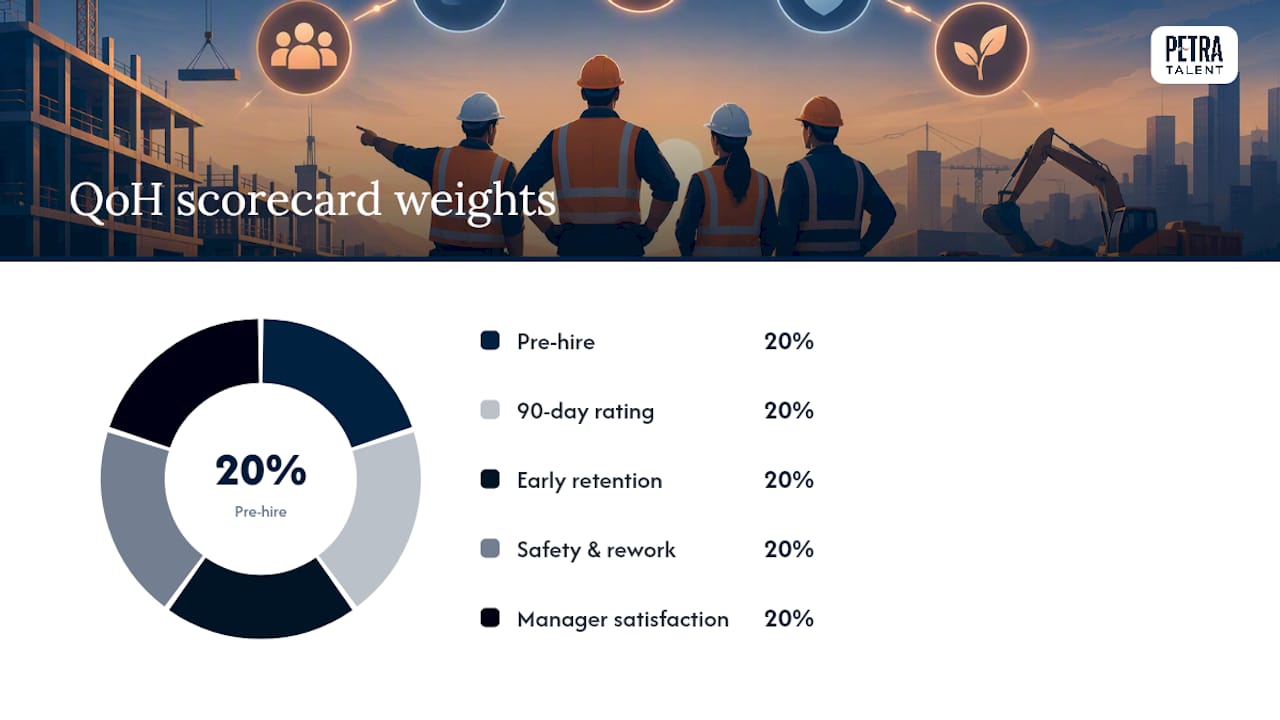
- Pre-hire score — a combined result from a structured interview scorecard and any skills or technical assessment used during screening.
- 90-day manager rating — a short supervisor survey covering output, safety compliance, and teamwork.
- Early retention/ramp — whether the hire is still active at 90 days and roughly how long it took them to reach full productivity.
- Safety and rework score (for field and trade roles) — incidents and NCRs attributed to the hire in the first six months.
- Hiring manager satisfaction — a quick rating of the recruiting process itself: quality of the candidate slate, speed, and communication.
For a starting point, weight these equally and average them into a single composite score. Guidance on building 90-day operating systems for QoH consistently favors simple, explainable scoring over complex weighted formulas, because a number nobody understands never gets used. You can adjust weights later once you have enough hires to see which input actually correlates with long-term success.
Assign clear ownership before you launch. Recruiting owns the pre-hire score. Field supervisors or project managers own the 90-day rating and safety/rework data. HR or a workforce analytics lead owns pulling it together and reporting it monthly.
Pilot this on one role, in one region, before rolling it out company-wide. Pick a role with enough hiring volume to generate data within a quarter, such as HVAC technician or plumber, run the scorecard for 90 days, then review what you learned before expanding.
Screening, Interview, and Onboarding Tactics That Raise Hire Quality
Improving hire quality starts well before day one. The screening stage is where most preventable mis-hires get through.
Build a pre-qualification checklist before you ever schedule an interview. For skilled trades, that means verifying licenses and certifications, reviewing project history or a portfolio of completed work, and checking safety training records. Practical construction hiring guidance recommends short, mobile-friendly pre-screen questions and reference checks that focus specifically on project outcomes rather than generic character references, along with verifying licenses and safety records before candidates move to interviews.
Structured interviews outperform unstructured ones consistently. Use a fixed scorecard with the same core questions for every candidate in a given role, and score responses against defined criteria rather than gut feel. Scenario-based questions work especially well in construction: ask a candidate how they would handle a subcontractor falling behind schedule, or a safety violation they witnessed on a previous job. Answers reveal judgment in a way a resume never will.
Skills checks matter more in the trades than almost any other industry. A brief, realistic technical assessment (a wiring diagram read, a piping layout problem, a tool identification test) filters out candidates who interview well but cannot perform.
Onboarding tactics that reduce early rework:
- Set a documented 30/60/90-day plan with specific milestones tied to the role.
- Schedule structured supervisor check-ins at each milestone, not just an informal “how’s it going.”
- Front-load safety and equipment training in week one, before the hire touches live project work.
Pro Tip: Ask every hiring manager for a copy of their interview scorecard after three months. If two managers are scoring the same role completely differently, your interview process needs recalibration before your data means anything.
Setting Benchmarks by Role: PMs, Superintendents, and Field Trades
Different roles need different measurement cues, because a project manager’s job and a plumber’s job produce entirely different kinds of evidence.
For project managers and superintendents, the strongest early indicators are schedule adherence (are their projects hitting milestone dates), NCR volume on projects under their supervision, and budget variance against original estimates. A superintendent who consistently runs 5 to 10 percent over budget in their first two projects is a signal worth investigating early, not after a full year.
For skilled trades, prioritize first-pass quality (work that passes inspection without rework), safety incident rate, and demonstrated proficiency with the tools and technology specific to the role. A construction-specific QoH composite should map safety and rework directly to supervisor assessments so the score reflects both individual performance and project-level outcomes.
If you have no historic data to benchmark against, start conservative. Set your first-quarter targets using industry-typical ranges rather than aspirational numbers, then tighten them once you have three or four hiring cycles of real data. A contractor tracking schedule adherence for the first time might also lean on a jobsite management tool. Resources like Anodos’s guide to avoiding delays with site-management software show how digital tracking connects field execution back to the hiring decisions that shaped it.
How Specialist Vetting Strengthens Quality of Hire
General staffing approaches often miss the details that predict success on a jobsite. A specialist recruiter working exclusively in HVAC and plumbing brings a different level of scrutiny to the same hiring decision.
Technical vetting for these trades typically covers a checklist built around what actually predicts field performance:
- Active license and certification verification, checked against state and local requirements.
- Documented project history or portfolio review, not just a resume summary.
- Safety training records and any prior incident history.
- A structured technical interview or scenario assessment specific to HVAC or plumbing work.
Contractors working with a recruiter that applies this kind of pre-vetting generally see faster time-to-productivity, since candidates arrive already screened against the role’s real technical demands. That translates into stronger 90-day retention, because fewer hires wash out during the ramp period when expectations and reality collide. Petratalent’s approach to performance-based screening for HVAC and plumbing hiring reflects this same principle: build the vetting into the process, not into the aftermath.
Your First 90 Days: An Implementation Checklist
Standing up a quality-of-hire program does not require a full year of planning. It requires four inputs, one pilot role, and 90 days of discipline.
- Lock your minimum viable data set. Pre-hire score, 90-day manager rating, retention/ramp status, and (for field roles) safety and rework data. Assign an owner to each.
- Choose one pilot role. Pick something with enough hiring volume to generate a readable sample within one quarter.
- Collect consistently for 90 days. Resist the urge to add more metrics mid-pilot. A 90-day operating system works because it stays simple long enough to produce usable data.
- Run a 90-day readout with hiring managers. Review what the scores actually predicted, and adjust weighting if one input turns out to matter more than expected.
Pro Tip: Treat month one as data-collection only. Do not try to act on trends until you have at least two full hiring cycles behind you, or you risk overreacting to noise.
Quick wins to prioritize in the first three months: get the 90-day manager survey live immediately, since it requires no new tooling, and add safety/rework tracking for one field role before expanding company-wide.
Why Trade-Focused Vetting Changes the Math
Most construction hiring programs treat quality of hire as an HR metric to report quarterly. That undersells it. QoH is closer to a leading indicator of project risk, and treating it that way changes what gets measured first.
The construction and skilled trades sector has a structural advantage most industries lack: outcomes show up fast and they show up in numbers everyone already tracks (safety logs, rework tickets, schedule variance). A contractor who links hiring data to those existing systems, rather than building a parallel HR dashboard nobody checks, tends to see faster course correction. One mechanical contractor that started tracking rework by hire cohort found the pattern within two quarters: hires who passed a structured technical assessment before the offer produced roughly half the rework tickets of those who did not. That is the kind of signal a resume review never surfaces.
— David
Where Petratalent Fits Into Your Hiring Strategy
Some recruiting firms position themselves as alternatives to general staffing agencies for contractors who need quality of hire built into the process instead of measured after the fact. Firms focusing exclusively on HVAC and plumbing may provide technical vetting, credential verification, and market wage benchmarking tailored around common failure points in these trades, rather than using generic screening templates applied across unrelated industries.

If you are evaluating any recruiting partner against the framework in this article, ask three direct questions: what evidence do they have of vetting beyond a resume screen, what do their placements look like at the 90-day mark, and can they show you a sample scorecard. Petratalent’s HVAC recruiting services and plumbing recruiting services are built around exactly this kind of technical vetting, and leadership roles are covered separately through leadership and management search. Placement fees run on a straightforward 18% one-time placement fee, with flexible payment options available. Reach out through the pricing page to talk through a role you are struggling to fill and see whether a specialist search changes your 90-day outcomes.
Sources
For deeper methodology on building and scaling a QoH program, review Crosschq’s breakdown of quality of hire metrics, BrightHire’s approach to systems that improve over time, and SHRM’s research on measuring quality of hire.
- Quality of Hire metrics & analytics (Crosschq blog)
- Irecruit
- How to improve quality of hire: a 90-day operating system (Talent Acquisition Strategy)
- The Holy Grail of Recruiting: How to Measure Quality of Hire (SHRM)
FAQ
Is There a Formula for Calculating Quality of Hire?
There is no single universal formula, but a practical approach averages four or five weighted inputs, such as pre-hire assessment score, 90-day manager rating, retention status, and manager satisfaction, into one composite number. Guidance on building QoH systems that improve over time recommends starting with equal weighting and adjusting once you have enough data to see which input predicts long-term performance.
How Do You Determine Quality of Hire in Construction?
You determine it by combining manager performance ratings, retention at 30/90/365 days, time-to-productivity, and field-specific outcomes like safety incidents and rework rates into a single scorecard. Construction-specific benchmarks recommend tying these directly to schedule adherence and supervisor assessments so the score reflects real project impact.
What Are the 5 C’s of Hiring?
Definitions of the “5 C’s” vary across recruiting resources, and no single version applies specifically to construction quality of hire. Rather than rely on an unverified framework, focus on the metrics with direct evidence behind them: manager ratings, retention, time-to-productivity, safety, and rework.
What Is the 70/30 Rule in Hiring?
There is no widely established or verified “70/30 rule” specific to quality of hire in construction hiring. If you encounter this term, treat it as a general heuristic rather than an industry standard, and rely instead on measured inputs like the scorecard outlined above.
How Much Does It Cost to Work With a Specialist Construction Recruiter?
Petratalent charges an 18% one-time placement fee for successful direct hire placements, with flexible payment options available. Contact the pricing page directly for a quote specific to your role and location.
Recommended
Related Posts

October 13, 2026
Recruiting Contract Terms: 10 Checks and Ready to Use Clauses
Define fee triggers, candidate ownership, guarantees, and compliance terms. Get a master agreement, short schedule,…

October 12, 2026
Offer Acceptance Rates: Segment Benchmarks, HVAC’s 3–5 Day SLA
See why a 78% to 82% offer acceptance benchmark can mislead, how role and source…

October 11, 2026
Bad Hires Can Cost Construction Firms 30% to 200% of Salary
Bad hires can cost construction firms 30% to 200% of annual salary. Calculate recruiting, rework,…

October 10, 2026
Construction Labor Forecasting for PMs: 7 Steps to Time Hiring
Learn when construction project managers should use WBS or simulation, track labor KPIs, and turn…

