



The average U.S. plumbing estimator earns $83,002 to $88,897 a year depending on the source, or roughly $40 to $43 an hour. Most estimators earn a range starting from the low $60,000s up to well over one hundred thousand annually depending on experience and region. The gaps below explain why the number moves.
TL;DR:
- Plumbing estimators in large metros like New York City, Boston, and San Francisco tend to earn towards or above the 75th percentile due to higher project stakes and bidding complexity.
- State averages are influenced by union premium scales and cost of living, with California, New York, Massachusetts, and Illinois generally posting higher wages than the national mean.
- Experience significantly impacts pay, with senior estimators earning over $100,000 mainly by leading large bids, owning full packages, and earning industry certifications.
- Estimators fluent in multiple software platforms such as Bluebeam and PlanSwift can negotiate higher wages because they are more versatile across workflows.
- Employers should benchmark regional pay ranges accurately by using multiple sources and local job postings to avoid underpaying experienced estimators or losing candidates to competitors.
Table of Contents
- Plumbing Estimator Salary: National Averages, Percentiles, and Pay Structure
- How Plumbing Estimator Pay Varies by State and Metro Area
- Plumbing Estimator Salary by Experience Level
- What a Plumbing Estimator Actually Does (and Why Titles Get Confused)
- What Drives Plumbing Estimator Pay Up or Down
- Using Salary Data to Negotiate or Set a Pay Range
- Why Experienced Plumbing Estimators Command a Premium
- How Petratalent Helps Contractors Hire and Benchmark Estimator Pay
- Sources
Plumbing Estimator Salary: National Averages, Percentiles, and Pay Structure
Three major compensation platforms track this role, and their numbers cluster close enough to trust the range. ZipRecruiter’s August 2026 data puts the national average at $83,002 per year, or $39.90 an hour. PayScale reports a slightly higher average near $86,837. Salary lands highest at roughly $88,897, or about $43 hourly.
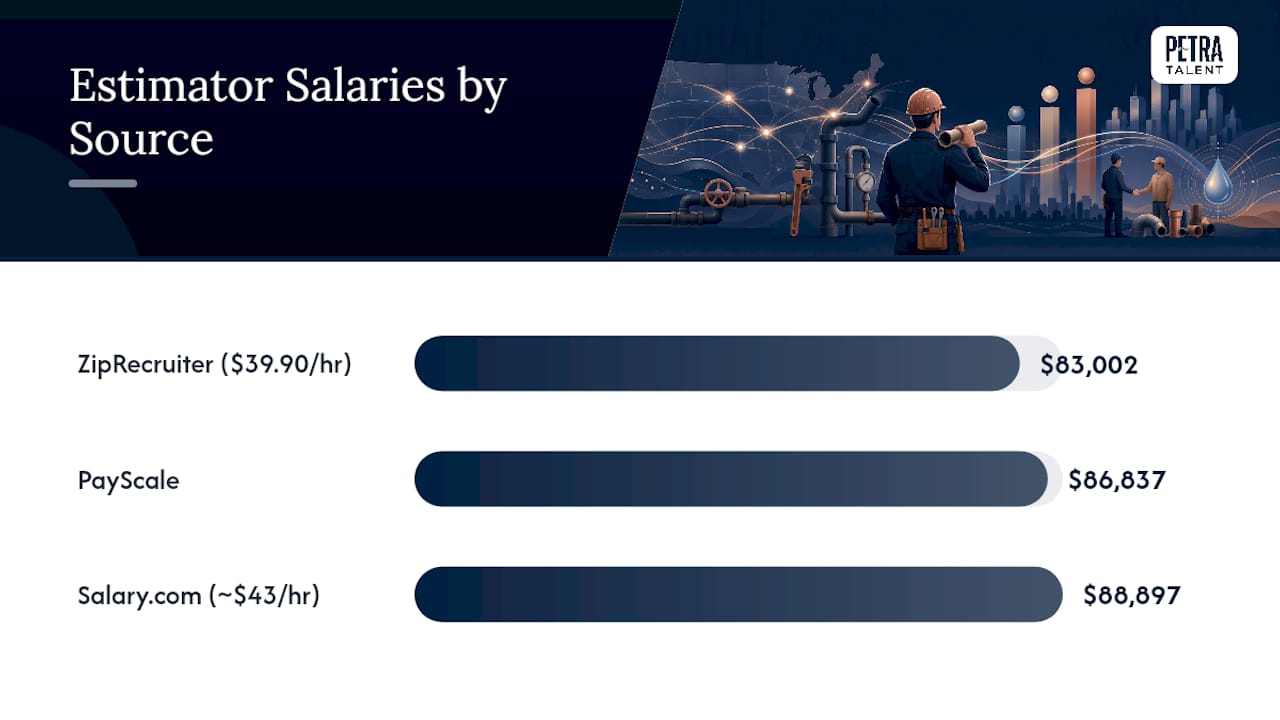
The spread between sources comes down to sample composition. ZipRecruiter pulls from active job postings and aggregated payroll data, PayScale relies on self-reported employee surveys, and Salary.com blends employer-submitted compensation data with its own market-pricing models. None of them is “wrong.” They’re measuring overlapping but not identical populations of estimators.
Percentile breakdowns matter more than any single average for benchmarking your own pay:
- 25th percentile: starting near the low $60,000s annually, typically entry-level or smaller residential shops
- Median: around the high $70,000s, a realistic midpoint for a working estimator with some experience
- 75th percentile: approaching the mid to high $90,000s for estimators handling larger commercial bids
- 90th percentile: exceeding one hundred thousand and up to the mid $130,000 range for senior estimators or those managing large mechanical packages
Quick benchmark: if you’re a plumbing estimator earning less than $62,000 with more than three years of experience, you’re likely underpaid relative to the market.
Base salary rarely tells the whole story. Many employers layer on bonuses tied to bid win rate or project margin, and overtime pay shows up during peak bid season when estimators are racing deadlines. Some larger mechanical contractors also offer profit-sharing for estimators whose bids consistently land accurate.
How Plumbing Estimator Pay Varies by State and Metro Area
Geography moves the number more than almost any other factor. States with dense commercial and industrial construction activity, particularly those with strong union presence, consistently post the highest plumbing estimator wages. California, New York, Massachusetts, and Illinois tend to sit above the national average, often by a noticeable margin driven by union wage scales and a higher cost of living.
Metro areas matter even more than states. Estimators working in and around New York City, Boston, San Francisco, and Chicago routinely see offers at or above the 75th percentile simply because the projects are larger and the bidding stakes are higher. Rural and small-metro markets, by contrast, often settle closer to the 25th to median range, even for experienced estimators.
A few things to keep in mind when comparing postings across regions:
- Union shops typically pay a wage premium but may cap total compensation through fixed scales.
- Non-union commercial contractors in high-growth metros sometimes exceed union rates to compete for scarce talent.
- Cost-of-living adjustments matter less than raw market demand. A $95,000 estimator role in Dallas can outcompete a $100,000 role in a market with a much higher cost of living.
Contractors setting pay ranges should anchor to their specific metro, not the national average, or they’ll lose candidates to local competitors quietly paying more.
Plumbing Estimator Salary by Experience Level
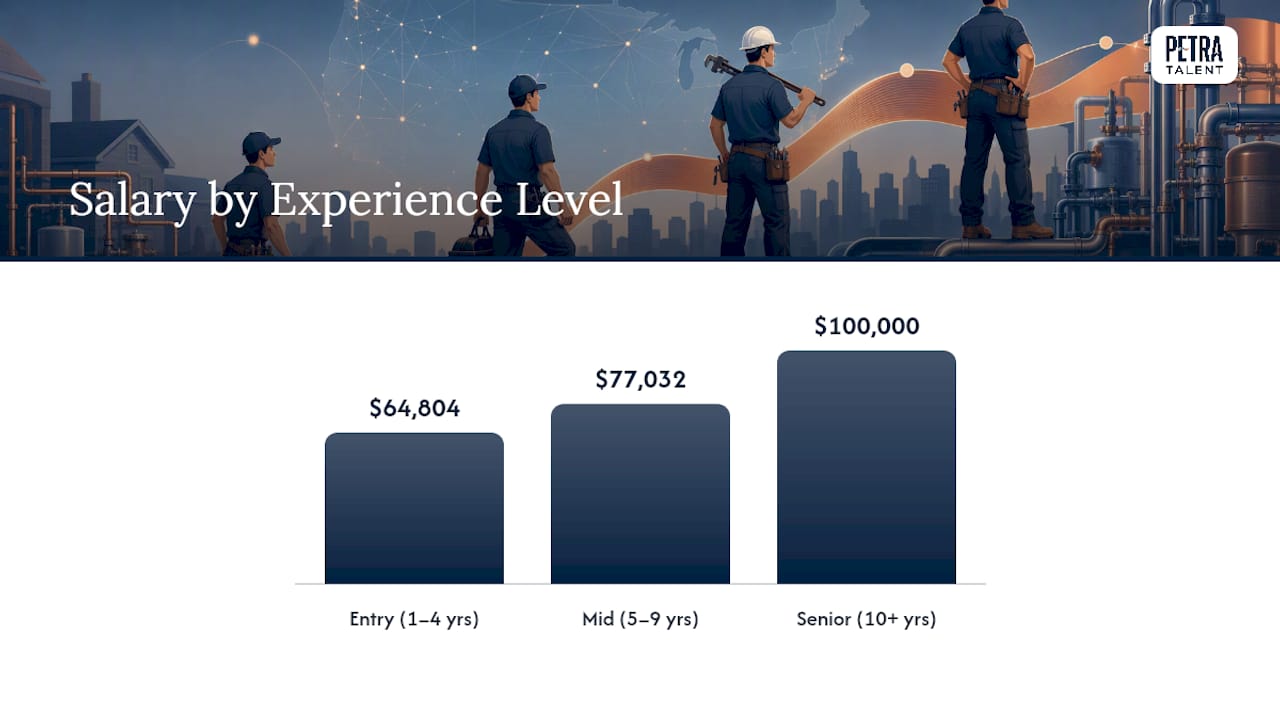
Experience drives pay progression faster in estimating than in most trade roles, because accuracy and speed compound with reps. PayScale’s experience breakdown shows entry-level estimators (one to four years) averaging around $64,804 in total compensation, while mid-career estimators (five to nine years) average closer to $77,032.
Senior estimators with a decade or more of experience routinely clear $100,000, especially once they’re trusted to lead bid strategy on large commercial jobs or defend pricing directly to owners and general contractors. The jump from mid to senior isn’t just tenure. It’s usually tied to:
- Taking ownership of full bid packages rather than assisting on takeoffs
- Building a track record of accurate, winning bids that hold up post-award
- Earning industry certifications through programs covered in plumbing trade certification paths
What a Plumbing Estimator Actually Does (and Why Titles Get Confused)
A plumbing estimator handles material takeoffs, prices labor and equipment, collects vendor quotes, and assembles the final bid package before it goes to a general contractor or owner. That scope sounds simple on paper but requires deep familiarity with code, fixtures, and installation sequencing.
Job boards often blur this title with related ones. A mechanical estimator typically covers plumbing, HVAC, and sometimes fire protection scope, which usually commands higher pay because the workload spans more trades. An MEP estimator covers all three: mechanical, electrical, and plumbing. A chief estimator manages a team and carries executive-level compensation. When comparing salary data, confirm which scope the posting actually means.
What Drives Plumbing Estimator Pay Up or Down
Tool fluency separates average estimators from top earners. Bluebeam Revu remains the leading digital takeoff platform in the industry, and estimators who pair it with PlanSwift and working knowledge of RSMeans cost databases produce faster, more defensible bids. That speed and accuracy translate directly into employer value.
Soft skills matter just as much. Estimators who can defend a bid in front of a skeptical general contractor, or manage vendor relationships under deadline pressure, earn more than those who only build numbers in isolation.
Market conditions add another layer:
- Union shops offer wage stability but less negotiating flexibility.
- Large commercial and industrial projects pay more than small residential work.
- AI-assisted takeoff tools are shifting estimator time from manual measurement toward review and judgment, which increasingly rewards estimators who catch errors rather than just count fixtures.
Pro Tip: If you only know one software platform, learn a second. Estimators fluent in both Bluebeam and PlanSwift routinely negotiate above the median because they can slot into more employer workflows without a training ramp-up.
Using Salary Data to Negotiate or Set a Pay Range
Turning percentile data into an actual number takes a few deliberate steps:
- Identify your experience band (entry, mid, senior) and pull the matching percentile from at least two sources.
- Target the 50th to 75th percentile if you have specialized scope, like large commercial or industrial plumbing work.
- Pull two or three local job postings to confirm the regional adjustment on top of the national figure.
- Bring the percentile and sample sources to the conversation, not just a single number.
Employers should build ranges the same way. Anchoring only to the national average risks losing strong candidates to competitors who priced their local market correctly. A contractor hiring playbook can help formalize that process.
Why Experienced Plumbing Estimators Command a Premium
Qualified estimators are hard to find, and contractors know it. Mechanical subcontractors, commercial plumbing firms, and general contractors building out internal preconstruction teams are all actively competing for the same small pool. Scarcity, not just seniority, is what pushes pay toward the top percentiles. Contractors serious about winning bids should budget for that premium rather than hoping to fill the role at the national median.
— David
How Petratalent Helps Contractors Hire and Benchmark Estimator Pay
Guessing at estimator pay costs contractors more than the salary gap itself. Underpricing a role means losing candidates mid-search to a competitor who moved faster with a realistic offer. Petratalent works exclusively in HVAC and plumbing recruitment, which means market wage benchmarking for a role like plumbing estimator comes from live placement data, not a generic salary survey.

Petratalent’s technical vetting and workforce solutions help contractors confirm a candidate’s takeoff accuracy and bid experience before an offer goes out, so the pay you set actually matches the skill you’re hiring. If you’re building or defending a compensation range for a plumbing estimator role, visit Petratalent’s services page to talk through current market rates for your region and get a hire moving.
Sources
ZipRecruiter, PayScale, and Salary.com each pull from different populations and update on different cycles, which explains the few-thousand-dollar gaps between their averages. Smaller regional samples carry more noise, especially outside major metros.
A few practical checks:
- Salary: Plumbing Estimator (August, 2026) United States
- Plumbing Estimator Salary in 2026 | PayScale
- Plumbing Estimator Salary in the United States
- Bluebeam named highest‑rated construction estimating software of 2025
- 13 costly construction bidding mistakes — how to avoid them
Recommended
Related Posts

September 20, 2026
Construction Offer Letters for HR: Site Assignments, Certs, Petra Tips
HR ready construction offer letters: copy ready language for site assignments, certs, contingencies, and a…

September 19, 2026
Create E-Verify Cases by Day Three: U.S. HVAC & Plumbing Rules
E-Verify for U.S. HVAC and plumbing contractors: who needs I-9s, the three business day case…

September 18, 2026
72.5¢ Rate: Take Home Vehicle Policy for Employers and Agencies
Checklist and policy language for employers and agencies: apply the IRS 2026 mileage rate (72.5…

September 17, 2026
Avoid Overtime Back-Pay: Job-to-Job Travel Pay for U.S. Technicians
U.S. employers: learn DOL/WHD travel-pay tests, a blended rate overtime example, state pitfalls, and Petratalent…