



A healthy interview-to-hire ratio falls between 3:1 and 5:1, meaning it takes three to five completed interviews to produce one hire. Calculate it by dividing total interviews conducted by total hires made in the same period. Ratios climb higher for leadership and specialized technical roles and drop lower for high-volume frontline positions, so track the number by role family and watch the trend rather than chasing one company-wide target.
TL;DR:
- Consistent counting rules for interviews, such as including panel and phone screens equally, are essential for accurate and comparable ratios over time.
- Upstream factors like intake quality, screening rigor, and scoring discipline directly influence the interview-to-hire ratio and should be targeted for improvement.
- Technical vetting and pre-screen assessments for trade roles reduce wasted onsite interviews and speed up the hiring process.
- Tracking upstream ratios alongside ITHR helps identify bottlenecks, with screening and candidate quality being the most common leakiest points.
- Most efficient improvements come from tightening intake criteria and standardizing assessment processes, not from adding more interview rounds.
Table of Contents
- What Does Interview-to-Hire Ratio Actually Measure?
- A Worked Example You Can Replicate
- What Is a Good Interview-to-Hire Ratio by Role Type?
- What Upstream Ratios Actually Drive Your Number?
- How to Improve Your Interview-to-Hire Ratio
- How Do You Measure the Ratio Consistently Across Periods?
- Which Metrics Should You Track Alongside ITHR?
- Applying These Benchmarks to HVAC and Plumbing Hiring
- What I’d Prioritize in Your Next 30-Day Hiring Sprint
- Reduce Interview Load Without Lowering Hire Quality
- Sources
- FAQ
What Does Interview-to-Hire Ratio Actually Measure?
Interview-to-hire ratio (ITHR) is the total number of interviews conducted divided by the total number of hires made over the same period. AIHR’s definition frames it as a straightforward efficiency check: how much interview capacity does your team spend to land one hire? The formula looks simple, but the counting rules underneath it determine whether the number means anything at all.
Get these rules wrong and two teams doing identical work will report wildly different ratios. Here’s how to keep the count consistent:
- Decide what counts as an interview. A 15-minute phone screen and a 90-minute onsite panel are both interviews, but many teams only count the panel stage, which quietly inflates the appearance of efficiency.
- Decide how a panel counts. If four interviewers meet one candidate in a single loop, that can register as one interview event or four interviewer touches. Pick one method and apply it everywhere.
- Match your time windows. Count hires made in March against interviews conducted in March, not against a rolling 90-day interview total that includes candidates still in process.
- Exclude withdrawn or ghosted candidates from the interview count only if you’re consistent about it. Including them without a rule for how skews the ratio unpredictably.
The most common distortion happens when a company changes its counting method mid-year without noting it, so a “ratio improvement” is really just a definition change. Document your rule once and stick to it across every reporting cycle.
A Worked Example You Can Replicate
Say a technical support team ran 45 total interviews last quarter and made 10 hires. Divide 45 by 10 and the interview-to-hire ratio comes out to 4.5:1, comfortably inside the practical band most practitioner benchmarks cite.
Now change only the counting method and watch the number move:
- Panel-as-one counting: Five candidates each go through a 3-person onsite panel, counted as 5 interview events. Add 10 earlier phone screens, and total interviews equal 15. Against 10 hires, that’s a 1.5:1 ratio.
- Panel-as-many counting: The same five onsite panels, counted per interviewer, produce 15 interview touches. Add the same 10 phone screens for 25 total interviews. Against 10 hires, that’s 2.5:1.
- Interpretation: Neither number is wrong, but they’re not comparable to each other or to an outside benchmark unless you know which method produced them.
The takeaway isn’t which method is “correct.” It’s that the method has to stay fixed if you want quarter-over-quarter comparisons to mean anything.
What Is a Good Interview-to-Hire Ratio by Role Type?
A good ratio depends heavily on what you’re hiring for. Frontline and high-volume roles typically convert faster because the screening bar is narrower and candidate supply is deeper. Technical and leadership roles run higher because each stage adds a layer of evaluation, from live coding exercises to executive panel rounds, that filters out more people per hire.
NACE’s benchmarking data on interview-to-offer conversion supports this pattern in campus recruiting, where structured, high-volume programs post noticeably tighter ratios than specialized lateral hiring.
The more useful comparison isn’t your ratio against an industry table. It’s your ratio for “senior project manager” this quarter against the same role last quarter. A drift from 5:1 to 8:1 for an unchanged role tells you something upstream broke, even if 8:1 still sits inside a “normal” band for that role family.
What Upstream Ratios Actually Drive Your Number?
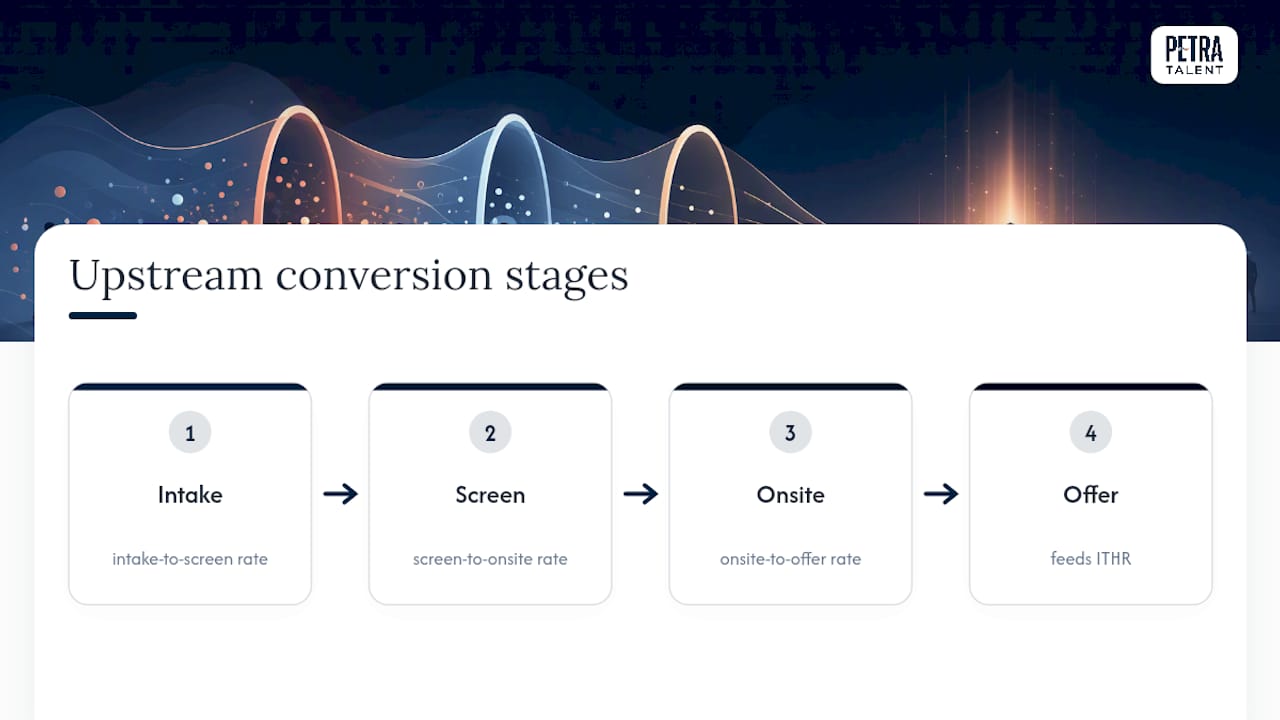
ITHR is a lagging metric. It’s the output of three upstream pass rates multiplying together, and Metaview’s research on interview funnels makes the case that diagnosing those three rates is more useful than staring at the final number:
- Intake-to-screen: the share of applicants who make it from application to an initial recruiter screen. Weak intake alignment with hiring managers fills this stage with unqualified candidates.
- Screen-to-onsite: the share of screened candidates who advance to a full interview loop. Inconsistent screening criteria let too many marginal candidates through.
- Onsite-to-offer: the share of onsite candidates who receive an offer. This is where interviewer rigor and scorecard discipline matter most.
A weak link at any stage inflates ITHR even if the other two stages run well. Loose intake criteria flood the screen stage with noise. Inconsistent interviewer scoring, which Metaview’s interview metrics research associates with lower funnel efficiency, drags down onsite-to-offer. Tight labor markets, tracked in BLS JOLTS data, can also push ratios up simply because qualified candidates have more competing offers and drop out mid-process.
Pro Tip: Before touching your interview process, pull all three upstream ratios for the last two quarters. The stage with the sharpest decline is almost always where the fix belongs, not necessarily where the complaint is loudest.
How to Improve Your Interview-to-Hire Ratio
Reducing ITHR without lowering hire quality comes down to cutting waste earlier in the funnel, not skipping steps later in it. Here’s the order that produces results fastest:
- Tighten intake before you post the role. A 20-minute kickoff between the recruiter and hiring manager to nail down must-have criteria, deal-breakers, and comp range prevents dozens of mismatched interviews downstream.
- Add a pre-interview skill screen or work sample. A short technical assessment or take-home exercise filters out unqualified candidates before they consume a live interview slot, which directly improves screen-to-onsite quality.
- Standardize scorecards across every interviewer. Structured, criteria-based scorecards make onsite-to-offer decisions faster and more consistent, and they cut the debrief meetings that stall a hiring decision by days.
- Compress the panel and debrief instead of adding rounds. A tighter 3-person panel with a same-day debrief beats a sprawling 5-person loop that takes two weeks to reconvene.
- Track time-to-interview and time-to-offer as momentum metrics. Strong candidates disengage when a process stalls, and protecting speed protects your offer-acceptance rate as much as your ITHR.
Run this as a 30 to 45 day pilot on one role family before rolling it out company-wide. Measure the upstream ratios before and after so you know exactly which lever moved the number, rather than crediting the whole bundle of changes at once.
Pro Tip: If you only have time to fix one stage, fix screen-to-onsite first. It’s usually the leakiest point in the funnel and the fastest to repair with a better screening question set.
How Do You Measure the Ratio Consistently Across Periods?
Consistency starts with documenting your counting rules once, in writing, and applying them the same way every reporting cycle. Decide whether a phone screen counts as an interview, whether a panel counts as one event or several, and whether withdrawn candidates are included, then put that definition somewhere everyone on the team can reference.
Pull both sides of the ratio from the same time window using your ATS. Useful export fields include interview stage name, interview date, interviewer count per stage, candidate disposition, and hire date. Cross-referencing these fields lets you rebuild the ratio at the role level instead of relying on a single company-wide export that hides which roles are dragging the average down.
For reporting, present ITHR alongside its upstream components in the same table each quarter. A standalone ratio invites debate about whether it’s “good.” A ratio shown next to intake-to-screen, screen-to-onsite, and onsite-to-offer shows exactly where to focus next.
Which Metrics Should You Track Alongside ITHR?
ITHR tells you how many interviews a hire costs, but it doesn’t tell you whether the process is fast, whether candidates are accepting offers, or whether the people you hire actually stick around. Pair it with:
- Interview-to-offer ratio and offer-acceptance rate, which show whether your onsite stage is calibrated correctly and whether your offers are competitive once extended.
- Applicant-to-interview ratio, which flags whether your job postings and sourcing are attracting the right volume of qualified candidates in the first place.
- Time-to-first-interview, time-to-offer, and time-to-fill, a momentum bundle that protects candidate enthusiasm when you’re actively trying to compress interview loops.
- Quality-of-hire and 90-day attrition, the downstream check that confirms you didn’t just cut interviews faster at the expense of hiring the wrong people.
Watching ITHR in isolation risks optimizing the wrong thing. A ratio that drops because you’re skipping a necessary screening step will show up as a spike in early attrition a few months later.
Applying These Benchmarks to HVAC and Plumbing Hiring
Trade hiring runs on a different risk profile than most corporate roles. A mis-hire on a licensed plumber or HVAC service technician carries safety, licensing, and warranty exposure that a bad hire in a typical office role doesn’t. That’s why credential verification and hands-on technical checks often extend the interview process for trade roles, even when the eventual ratio still lands in a reasonable band.
Petratalent builds technical vetting directly into the sourcing stage rather than leaving it to the interview loop, which is where the biggest gains show up:
- Structured technical screen templates verify licensing, certifications, and hands-on competency before a candidate reaches a contractor’s onsite interview.
- Pre-vetted candidate pools mean fewer unqualified applicants ever enter the interview funnel, tightening intake-to-screen before hiring managers see a resume.
- Role-specific benchmarking for technicians, project managers, and leadership search reflects how technical screening for HVAC and plumbing hiring reduces the live interview load contractors have to carry themselves.
The result for mechanical contractors is fewer wasted onsite interviews and a faster path to a hire who’s already been checked against the job’s real technical demands.
What I’d Prioritize in Your Next 30-Day Hiring Sprint
If you take one thing from this article, measure your three upstream ratios before you touch anything else. Most teams try to fix ITHR by adding more interview rounds, which almost always makes the number worse, not better. Run this instead over the next 30 days: tighten intake criteria with every hiring manager, add one pre-interview screen for your highest-volume role, standardize scorecards across every panel, and report all three upstream ratios alongside ITHR every two weeks. Iterate on whichever stage moves least.
— David
Reduce Interview Load Without Lowering Hire Quality
The fastest way to cut interviews per hire isn’t a scorecard template. It’s not having to interview unqualified candidates in the first place. Petratalent’s technical vetting and workforce solutions screen HVAC and plumbing candidates for licensing, hands-on competency, and job history before a contractor ever schedules an onsite interview, which shrinks the funnel at the stage where most wasted interviews happen.

For contractors filling technician, project manager, or superintendent roles, HVAC recruiting services and plumbing recruiting services apply this same upstream discipline to direct-hire searches, so hiring managers spend interview time on candidates who’ve already cleared the technical bar. Contractors building out leadership teams can also review leadership and management search for roles where credential depth and onsite-to-offer rigor matter most. Teams looking for broader recruiting playbook ideas alongside metric tracking can also review tactical recruiting strategies for additional funnel-building approaches.
Contact Petratalent to run a diagnostic on your current interview funnel and get a role-specific benchmark for your next open search.
Sources
- Interview To Hire Ratio: Definition & How To Calculate – AIHR
- Interview-to-hire ratio is a lagging metric: the 3 upstream ratios actually moving it. · Metaview Blog
- Calculating and using interview-to-offer/offer-to-acceptance rates – NACE
- BLS JOLTS data – U.S. Bureau of Labor Statistics
FAQ
What Is a Good Interview-to-Hire Percentage?
A good interview-to-hire ratio typically falls between 3:1 and 5:1, meaning three to five interviews produce one hire, though technical and leadership roles often run higher.
How Many Interviews Should It Take to Hire Someone?
Most roles land between three and five interviews per hire, but frontline positions can convert closer to 2:1 while leadership searches often need six to eight or more.
What Is the Ratio of Interview to Offer?
Interview-to-offer ratio measures how many interviewed candidates receive an offer, and NACE’s benchmarking data shows this rate varies widely by recruiting program structure and role type.
What Is a Good Interview-to-Application Ratio?
This measures how many applicants get interviewed at all, and it’s driven by sourcing quality and screening rigor rather than the interview stage itself. A tighter applicant-to-interview ratio usually signals stronger upfront screening, which in turn improves your interview-to-hire ratio downstream.
Recommended
Related Posts

October 14, 2026
HVAC Recruiter Fees: Contractors Weigh $10,000 Against Vacancy Costs
See how HVAC recruiter fees work for contractors, from 15% to 25% placement costs to…

October 13, 2026
Recruiting Contract Terms: 10 Checks and Ready to Use Clauses
Define fee triggers, candidate ownership, guarantees, and compliance terms. Get a master agreement, short schedule,…

October 12, 2026
Offer Acceptance Rates: Segment Benchmarks, HVAC’s 3–5 Day SLA
See why a 78% to 82% offer acceptance benchmark can mislead, how role and source…
October 11, 2026
Bad Hires Can Cost Construction Firms 30% to 200% of Salary
Bad hires can cost construction firms 30% to 200% of annual salary. Calculate recruiting, rework,…