



HVAC hiring cost refers to what a contractor pays to recruit and place a new employee, not the wage that employee earns once hired. Agency direct-placement fees typically run 15% to 25% of first-year pay for trade roles, while employer-side recruiting (labor, tools, screening, onboarding) usually adds $4,000 to $20,000 per hire depending on the position. As a rule of thumb, contractors filling lower volumes of roles per year almost always come out ahead using a specialized agency; above that volume, in-house recruiting starts to win.
TL;DR:
- Agency placement fees for HVAC technicians range from 15% to 25% of first-year salary, with total costs including onboarding often reaching $13,000 to $15,000 per hire.
- In-house recruitment becomes more cost-effective than agency hiring when hiring volumes exceed 30 to 50 roles annually, due to spreading fixed costs.
- Temporary staffing costs may seem high with 40% to 50% markups but can be cheaper for short-term projects under 12 weeks because the agency covers taxes and workers’ compensation.
- Success in reducing net hiring costs depends on negotiating volume discounts, standardizing processes, and ensuring clear contract guarantees like 60- to 90-day replacement windows.
- For leadership or hard-to-fill roles, retained or hybrid recruiting models often cost more upfront but offer better guarantees and targeted searches.
Table of Contents
- What Does HVAC Hiring Cost Actually Include?
- How Do HVAC Recruiter Pricing Models Compare?
- In-House vs. Agency vs. RPO: Where’s the Break-Even?
- What Does HVAC Hiring Actually Cost in Practice?
- How Can Contractors Lower Their Net Hiring Cost?
- Where Contractors Waste the Most Money Hiring
- Where Petra Talent Fits Into Your Hiring Budget
- Sources
- FAQ
What Does HVAC Hiring Cost Actually Include?
Every dollar in a hiring budget falls into one of two buckets: the fee you pay a recruiter, or the cost you absorb internally to fill the role yourself. Contractors who only track the first number consistently underestimate their real spend.
Agency placement fees are calculated as a percentage of the candidate’s first-year salary or total cash compensation, generally ranging widely depending on the contract. A contractor’s guide to common hiring mistakes points out that vague fee bases are one of the most frequent disputes between contractors and staffing firms, so pin this down before signing anything.
If you’re building the job yourself, the line items add up fast:
- Recruiter or HR labor hours spent sourcing and screening
- Job board postings and sourcing tools
- Interview time for hiring managers and technical leads
- Background checks, drug screens, and skills assessments
- Onboarding, training time, and equipment setup
- Payroll taxes and workers’ compensation on the new hire
- Lost productivity while the seat sits empty
That last item is easy to overlook and often the largest. A single unfilled HVAC technician role can cost $15,000 to $25,000 once you factor in recruiting time, onboarding, and the revenue that goes uncaptured while trucks sit idle. Costs also shift by role: technician hires need technical vetting for licensing and certifications, while public-sector or government-adjacent contracts often carry prevailing wage and compliance requirements that add administrative overhead to the broader recruiting workload facing HR teams.
How Do HVAC Recruiter Pricing Models Compare?
The fee structure you agree to shape your total cost of hire more than almost anything else in the contract. Four models dominate the trades:
- Contingency: You pay only when a candidate is hired, typically 15% to 25% of first-year salary for skilled trades, sometimes higher for general staffing placements. This is the lowest-risk model for contractors testing a new recruiting partner.
- Retained search: Used for leadership and hard-to-fill roles, retained fees run 25% to 35% and bill in milestones (often a third at kickoff, a third at shortlist, a third at placement) regardless of outcome.
- RPO or embedded recruiter: Per-hire costs commonly land at $1,500 to $3,500, or a flat monthly rate of $8,000 to $15,000 for an embedded recruiter working your pipeline full time. This model gets attractive once you’re hiring in volume.
- Hybrid and success-based models: Blend a smaller upfront fee with a reduced percentage on placement, often paired with replacement guarantees of 60 to 120 days.
Read the guarantee language closely. A 90-day replacement window with no exclusions is worth more than a lower headline percentage with vague SLA terms, especially for roles where technical vetting and workforce compliance matter as much as the resume.
In-House vs. Agency vs. RPO: Where’s the Break-Even?
The math here depends almost entirely on your hiring volume. A fully loaded in-house recruiter, once you add salary, benefits, software subscriptions, and overhead, typically costs $80,000 to $110,000 a year. Spread across a small number of hires, that’s a brutal per-hire rate. Spread across 40 hires, it often beats agency fees outright, since average cost-per-hire across roles sits around $4,683 when volume is high enough to justify the fixed cost.
Here’s a simplified way to think through it:
- Estimate your annual hire count for the role type in question.
- Divide your fully loaded in-house recruiting cost by that number to get a per-hire rate.
- Compare that figure against a contingency agency’s flat percentage of salary for the same role.
- Factor in time-to-fill, since a slower in-house process can cost more in lost productivity than it saves in fees.
Contractors hiring 30 to 50-plus positions a year usually see in-house or RPO models undercut per-hire agency costs. Below that threshold, contingency search almost always wins on total cost.
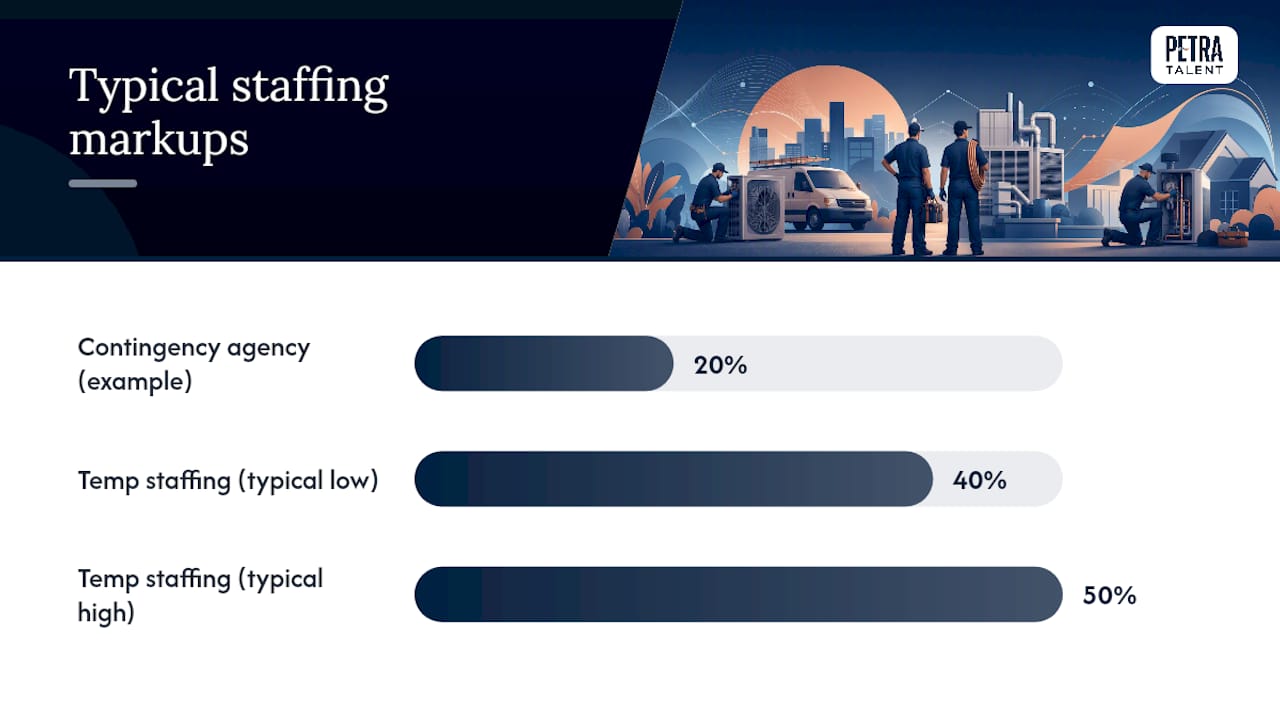
Temp staffing deserves a separate note. Markups typically run 40% to 50% above base pay, which looks expensive on an hourly basis. But for short assignments under about 12 weeks, temp staffing can be cheaper overall because the agency absorbs payroll taxes and workers’ comp, costs you’d otherwise carry directly.
Pro Tip: Don’t judge a staffing option purely on the fee percentage. A 20% agency fee that delivers a vetted technician in three weeks often beats a “free” in-house search that drags on for two months and costs you in lost billable hours.
What Does HVAC Hiring Actually Cost in Practice?
Numbers get clearer with real scenarios. Here are three that map to what contractors actually encounter.
- Scenario 1: Technician via contingency agency. Assume a $60,000 salary and an 18% contingency fee. That’s a $10,800 placement fee, plus roughly $2,000 to $4,000 in employer-side onboarding, licensing checks, and equipment. Total cost to fill: around $13,000 to $15,000.
- Scenario 2: HVAC project manager via retained or hybrid search. Petra Talent’s 2026 wage data puts the median HVAC project manager salary at $95,000. A hybrid model at 22% runs $20,900, spread across milestone payments, plus internal interview time from senior leadership.
- Scenario 3: Steady-volume in-house program. A contractor hiring 35 technicians a year with a fully loaded recruiter cost of $95,000 annually lands at roughly $2,700 per hire once ramp time and tools are included, well under the per-hire cost of a one-off contingency search at that role level.
These figures assume standard licensing requirements and no relocation costs. Adjust upward for leadership roles or markets with tighter technician supply.
How Can Contractors Lower Their Net Hiring Cost?
Reducing what you pay per hire is less about squeezing fee percentages and more about controlling the variables that drive up total cost.
- Negotiate volume discounts or holdbacks tied to hire performance, not just placement.
- Ask about shared-sourcing credits if you’re running multiple searches with one agency simultaneously.
- Standardize your screening and onboarding process so new hires reach full productivity faster; a structured hiring process shortens ramp time measurably.
- Use technical vetting and apprenticeship pipelines to reduce mis-hires, which are the single biggest driver of repeat placement fees.
- Insist on clear contract language: a defined fee base (salary vs. total comp), a candidate ownership window of 6 to 12 months, and a replacement guarantee of at least 60 days.
Pro Tip: Ask any recruiter for their guarantee terms in writing before signing. A vague “we’ll work with you” promise is not the same as a contractual 90-day replacement window.
Where Contractors Waste the Most Money Hiring
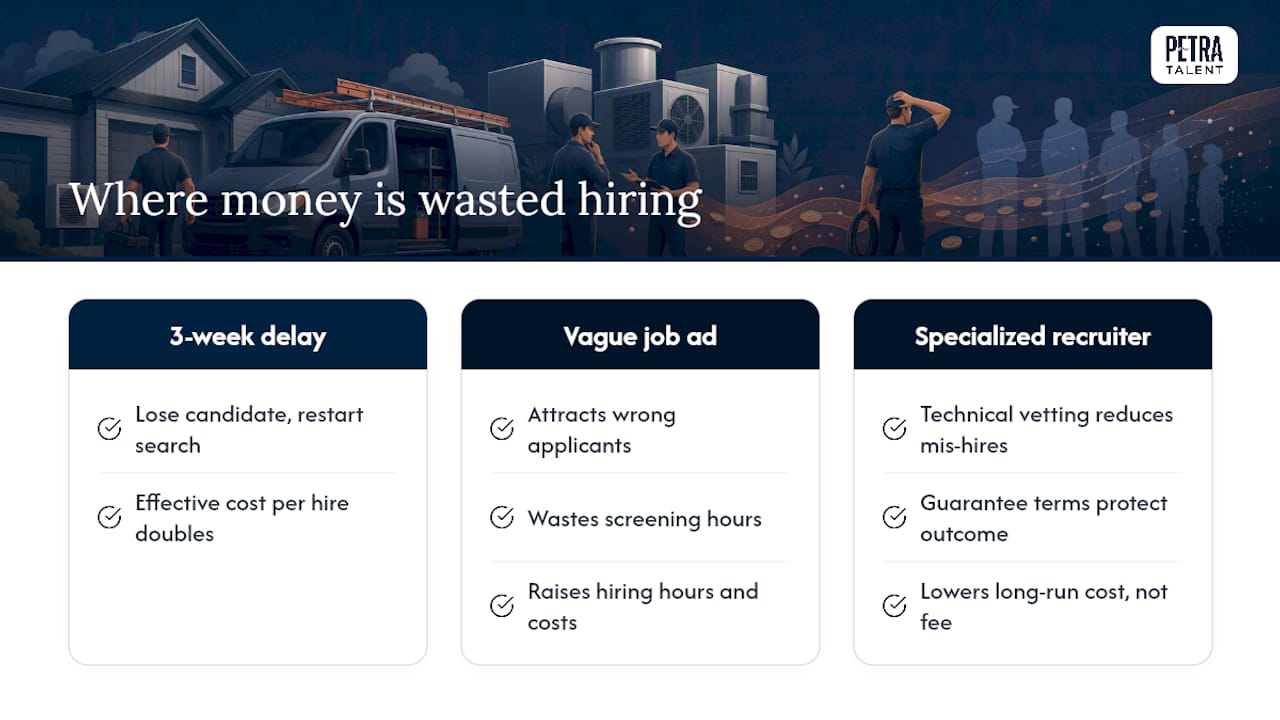
The biggest cost driver isn’t the fee percentage. It’s decision speed. Contractors who take three weeks to approve a candidate lose them to a competitor and restart the search, doubling their effective cost per hire.
Vague job descriptions do similar damage: they attract the wrong applicants and waste screening hours. A specialized HVAC recruiter typically lowers long-run cost not by charging less, but by reducing mis-hires through technical vetting, which is where guarantee terms actually pay off.
— David
Where Petra Talent Fits Into Your Hiring Budget
Petra Talent specializes exclusively in HVAC and plumbing recruiting, with service lines built around direct hire placement, leadership and management search, technical vetting, and workforce consultation. That focus matters most when you’re filling hard-to-fill technician roles, running a leadership search, or scaling a volume hiring program that needs consistent technical screening rather than generalist staffing.

Petra Talent works on a one-time placement fee model, currently 18% of first-year compensation, with flexible payment terms and a focus on long-term retention rather than fast, disposable placements. If you’re weighing whether a contingency search, retained search, or in-house build makes sense for your volume, start by reviewing HVAC recruiting services or requesting current pricing directly.
Sources
- So, How Much Does It Cost to Hire Through a Staffing Agency?
- Skilled Trades Staffing Agency North Alabama (2026) – Vervic | Huntsville Recruiters and HR consulting Blog
- Construction Recruiter Fees — 2026 Guide
- HVAC Staffing Costs 2026: Unfilled, $59,810 | Stealth Agents
FAQ
What Is a Typical HVAC Hiring Cost Per Placement?
Agency direct-placement fees for HVAC technicians typically run 15% to 25% of first-year salary, while replacing a technician entirely (including lost productivity) can reach $15,000 to $25,000. Leadership and project manager roles run higher due to retained search fees.
Is In-House Recruiting Cheaper Than Using an Agency?
It depends almost entirely on volume. Contractors hiring more than 30 to 50 positions a year often see in-house recruiting undercut agency fees, since fixed recruiter salary costs spread thin across more hires; below that threshold, agency placement usually wins on total cost.
How Much Does Petra Talent Charge for Placements?
Petra Talent uses a one-time placement fee model set at 18% of first-year compensation, with flexible payment options available. Exact terms depend on the role and search type.
Are Replacement Guarantees Worth Negotiating?
Yes. Guarantee windows of 60 to 120 days protect contractors from paying twice for the same seat if a hire doesn’t work out, and they’re a standard, negotiable part of most recruiter contracts.
Is Temp Staffing Cheaper Than Direct Hire?
For short assignments under about 12 weeks, temp staffing can be cheaper overall despite markups of 40% to 50% above base pay, since the agency covers payroll taxes and workers’ comp. For permanent roles, direct-hire placement fees are usually the better long-term value.
Recommended
Post a comment
Related Posts

September 20, 2026
Construction Offer Letters for HR: Site Assignments, Certs, Petra Tips
HR ready construction offer letters: copy ready language for site assignments, certs, contingencies, and a…

September 19, 2026
Create E-Verify Cases by Day Three: U.S. HVAC & Plumbing Rules
E-Verify for U.S. HVAC and plumbing contractors: who needs I-9s, the three business day case…

September 18, 2026
72.5¢ Rate: Take Home Vehicle Policy for Employers and Agencies
Checklist and policy language for employers and agencies: apply the IRS 2026 mileage rate (72.5…

September 17, 2026
Avoid Overtime Back-Pay: Job-to-Job Travel Pay for U.S. Technicians
U.S. employers: learn DOL/WHD travel-pay tests, a blended rate overtime example, state pitfalls, and Petratalent…