


An insurance underwriter evaluates risk submissions and makes three core decisions: whether to insure a risk, what price to charge, and what terms and conditions to attach. According to the Bureau of Labor Statistics and O*NET, underwriters work across personal lines property and casualty, commercial lines P&C, life, health, mortgage and loan origination, credit, reinsurance, and specialty lines such as cyber and directors and officers (D&O) liability.
For job seekers, the immediate priorities are building analytical skills, pursuing a CPCU or AU designation once employed, and targeting a trainee or assistant underwriter role at a carrier or managing general agent. For hiring managers, an effective posting must specify the line of business, delegated authority level, required software platforms, and whether the role handles referrals or writes independently.
Key Takeaways
Underwriters make three core decisions on every submission: whether to insure a risk, what price to charge, and what terms to attach, with specialty and commercial roles demanding the most judgment and offering the strongest career trajectory.
| Point | Details |
|---|---|
| BLS employment outlook | Employment is projected to decline 3% from 2024 to 2034, but about 8,200 openings per year arise from replacement needs. |
| Automation split | Personal lines face the most automation pressure; commercial, specialty, and reinsurance roles still require human judgment. |
| Top credentials | CPCU, AU, RPLU, and ARe are the most valued designations; entry-level candidates should start with API or ACU. |
| Hiring manager priority | Specify delegated authority, line of business, and required software in every posting to attract the right experience level. |
| Career milestone | Expanding delegated authority is the clearest signal of underwriter performance and the most concrete resume evidence of growth. |
Table of Contents
- What does an underwriter job description actually cover?
- What types of underwriters are there?
- What skills and qualifications do employers require?
- How do you become an underwriter?
- Where do underwriters work and how do careers progress?
- What is the salary range and job outlook for underwriters?
- What tools and platforms do underwriters use?
- Sample underwriter job description templates
- Certifications and professional organizations worth knowing
- How to write an effective underwriting job posting
- What the conventional advice on underwriting careers gets wrong
- Need help filling an underwriting or technical role?
- Sources
What does an underwriter job description actually cover?
The underwriter job description covers far more than approving or declining applications. The role sits at the intersection of risk analysis, pricing strategy, and portfolio management, and the specific duties shift considerably depending on the line of business.
Daily tasks and decision points
A typical underwriting workday involves:
- Reviewing new and renewal submissions (ACORD applications, loss runs, financial statements, inspection reports)
- Running submissions through automated scoring tools or rating engines and interpreting the output
- Analyzing exposure data, claims history, and financial condition to assess risk quality
- Setting or confirming pricing, coverage limits, and endorsements within delegated authority
- Referring risks that exceed authority limits to a senior underwriter or underwriting committee
- Requesting additional information from brokers or agents when submissions are incomplete
- Renewing, modifying, or nonrenewing existing policies based on updated loss experience
- Negotiating terms with brokers on competitive accounts
- Monitoring portfolio loss ratios and flagging adverse trends to management
The decision flow for a standard submission runs: initial triage and completeness check, automated score or system-generated indication, manual review of flagged items, then a decision to approve as quoted, modify terms, refer upward, or decline.
KPIs used to evaluate underwriters include turnaround time on new submissions, referral hit rate (the percentage of referred risks that ultimately bind), loss ratio on written business, renewal retention rate, and premium volume against plan.
Pro Tip: The clearest signal separating a mid-level underwriter from an entry-level one is delegated authority. An expanding authority limit means the carrier trusts the underwriter’s judgment on larger and more complex risks without a supervisor’s sign-off. Candidates should track and document their authority expansions as concrete resume evidence.
What types of underwriters are there?
Underwriting specializations differ in the inputs evaluated, the degree of automation, and the judgment required. Here is a practical breakdown.
Personal lines P&C (auto, homeowners, renters): Decisions rely heavily on credit scores, driving records, property characteristics, and geographic catastrophe exposure. Automated underwriting handles the vast majority of standard submissions. Human review is reserved for non-standard risks and referrals.
Commercial lines P&C (general liability, commercial property, workers’ compensation, commercial auto): Underwriters analyze financial statements, loss runs, site inspection reports, and industry class codes. Judgment matters significantly here. A commercial property underwriter working in coastal or wildfire-exposed territories increasingly needs to interpret catastrophe model outputs.

Life underwriting: Medical records, attending physician statements, lab results, and lifestyle factors drive decisions. Automated tools handle simplified-issue products; complex cases go to a medical underwriter or chief medical officer.
Health underwriting: Group health underwriters assess employer group demographics, prior claims experience, and benefit plan design. Individual health underwriting in the ACA market is heavily regulated and largely community-rated.
Mortgage and loan underwriting: Underwriters evaluate the three Cs: creditworthiness, capacity to repay, and collateral value. Desktop Underwriter (DU) and Loan Prospector (LP) automated systems handle conforming loans; manual underwriting applies to non-QM and complex borrower profiles.
Credit underwriting: Banks and lenders assess borrower financials, debt service coverage, and collateral for commercial credit facilities. This discipline overlaps with commercial banking and requires strong financial statement analysis.
Reinsurance: Reinsurance underwriters evaluate cedent portfolios, treaty structures, and aggregate exposure rather than individual risks. The role demands strong actuarial literacy and portfolio-level thinking.
Specialty lines (cyber, D&O, professional liability, environmental): These roles carry the highest judgment premium. Cyber underwriters, for example, assess IT security controls, incident response plans, and network architecture. D&O underwriters analyze corporate governance, financial health, and litigation history. Automation plays a minimal role.
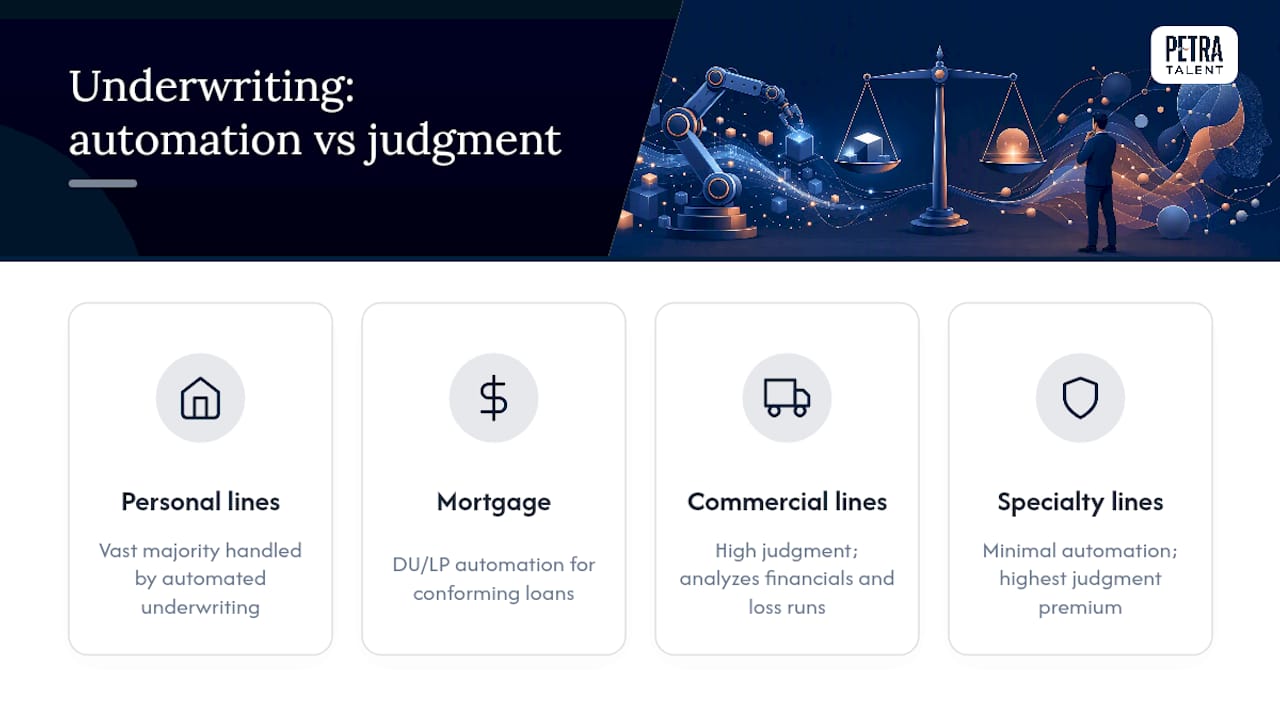
Specialty and senior commercial roles tend to command higher compensation. Personal lines roles face the most direct automation pressure on headcount.
What skills and qualifications do employers require?
The BLS identifies analytical skills, decision-making ability, attention to detail, interpersonal skills, and math aptitude as the core qualities employers look for. Those traits translate into specific hard and soft skill requirements on actual job postings.
Hard skills
- Financial statement analysis (income statement, balance sheet, cash flow)
- Loss-run analysis and loss development interpretation
- Policy form and endorsement reading
- Proficiency with underwriting platforms such as Guidewire, Duck Creek, or carrier-proprietary systems
- Rating engine operation and output interpretation
- Basic catastrophe modeling literacy for property roles (RMS, AIR Worldwide)
- Familiarity with ACORD forms and submission workflows
Soft skills
- Analytical reasoning applied to ambiguous or incomplete data
- Clear written and verbal communication with brokers, agents, and internal teams
- Sound judgment under time pressure
- Negotiation skills for competitive account retention
- Portfolio-level thinking, not just individual risk assessment
Education and experience
Most employers prefer a bachelor’s degree in business, finance, economics, risk management, or a related field. O*NET classifies the role in Job Zone 4, indicating considerable preparation is typical. That said, relevant work experience in claims, brokerage, or financial analysis can substitute for a degree at some carriers, particularly for experienced hires moving laterally.
Certifications
The credentials hiring managers most commonly value are:
- CPCU (Chartered Property Casualty Underwriter): The most recognized designation in P&C insurance. Relevant for commercial and personal lines roles.
- AU (Associate in Commercial Underwriting): A focused credential for commercial lines underwriters, often pursued before CPCU.
- RPLU (Registered Professional Liability Underwriter): Specific to professional liability and specialty lines.
- ARe (Associate in Reinsurance): Valued for reinsurance roles.
- API/ACU (Associate in Personal Insurance / Associate in Commercial Underwriting): Entry-level designations that demonstrate commitment early in a career.
Certifications matter most for advancement into senior underwriting, product management, or underwriting manager roles. At the entry level, employers typically prioritize aptitude and degree over credentials.
How do you become an underwriter?
The path from no experience to a functioning underwriter with delegated authority follows a predictable sequence, though timelines vary by carrier and line of business.
- Earn a relevant bachelor’s degree. Finance, business administration, economics, or risk management are the most common majors. Some carriers also hire from actuarial science or engineering programs for technical roles.
- Target an entry-level trainee or assistant underwriter role. Most carriers and managing general agents offer structured training programs that combine classroom instruction with supervised desk work. These programs typically run 6–12 months.
- Complete the supervised period. New underwriters work under a senior underwriter’s oversight, handling lower-complexity submissions and learning the carrier’s appetite, systems, and referral protocols. Expect to spend the first year building product knowledge and system fluency.
- Earn initial delegated authority. After demonstrating consistent judgment and meeting performance benchmarks, underwriters receive a formal authority limit. This is the first major career milestone. Document it.
- Pursue an entry-level designation. The AU or API designation is a practical first credential to pursue during years one through three. Many carriers reimburse exam fees.
- Specialize and expand authority. By years three through five, underwriters typically move into a defined specialty (commercial property, cyber, professional liability) and take on larger or more complex accounts. Authority limits expand accordingly.
- Pursue advanced credentials. The CPCU is the standard benchmark for senior P&C underwriters. Specialty roles may call for the RPLU or ARe instead. CareerOneStop provides a useful tool for locating accredited programs and certification pathways.
- Move into senior underwriting or management. Senior underwriters handle the most complex accounts, mentor junior staff, and often participate in product development or appetite-setting. The management track leads to underwriting manager, product lead, or portfolio manager.
Practical ways to build relevant experience before landing a trainee role include working in claims (which builds policy and coverage literacy), interning at a brokerage (which builds submission and negotiation knowledge), or taking actuarial coursework (which builds pricing intuition).
Where do underwriters work and how do careers progress?
Most underwriters work in office settings during standard business hours, with significant time spent reviewing documents, operating underwriting systems, and communicating with brokers by phone and email. Remote and hybrid arrangements have become more common at carriers and managing general agents, particularly for experienced underwriters handling accounts that do not require in-person inspections.
Common employer types include:
- Property and casualty insurance carriers (regional and national)
- Life and health insurance carriers
- Managing general agents (MGAs) and managing general underwriters (MGUs)
- Reinsurance companies
- Banks and mortgage lenders (for loan underwriting)
- Specialty markets and Lloyd’s syndicates
The standard career ladder runs: Underwriting Trainee or Assistant Underwriter, Underwriter, Senior Underwriter, Underwriting Manager, and then into product leadership or portfolio management. Non-linear moves are also common. Experienced underwriters frequently transition into claims management (leveraging coverage expertise), actuarial support roles, or brokerage (where underwriting knowledge is a competitive advantage in client advisory work).
O*NET’s sample titles for the occupation include Account Underwriter, Commercial Lines Underwriter, and Personal Lines Underwriter, reflecting how carriers typically structure their underwriting departments by line of business.
What is the salary range and job outlook for underwriters?
The BLS projects employment of insurance underwriters to decline 3 percent from 2024 to 2034, driven largely by automation handling routine personal-lines decisions. Despite that decline, approximately 8,200 openings per year are expected, almost entirely from replacement needs as experienced underwriters retire or move into other roles.
The headline decline masks an important split: personal lines roles face real headcount pressure from automated underwriting systems, while commercial lines, specialty, and reinsurance roles remain in demand because they require judgment that current automation cannot replicate.
Pay varies considerably by experience, line of business, and employer size. Entry-level underwriting trainees and assistant underwriters typically earn less than mid-career underwriters handling complex commercial accounts. Senior underwriters and underwriting managers at specialty carriers or large nationals command the highest base salaries, often supplemented by performance bonuses tied to loss ratio and premium volume targets.
| Experience Level | Typical Role | Key Compensation Drivers |
|---|---|---|
| Entry | Underwriting Trainee, Assistant Underwriter | Degree, line of business, carrier size |
| Mid (3–6 years) | Underwriter, Senior Underwriter | Delegated authority level, specialty, book size |
| Senior (7+ years) | Senior Underwriter, Underwriting Manager | Portfolio P&L responsibility, specialty credentials, team scope |
Factors that move pay upward include a larger delegated authority limit, specialty expertise in high-demand lines (cyber, D&O, excess and surplus), book-of-business ownership, and credentials such as CPCU or RPLU. Regional demand also affects pay; ProjectionsCentral publishes state-level employment projections that hiring managers can use for local benchmarking.
What tools and platforms do underwriters use?
Underwriting is a technology-intensive role. The platforms and tools an underwriter uses daily depend on the line of business, but several categories appear across most specializations.
Policy administration and underwriting systems: Guidewire PolicyCenter and Duck Creek Policy are the most widely cited platforms at mid-to-large carriers. These systems manage the full policy lifecycle from submission through renewal and handle rating, form generation, and endorsement processing.

Rating engines: Standalone or embedded rating tools calculate premium indications based on risk characteristics. Underwriters interpret the output and apply manual adjustments within their authority.
Catastrophe models: RMS and AIR Worldwide (now Verisk) are the standard platforms for property catastrophe exposure analysis. Commercial property underwriters working in wind, flood, or wildfire-exposed territories are expected to read and interpret model outputs.
Automated underwriting systems in mortgage lending: Desktop Underwriter (DU), operated by Fannie Mae, and Loan Product Advisor (LP), operated by Freddie Mac, handle conforming mortgage decisions. Loan underwriters review the automated findings and resolve conditions.
Data and analytics tools: Excel remains a daily tool for loss analysis and portfolio tracking. More experienced underwriters at larger carriers may work with SQL queries or business intelligence dashboards to monitor book performance.
The automation picture is clear: standard personal lines submissions run almost entirely through automated systems, with human review reserved for exceptions and referrals. Complex commercial, specialty, and reinsurance submissions still require human judgment at every step. Underwriters who develop skills in portfolio analysis, manuscript policy drafting, and catastrophe model interpretation are the least exposed to automation displacement.
Sample underwriter job description templates
The templates below are designed for hiring managers to adapt. Adjust the delegated authority limits, software requirements, and specialty-specific language to match the open role.
Personal lines P&C underwriter
Job summary: Review and underwrite personal auto, homeowners, and umbrella submissions within assigned authority. Evaluate risk quality, apply rating guidelines, and communicate decisions to agents and brokers.
Key responsibilities:
- Evaluate new and renewal personal lines submissions against underwriting guidelines
- Apply rating tools and interpret automated scoring outputs
- Approve, modify, or decline risks within delegated authority
- Request additional information from agents when submissions are incomplete
- Monitor renewal book for adverse loss trends and recommend corrective action
Required qualifications: Bachelor’s degree in business, finance, or related field; 1–3 years of personal lines underwriting experience; proficiency with carrier underwriting systems.
Preferred certifications: API, CPCU coursework in progress.
Screening questions: Describe how you handle a submission where the automated score indicates standard eligibility but the loss history raises concerns. What additional information would you request, and what would change your decision?
Commercial lines P&C underwriter
Job summary: Underwrite small-to-mid-market commercial accounts across general liability, commercial property, and commercial auto. Manage an assigned book of business and develop broker relationships.
Key responsibilities:
- Analyze ACORD applications, loss runs, financial statements, and inspection reports
- Price and structure coverage within delegated authority limits
- Negotiate terms with brokers on competitive renewals
- Refer risks exceeding authority to senior underwriter or underwriting committee
- Track portfolio loss ratio and flag adverse segments to management
Required qualifications: Bachelor’s degree; 3+ years of commercial lines underwriting experience; experience with Guidewire or Duck Creek preferred.
Preferred certifications: AU, CPCU.
Screening questions: Walk through how you evaluate a commercial property submission in a coastal market. What data points matter most, and how do you use catastrophe model output in your pricing decision?
Mortgage loan underwriter
Job summary: Underwrite residential mortgage loan files to agency and investor guidelines. Evaluate creditworthiness, income documentation, and collateral to render credit decisions.
Key responsibilities:
- Review loan files for completeness and compliance with agency guidelines
- Analyze credit reports, income documentation, and appraisal reports
- Interpret DU or LP findings and resolve open conditions
- Issue clear-to-close decisions or suspend files pending additional documentation
- Communicate decisions and conditions to loan officers and processors
Required qualifications: 2+ years of mortgage underwriting experience; DE (Direct Endorsement) certification preferred; strong knowledge of Fannie Mae and Freddie Mac guidelines.
Screening questions: A borrower has a 680 credit score, two years of self-employment income, and a debt-to-income ratio of 48 percent. DU returns an Approve/Eligible. What conditions would you require before issuing a clear-to-close?
Underwriting trainee (entry-level)
Job summary: Learn underwriting fundamentals through a structured training program combining classroom instruction and supervised desk work. Develop skills in risk evaluation, policy forms, and carrier systems under senior underwriter mentorship.
Key responsibilities:
- Complete carrier training curriculum covering policy forms, rating, and underwriting guidelines
- Assist senior underwriters with submission review and data gathering
- Process endorsements, certificates, and routine policy changes
- Build familiarity with underwriting systems and rating tools
- Participate in broker calls and account reviews under supervision
Required qualifications: Bachelor’s degree in business, finance, economics, or risk management; strong analytical aptitude; no prior underwriting experience required.
Preferred certifications: None required; API or CPCU enrollment encouraged.
Screening questions: Describe a time you had to make a judgment call with incomplete information. What process did you use, and what would you do differently?
Customization checklist for hiring managers: When adapting these templates, update the delegated authority dollar limit, specify the exact software platforms in use, name the lines of business covered, clarify whether the role handles new business only or both new and renewal, and confirm whether broker relationship management is part of the scope.
Certifications and professional organizations worth knowing
The credential landscape for underwriters is well-organized, with clear entry-to-advanced pathways.
Entry-level credentials:
- API (Associate in Personal Insurance): Covers personal lines fundamentals. A practical first step for personal lines trainees.
- ACU (Associate in Commercial Underwriting): Equivalent entry point for commercial lines.
Mid-career credentials:
- AU (Associate in Commercial Underwriting): Builds on ACU with deeper commercial lines content. Often pursued in years two through four.
- RPLU (Registered Professional Liability Underwriter): The standard credential for professional liability and specialty lines underwriters.
- ARe (Associate in Reinsurance): Designed for reinsurance professionals; covers treaty and facultative concepts.
Advanced credentials:
- CPCU (Chartered Property Casualty Underwriter): The most recognized designation in P&C insurance. Requires passing eight exams and meeting experience requirements. Employers frequently list it as preferred for senior and management roles.
Professional organizations:
- The Institutes: Administers CPCU, AU, ARe, RPLU, and most other P&C designations. Offers study materials, exam prep, and continuing education.
- CPCU Society: The membership organization for CPCU holders. Provides networking, chapter events, and annual conference access.
- National Association of Professional Insurance Agents (PIA): Relevant for underwriters working closely with independent agents.
- Mortgage Bankers Association (MBA): The primary professional organization for mortgage underwriters, offering education and the CMB designation.
CareerOneStop’s certification finder is a practical starting point for candidates researching accredited programs and prerequisites before committing to a credential path.
How to write an effective underwriting job posting
A well-written underwriting job posting attracts qualified candidates and filters out mismatches before the first interview. Vague postings generate volume; specific postings generate quality.
- Write a clear one-paragraph job summary. State the line of business, the account size or complexity, and whether the role is new business, renewal, or both. Candidates self-select based on this paragraph more than any other.
- Specify delegated authority. Include the dollar limit or account size threshold. This single detail tells experienced underwriters immediately whether the role matches their level.
- List required software. Name the specific platforms (Guidewire, Duck Creek, DU/LP, RMS) rather than writing “underwriting systems.” Candidates with the exact experience recognize it; those without know to disclose the gap.
- Separate required from preferred qualifications. Required credentials (DE certification for mortgage, for example) should be listed separately from preferred ones (CPCU in progress). Conflating them deters qualified candidates who lack a preferred but not required credential.
- Include a work sample or case exercise in the screening process. A 15-minute underwriting exercise using a sample submission is the single most effective screen for analytical judgment. It takes less time than a second interview and reveals more.
- Add 3–5 targeted interview questions. Generic behavioral questions produce generic answers. Underwriting-specific questions produce useful signal.
Sample interview questions for underwriting roles:
- Walk me through how you evaluate a new commercial property submission in a market with significant catastrophe exposure.
- Describe a time you declined a risk that the broker pushed back on. How did you handle the conversation?
- How do you monitor your book’s loss ratio, and what actions do you take when a segment starts trending adversely?
- A submission falls just outside your delegated authority. What information do you prepare before referring it to a senior underwriter?
- How do you stay current on emerging risks in your line of business?
- Describe your experience with [specific platform]. What limitations have you worked around?
- How do you balance competitive pricing pressure with underwriting discipline on a renewal account?
Acceptable answer rubric: Strong candidates describe a structured process, reference specific data points they evaluate, acknowledge uncertainty where it exists, and demonstrate awareness of portfolio-level impact. Weak answers focus on following rules without explaining the reasoning behind them.
What the conventional advice on underwriting careers gets wrong
Most career guides treat the BLS’s projected 3 percent employment decline as a warning sign for anyone considering underwriting. That reading is too simple and, for candidates targeting the right specializations, actively misleading.
The decline is concentrated in personal lines, where automated underwriting systems have been replacing routine decision-making for years. The underwriters who are genuinely at risk are those who spend their careers processing standard homeowners and personal auto submissions without building judgment-intensive skills. That is a real and ongoing trend. But it is not the whole picture.
Commercial lines, specialty lines, and reinsurance are different disciplines. A cyber underwriter assessing a mid-market company’s security posture, or a D&O underwriter evaluating a pre-IPO company’s governance structure, is doing work that no current automated system handles reliably. Climate-driven complexity in property underwriting has actually increased demand for underwriters who can interpret catastrophe model outputs and make defensible pricing decisions on difficult risks. The skills that protect against automation are the same ones that command the highest pay: portfolio management, manuscript policy drafting, and the ability to evaluate risks where the data is incomplete or novel.
The second piece of conventional advice worth questioning is the emphasis on credentials as a hiring prerequisite. Certifications matter for advancement, but most carriers hire trainees on aptitude and degree, not designations. Candidates who spend two years accumulating credentials before applying are often outpaced by those who enter a trainee program, earn delegated authority, and then pursue the CPCU while working. The credential has more value when it is attached to real underwriting experience.
For hiring managers, the practical implication is straightforward: a posting that lists CPCU as required for a mid-level commercial lines role will filter out strong candidates who have the judgment but not yet the designation. Listing it as preferred, and using a case-based underwriting exercise to screen for analytical ability, produces a better candidate pool. Petratalent’s insurance job recruiter perspective reinforces this: the most placeable underwriting candidates combine demonstrable judgment, documented authority expansion, and a clear specialty focus, not just a credential list.
The underwriting career is not shrinking. It is sorting. Candidates who specialize early, build portfolio-level skills, and pursue credentials strategically will find sustained demand. Those who stay in commoditized personal lines without developing adjacent skills face real pressure. The guide above is built around that distinction.
Need help filling an underwriting or technical role?

Petratalent specializes in sourcing and vetting skilled professionals for technical and specialized roles across the United States. Whether you need a commercial lines underwriter with a specific platform background or a senior underwriting manager with portfolio P&L experience, Petratalent’s structured screening process identifies candidates who match both the technical requirements and the authority level your role demands. Explore Petratalent’s recruitment and workforce solutions to see how the process works.
Sources
The sources below were used to inform this guide and are worth bookmarking for ongoing reference.
- Insurance Underwriters : Occupational Outlook Handbook
- 13-2053.00 – Insurance Underwriters
- What Is an Insurance Underwriter and What Do They Do?
- Jobdescription
- Careeronestop
Recommended
Related Posts

October 13, 2026
Recruiting Contract Terms: 10 Checks and Ready to Use Clauses
Define fee triggers, candidate ownership, guarantees, and compliance terms. Get a master agreement, short schedule,…
October 12, 2026
Offer Acceptance Rates: Segment Benchmarks, HVAC’s 3–5 Day SLA
See why a 78% to 82% offer acceptance benchmark can mislead, how role and source…

October 11, 2026
Bad Hires Can Cost Construction Firms 30% to 200% of Salary
Bad hires can cost construction firms 30% to 200% of annual salary. Calculate recruiting, rework,…

October 10, 2026
Construction Labor Forecasting for PMs: 7 Steps to Time Hiring
Learn when construction project managers should use WBS or simulation, track labor KPIs, and turn…