



Build a three-tier plumbing technician ladder — Apprentice, Technician, Lead/Foreman, Supervisor — with objective promotion gates (certifications, OJT hours, competency check-offs) and linked pay steps, then roll it out in three incremental phases. To create plumbing technician career paths that actually hold, start with these three actions today:
- Asset map: List every current technician, their credentials, OJT hours logged, and any existing training materials.
- One standardized competency checklist: Draft a single sign-off sheet for your most common service task — pipe installation, fixture replacement, or similar.
- One wage-step rule: Write down exactly what triggers the first pay increase (e.g., 1,000 OJT hours + OSHA 10 card + supervisor sign-off).
A contractor who completes these three steps in the first 30 days has the foundation for a DOL Registered Apprenticeship and a defensible promotion process. Petratalent’s workforce consultation team can accelerate all three steps for contractors who need a faster start.
Key Takeaways
A phased, objective career ladder — built on verified OJT hours, recognized certifications, and signed competency check-offs — is the most reliable way to reduce technician turnover and make promotions defensible.
| Point | Details |
|---|---|
| Start with three assets | Complete an asset map, one competency checklist, and one wage-step rule before anything else. |
| Use objective promotion gates | Require OSHA 10, MC3 completion, verified OJT hours, and supervisor sign-off at each level transition. |
| Tie pay steps to gate completion | Document effective dates and use centralized tracking with approval workflows to prevent payroll errors. |
| Pilot on one crew first | Test the checklist and mentor process on a small team before company-wide rollout to catch gaps cheaply. |
| Petratalent accelerates the process | Petratalent provides market wage benchmarking, role-profile templates, and ladder-ready candidate sourcing for U.S. mechanical contractors. |
Table of Contents
- How do you create plumbing technician career paths that actually work?
- What role levels should a plumbing technician ladder include?
- Which certifications and benchmarks should gate promotions?
- How should you design pay ladders tied to skill gates?
- What does an effective onboarding and mentorship framework look like?
- How do you build a steady apprenticeship pipeline?
- What are the concrete implementation steps?
- How do you measure progress and enforce promotion rules?
- What are the U.S. apprenticeship compliance requirements?
- What templates and tools should contractors use?
- The case for starting smaller than you think you need to
- Petratalent supports contractors building career ladders
- Sources
How do you create plumbing technician career paths that actually work?
The answer is phased implementation. Plumbing & Mechanical’s reporting on staged apprenticeship programs shows that contractors who try to launch a full program at once routinely stall, while those who start with structured onboarding, then add consistency, then add accountability produce measurably more independent technicians.
| Phase | Timeline | Owner | Minimum Deliverables |
|---|---|---|---|
| Phase 1: Pilot | Months 1–3 | Operations lead | Asset map, one competency checklist, one wage-step rule, mentor assigned |
| Phase 2: Standardize | Months 4 and later | HR + field supervisor | Full leveling matrix, all role profiles written, training calendar live |
| Phase 3: Accountability | Months 10–12+ | Leadership + HR | KPI dashboard, quarterly evaluations, promotion packet process |
- Phase 1 runs on a single crew or region to reduce risk before company-wide rollout.
- Phase 2 locks in consistent documentation across all field teams.
- Phase 3 ties metrics to pay decisions and business planning.
Pro Tip: Pilot on your smallest crew first. A five-person team gives you real data on what the checklist misses without disrupting your largest revenue-generating jobs.
Aligning the ladder to where the business will be in one to three years keeps it strategic rather than reactive. Plumbing & Mechanical’s talent strategy guidance recommends asking simple leadership questions — “Which capabilities do we need in 18 months?” — and using hiring scorecards and quarterly check-ins to stay on track.
What role levels should a plumbing technician ladder include?
A four-level ladder fits most small-to-mid-size mechanical contractors. Larger operations can split Senior Technician into a specialty track.
| Level | Core Responsibilities | Minimum Credentials | OJT Hours |
|---|---|---|---|
| Apprentice | Assisted installs, material handling, tool prep | OSHA 10, MC3 enrollment | Up to 2,000 |
| Technician | Independent service calls, basic diagnostics | State registration/license (where required), MC3 completion | 2,000–4,000 |
| Senior Technician | Complex diagnostics, mentors apprentices | Journeyworker license or equivalent, OSHA 30 preferred | 4,000–8,000 |
| Lead/Foreman | Crew coordination, job-site quality control | Journeyworker + leadership competency sign-off | 8,000+ |
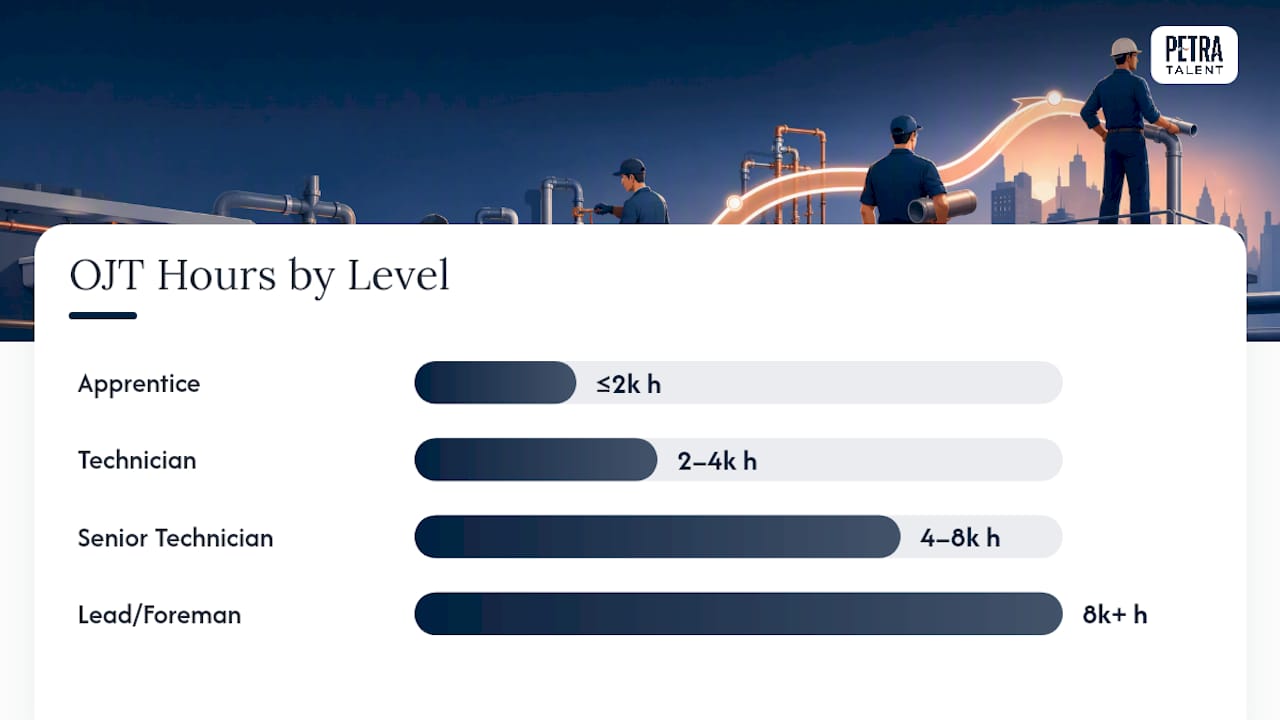
Each level requires a competency sign-off from a direct supervisor before promotion is eligible. Plumbing service technician specializations vary by market, so contractors should add specialty columns (medical gas, backflow, fire suppression) to the matrix where relevant.
A skills matrix using a 1–4 rating scale — 1 = no exposure, 4 = can teach it — maps each technician against five skill bands: technical, safety, customer communication, digital tools, and leadership. This makes gaps visible before a promotion conversation happens, not during it.
Sample role profile — Technician (Level 2):
- Title: Plumbing Technician II
- Reports to: Lead/Foreman
- Core duties: Independent residential and light-commercial service, basic leak diagnosis, fixture installation
- Required certs: OSHA 10, state plumbing registration, MC3 completion certificate
- OJT hours: 2,000 minimum, verified and logged
- Competency gates: Supervisor sign-off on 12 core task check-offs
- Pay band: Tied to Step 2 wage schedule (see wage section)
Which certifications and benchmarks should gate promotions?
Objective gates remove the gut-feel promotion decisions that erode trust and drive turnover. FASA’s retention research recommends making formal certifications prerequisites for advancement into supervisory roles specifically to eliminate subjectivity.
Core certification gates by level:
- Apprentice → Technician: OSHA 10 card, MC3 completion, 2,000 verified OJT hours, supervisor sign-off on core task checklist
- Technician → Senior Technician: State journeyworker license (or equivalent registration), OSHA 30 preferred, 4,000 OJT hours, written evaluation score above threshold
- Senior Technician → Lead/Foreman: Leadership competency sign-off, JATC-recognized credential or equivalent, 8,000 OJT hours
The Multi-Craft Core Curriculum (MC3), developed through NABTU, provides a standardized foundational curriculum that feeds directly into registered apprenticeship programs. OSHA 10 is the floor for field entry; OSHA 30 is appropriate for anyone moving into a supervisory role.
A simple decision gate reads: “Must hold [cert] + [OJT hours] + supervisor sign-off to be eligible for promotion review.” Writing that rule down and posting it removes the perception that promotions are political.
How should you design pay ladders tied to skill gates?
Wage steps work best when they are automatic on meeting a gate, not discretionary. GoSprout’s guidance on apprentice wage progression recommends centralized tracking with automated alerts 40–80 hours before a technician reaches eligibility, an approval workflow, and direct payroll integration to prevent errors on Davis-Bacon and other funded projects.
| Step | Trigger | Pay Structure |
|---|---|---|
| Step 1 (Apprentice) | Program enrollment + OSHA 10 | 50% of journeyworker rate |
| Step 2 | 1,000 OJT hours + competency check-off | About half the journeyworker rate |
| Step 3 | 2,000 OJT hours + MC3 completion | More than half the journeyworker rate |
| Step 4 (Technician) | State registration + supervisor sign-off | 75–80% of journeyworker rate |
| Journeyworker | Full licensure + 8,000 OJT hours | 100% (market-benchmarked) |
Payroll rules to set now:
- Document the effective date of each wage step in writing before it triggers.
- Use market wage data to set the journeyworker base rate annually — Petratalent’s market wage benchmarking service provides current regional data for U.S. mechanical contractors.
- Never backdate a wage step; set a 30-day processing window from gate completion to payroll change.
What does an effective onboarding and mentorship framework look like?
- Day 1–5: Safety orientation, OSHA 10 verification, tool inventory, introduction to competency checklist.
- Days 6–30: Shadowing assigned mentor on service calls, first five task check-offs completed, weekly 30-minute debrief with mentor.
- Days 31–60: Independent tasks with mentor oversight, written mid-point evaluation, first wage-step eligibility check.
- Days 61–90: Solo service calls on approved task list, competency checklist 50% complete, formal 90-day review with supervisor.
Mentors are Senior Technicians or Leads who receive a brief orientation on how to run check-offs, log competency, and give structured feedback. Pairing senior technicians as mentors also preserves institutional knowledge and gives experienced staff a less physically demanding career stage — a retention benefit that pay alone cannot replicate, as FASA’s retention roadmap documents.
Weekly micro-training sessions (30–60 minutes, shop-based) cover one skill per session: reading isometric drawings, pressure testing, code references. Blended learning — short video modules followed by a shop simulation — works well for apprentices who are not yet comfortable with classroom-only formats.

How do you build a steady apprenticeship pipeline?
The Building Trades Apprenticeship Readiness Programs (ARPs), operating on the MC3 curriculum through NABTU, provide a repeatable model for recruiting and preparing candidates for registered apprenticeships. NABTU’s ARP guidance covers more than 100 ARPs across the U.S. and lays out asset mapping, stakeholder tables, and ARP implementation planning as the core steps.
Pipeline source checklist:
- Local high school CTE programs and community colleges with plumbing or construction tracks
- Workforce development agencies and community-based organizations
- JATC partnerships for candidates completing pre-apprenticeship training
- Employee referral program (a structured bonus for referring a hire who completes 90 days)
- Experienced-hire conversions: award credit for previous OJT hours with documented verification
For a 6–12 week entry track, contractors can hire plumbing apprentices strategically by setting a minimum qualification bar (valid ID, physical ability to perform field tasks, basic math assessment), running a structured orientation week, and assigning a mentor on day one.
Experienced mid-career hires skip the early steps when they bring verified OJT hours and credentials. A credit-for-previous-experience policy — reviewed by the training coordinator and documented in the technician’s file — places them at the correct ladder step without requiring them to restart from zero.
What are the concrete implementation steps?
- Complete the asset map: List every technician, their current credentials, OJT hours, and any existing training materials.
- Convene stakeholders: Bring together operations, HR, a field supervisor, and at least one senior technician to review the draft ladder.
- Write the ARP implementation plan: Answer who teaches MC3 content, how training is funded, where the training site is, and what the placement strategy is for completers.
- Secure training site and instructors: A shop bay, a classroom, or a community college partnership all work; the key is a fixed schedule.
- Recruit and screen the first cohort: Use a screening committee, published minimum qualifications, and a documented admissions process.
Minimal budget checklist for a pilot:
- Competency checklist printing or digital form setup
- OSHA 10 course fees per apprentice
- Mentor stipend or recognition budget
- Training materials (MC3 curriculum access through NABTU or JATC)
Screening committee essentials: At least one field supervisor, one HR representative, and one senior technician. Document every admissions decision with the applicant’s qualifications and the committee’s rationale.
How do you measure progress and enforce promotion rules?
Essential KPIs to track:
- Apprenticeship completion rate by cohort
- OJT hours logged per technician per quarter
- Competency check-off pass rate
- Retention rate by ladder level at 6 and 12 months
- Rework rate and callback frequency by technician level
| Evaluation Event | Cadence | Required Documents |
|---|---|---|
| Probationary review | 90 days | Competency checklist, supervisor sign-off |
| Mid-year evaluation | 6 months | OJT hours log, cert copies, written eval |
| Promotion packet | At gate completion | All of the above + wage-step approval form |
When a promotion decision is contested, the escalation path is: technician raises concern in writing → HR reviews promotion packet against documented gate criteria → field supervisor and HR manager issue a written decision within 10 business days. Keeping the criteria objective and pre-published is what makes this process defensible.
What are the U.S. apprenticeship compliance requirements?
Sponsors of DOL Registered Apprenticeship programs carry specific non-optional responsibilities. The Northern Mechanical & Iron Range Plumbers & Pipefitters JATC standards illustrate typical requirements: documented OJT and related instruction hours, progressive wage schedules tied to those hours, and apprentice-to-journeyworker ratios that govern scheduling and supervision.
Sponsor responsibilities checklist:
- Register program standards with the state apprenticeship agency or DOL Office of Apprenticeship
- Maintain records of OJT hours, related instruction, evaluations, and wage steps
- Provide a minimum number of related instruction hours per year (typically 144 hours annually under most standards)
- Follow the published apprentice-to-journeyworker ratio (commonly 1:1 or 1:3 depending on state and trade)
- Operate a probationary period (typically the first 500–1,000 OJT hours) with documented evaluation
Registration steps: contact your state apprenticeship agency first; many states have their own registration process that runs parallel to or in place of federal DOL registration. The DOL’s ApprenticeshipUSA portal lists state contacts and program standards templates.
What templates and tools should contractors use?
Core template set:
- Leveling matrix: Columns for skill name, skill band (technical/safety/customer/digital/leadership), rating (1–4), hours required, cert required, approval signature line.
- Competency checklist: Task name, date demonstrated, location, supervising technician name, pass/fail, notes.
- Onboarding timeline: 30/60/90-day milestones, safety checks, mentor meeting log.
- Wage-step table: Step number, trigger criteria, effective date field, payroll approval signature.
- Implementation checklist: One-page version of the Phase 1 deliverables above, printable.
A 1–4 rating scale on the skills matrix drives promotion thresholds cleanly: a technician must reach a rating of 3 or above on all core technical skills before a promotion packet is submitted. Ratings below 3 generate a development plan, not a denial letter.
To convert templates into payroll inputs, export the wage-step table as a CSV with technician ID, step number, trigger date, and approved rate. Most payroll platforms accept this format directly. For audit purposes, retain signed competency checklists and evaluation forms for the duration of the apprenticeship plus three years.
The case for starting smaller than you think you need to
Most contractors who struggle to launch a career ladder share one pattern: they design the full system before testing any of it. A 20-page leveling document that no field supervisor has reviewed is not a career ladder — it is a filing cabinet item.
The contractors who get traction start with one crew, one checklist, and one wage-step rule. They find out quickly what the checklist misses, which mentor assignment does not work, and which gate criterion is ambiguous. Those corrections cost almost nothing in a pilot. They cost significant time and credibility when discovered after a company-wide rollout.
Subjective promotion decisions are the single fastest way to destroy trust in a new ladder. A senior technician who watches a less-experienced peer get promoted because of a personal relationship with the foreman will not stay long. Objective gates — certs, logged hours, signed check-offs — are not bureaucracy. They are the proof that the system is fair.
Petratalent supports contractors building career ladders
Contractors who want to move faster on plumbing career development without building every template from scratch have a direct path through Petratalent. Petratalent’s workforce consultation service provides market wage benchmarking, role-profile templates, and technical vetting frameworks built specifically for U.S. mechanical contractors — so the first phase of your ladder is grounded in real market data, not guesswork about what journeyworker rates look like in your region.

Beyond consultation, Petratalent’s plumbing recruiting services source and vet candidates who are already ladder-ready — apprentices with MC3 exposure, technicians with verified OJT hours, and leads with documented supervisory experience. For contractors building a leadership tier, Petratalent’s leadership and management search places foremen and supervisors who can run the mentorship and evaluation process from day one. Contact Petratalent to schedule a workforce consultation and get your ladder off the ground this quarter.
Sources
- Creating the complete technician | Plumbing & Mechanical
- The Retention Roadmap: How to Structure Career Pathways That Workers Won’t Leave – FASA
- How to Set Up a Building Trades Apprenticeship Readiness Program (MC3/ARP guidance) | NABTU
Recommended
Related Posts

October 13, 2026
Recruiting Contract Terms: 10 Checks and Ready to Use Clauses
Define fee triggers, candidate ownership, guarantees, and compliance terms. Get a master agreement, short schedule,…

October 12, 2026
Offer Acceptance Rates: Segment Benchmarks, HVAC’s 3–5 Day SLA
See why a 78% to 82% offer acceptance benchmark can mislead, how role and source…

October 11, 2026
Bad Hires Can Cost Construction Firms 30% to 200% of Salary
Bad hires can cost construction firms 30% to 200% of annual salary. Calculate recruiting, rework,…

October 10, 2026
Construction Labor Forecasting for PMs: 7 Steps to Time Hiring
Learn when construction project managers should use WBS or simulation, track labor KPIs, and turn…