



The fastest, lowest-risk route to hire mechanical construction foremen is a targeted employer-side process: build a precise Ideal Candidate Profile, run a short mobile screener to filter applicants within 48 hours, then verify licenses, OSHA credentials, and project history before any interview. When your timeline is under three weeks or your internal vetting capacity is limited, engage a specialist recruiter like Petratalent immediately. Your next step: draft a 5-question mobile screener today, notify your referral network, and contact Petratalent for a parallel intake call.
Foremen and supervisory leads typically take 6–8 weeks to fill through standard channels. Starting both tracks at once cuts that window significantly.
Table of Contents
- What does a mechanical construction foreman actually need to deliver?
- How do you vet and technically screen foreman candidates before interviews?
- What should you budget and expect for time-to-hire in today’s U.S. market?
- How should you onboard a new foreman and keep them past 90 days?
- When does engaging a specialist recruiter make more sense than hiring in-house?
- Key Takeaways
- A recruiter’s perspective on what contractors get wrong
- Petratalent places vetted mechanical foremen for U.S. contractors
- Useful sources and further reading
What does a mechanical construction foreman actually need to deliver?
The role is supervisory field leadership, not just senior technician work. A foreman owns crew productivity, schedule adherence, MEP installation quality, safety compliance, and client-facing communication on the job site. Vague resumes that list tasks without outcomes are a signal to probe harder.
Core certifications to require:
- State-issued mechanical, HVAC, or plumbing trade license (verify the specific state’s requirements)
- OSHA 10 at minimum; OSHA 30 preferred for commercial and industrial projects
- EPA 608 certification for refrigerant handling where applicable
- CDL Class B or C if the role involves equipment transport
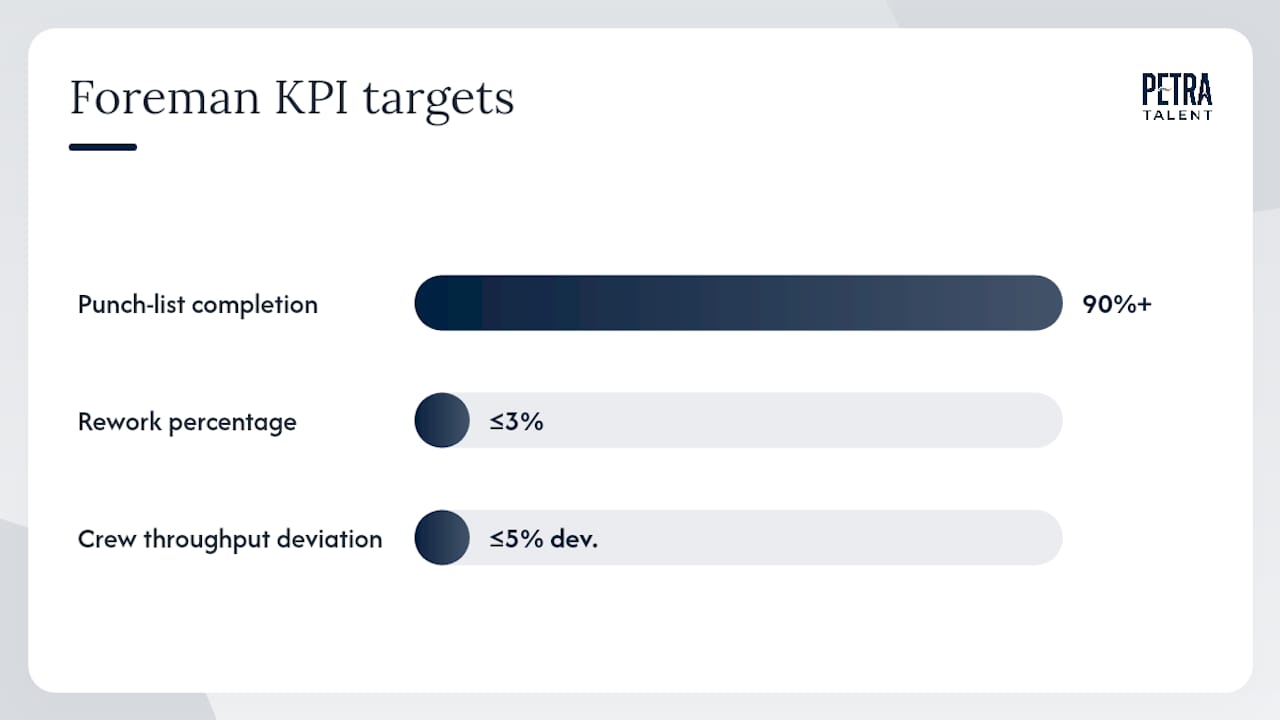
Performance metrics to include on scorecards:
| KPI | Target Benchmark | Why It Matters |
|---|---|---|
| Crew throughput (labor hours vs. budget) | Within 5% of estimate | Directly affects project margin |
| Punch list completion rate | 90%+ within 30 days of substantial completion | Signals quality and close-out discipline |
| Safety incident rate | Zero recordable incidents per project | OSHA compliance and insurance exposure |
| Rework percentage | Under 3% of installed work | Reflects installation quality and supervision |
| Schedule adherence | Milestones met on time — | Client satisfaction and subcontractor coordination |
How do you vet and technically screen foreman candidates before interviews?
Pre-qualifying candidates with documented licenses, OSHA cards, and verifiable project histories reduces hiring risk and speeds placement. Run this sequence before scheduling any in-person or video interview.
Vetting flow:
| Stage | Action | Red Flag |
|---|---|---|
| Mobile screener | Knockout questions: license, project type, travel, availability | Incomplete answers or license claim without number |
| Documentation collection | License copy, OSHA card, project list with roles and square footage | Gaps over 6 months with no explanation |
| Technical verification | Call state licensing board; confirm OSHA card via OSHA’s online portal | License expired, suspended, or in another name |
| Reference outreach | Contact two direct supervisors from the last three years | Supervisor unavailable or unwilling to confirm role |
| Background and drug screen | Per company policy and project owner requirements | Undisclosed violations that surface here |
Escalate to a specialist recruiter when the project involves federal prevailing wage compliance, owner-mandated background clearances, or when your team cannot complete technical verification within the hiring window. Petratalent’s technical vetting services are built specifically for these scenarios.
What should you budget and expect for time-to-hire in today’s U.S. market?
Compensation for mechanical construction foremen varies by project type, union status, and region. The ranges below reflect current U.S. market conditions for direct-hire placements.
| Role Type | Typical Annual Range | Key Variables |
|---|---|---|
| Residential HVAC/plumbing foreman | — | Non-union, service-heavy markets |
| Commercial mechanical foreman | — | Union vs. non-union, prevailing wage |
| Industrial/complex MEP lead | — | Federal projects, specialty systems, travel |
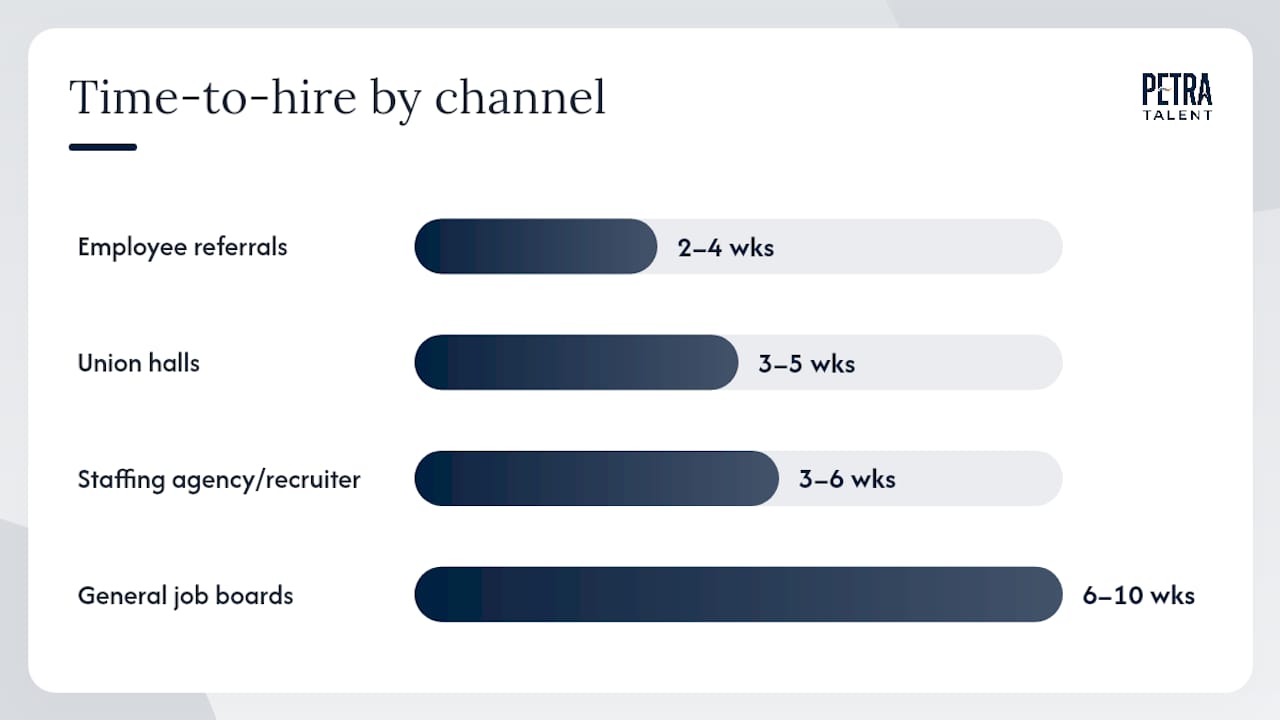
Time-to-hire by channel, based on current hiring channel benchmarks:
- Employee referrals: 2–4 weeks (fastest, highest fit reliability)
- Union halls: 3–5 weeks (credential-verified, but availability varies by local)
- Staffing agency or specialist recruiter: 3–6 weeks (vetted candidates, faster for complex roles)
- General job boards alone: 6–10 weeks (high volume, low signal)
Pro Tip: Calculate the daily cost of a vacant foreman seat before negotiating placement fees. A delayed commercial project can cost far more per day than a one-time direct-hire fee.
Hiring timelines directly affect project schedules. Understanding how time-to-hire impacts budgets helps contractors make the case internally for moving faster on offers.
How should you onboard a new foreman and keep them past 90 days?
Early turnover in supervisory roles is expensive. A structured 30/60/90 plan reduces it by setting clear expectations from day one.
- Days 1–30: Complete admin setup, safety orientation, and site access. Introduce the foreman to the crew, project manager, and key subcontractors. Assign a first project milestone with a defined scope.
- Days 31–60: Review first KPI results against the scorecard. Schedule a structured check-in with the project manager. Identify any training gaps and assign relevant upskilling resources.
- Days 61–90: Confirm retention. Discuss performance pay structure, next project assignment, and career path. Formalize mentoring relationship with a senior superintendent if available.
For long-term pipeline stability, Registered Apprenticeship programs served 480,399 construction apprentices in 2025, a 28% increase over five years. Partnering with a local trade school or sponsoring apprentices builds the foreman pipeline two to three years out.
Retention tactics that work:
- Structured 30/60/90 check-ins (not annual reviews alone)
- Performance pay tied to KPIs from the scorecard
- Tools and equipment readiness on day one
- Clear promotion criteria to superintendent or project manager
When does engaging a specialist recruiter make more sense than hiring in-house?
Use a specialist recruiter when any of these conditions apply:
- The role must be filled in under four weeks
- The project requires federal prevailing wage compliance or owner background clearances
- Your internal team lacks the bandwidth to verify licenses and run reference checks properly
- Previous hires from general boards have underperformed or left within 90 days
Petratalent delivers HVAC and mechanical recruiting services built specifically for these situations: targeted sourcing from trade-specific networks, role-specific technical vetting, documented reference packages, and placement terms that include post-hire follow-up.
Contractors who engage Petratalent receive a candidate presentation with a full technical evidence package: verified license copies, OSHA documentation, project history with outcomes, and reference summaries. The contingency model means contractors pay only on a successful placement, with no retainer required.
The engagement process is straightforward: intake call to confirm the ICP and project context, candidate sourcing and vetting, presentation of qualified candidates, and support through offer and onboarding. For sourcing mechanical leadership talent at the foreman and superintendent level, this structured process consistently outperforms general-board hiring on both speed and 90-day retention.
Key Takeaways
Hiring vetted mechanical construction foremen requires a defined ICP, documented technical vetting, and a realistic timeline of 6–8 weeks through standard channels, with faster channels such as referrals or specialist recruiters able to reduce this to as little as 3–6 weeks depending on project urgency and channel.
| Point | Details |
|---|---|
| Start with a mobile screener | A 5-question knockout screener filters unqualified applicants in 48 hours and protects interview time. |
| Verify credentials before interviews | Confirm license numbers, OSHA cards, and project history through primary sources before scheduling any interview. |
| Budget for realistic timelines | Foremen typically take several weeks to fill; referrals and specialist recruiters can reduce this timeframe significantly. |
| Onboard with a 30/60/90 plan | Structured check-ins and clear KPIs in the first 90 days are the strongest predictor of foreman retention. |
| Petratalent for vetted placements | Petratalent provides technical vetting, direct-hire placement, and post-hire follow-up for mechanical and HVAC contractors. |
A recruiter’s perspective on what contractors get wrong
Most contractors who struggle to recruit mechanical construction leaders are not failing at sourcing. They are failing at speed and documentation. A qualified foreman with options will accept the first reasonable offer that comes with clear project details and a verified pay structure. Contractors who take two weeks to respond to a strong screener-passer have usually lost that candidate to a faster competitor.
The second consistent mistake is treating technical vetting as optional. Skipping license verification or reference checks to move faster almost always produces a slower outcome: a foreman who underperforms, leaves within 60 days, or creates a compliance exposure on a prevailing wage project. The documentation step takes two to three hours. The cost of skipping it can be measured in weeks of project delay.
The contractors who hire well do three things consistently: they define the role in outcome terms before posting, they run a screener the same day the role opens, and they make offers within 24 hours of a completed technical vetting package. That sequence is repeatable regardless of market conditions.
Petratalent places vetted mechanical foremen for U.S. contractors
Mechanical and HVAC contractors who need a vetted foreman placed quickly have a direct option: Petratalent’s HVAC hiring solutions combine role-specific sourcing, full technical vetting, and a contingency placement model with no upfront retainer. Candidates arrive with verified credentials, documented project histories, and reference summaries already completed.
The intake process takes one call. Contractors describe the project scope, required credentials, and timeline. Petratalent sources from trade-specific networks, runs the vetting sequence, and presents qualified candidates with a complete technical evidence package. Post-hire follow-up is included. To start the process, contact Petratalent directly through the HVAC recruiting services page.
Useful sources and further reading
- Construction | Apprenticeship.gov
- How to Hire Construction Workers in 2026: 6 Channels Ranked
- Successful Construction Hiring: The 9-Step 2026 Blueprint
- Pre-Qualified Candidates: Construction Hiring Checklist
- HVAC Interview Questions: What to Ask HVAC Foreman Hires
Recommended
Related Posts
October 13, 2026
Recruiting Contract Terms: 10 Checks and Ready to Use Clauses
Define fee triggers, candidate ownership, guarantees, and compliance terms. Get a master agreement, short schedule,…

October 12, 2026
Offer Acceptance Rates: Segment Benchmarks, HVAC’s 3–5 Day SLA
See why a 78% to 82% offer acceptance benchmark can mislead, how role and source…
October 11, 2026
Bad Hires Can Cost Construction Firms 30% to 200% of Salary
Bad hires can cost construction firms 30% to 200% of annual salary. Calculate recruiting, rework,…
October 10, 2026
Construction Labor Forecasting for PMs: 7 Steps to Time Hiring
Learn when construction project managers should use WBS or simulation, track labor KPIs, and turn…