



TL;DR:
- Hiring a specialized trades recruitment agency helps U.S. contractors access passive candidates and verify certifications faster. It reduces operational delays and improves retention by ensuring candidates meet technical and site readiness standards. Contractors should consider using such agencies when roles are open over 30 days or require specialized skills.
Yes, a U.S. mechanical contractor should hire a specialized trades recruitment agency when filling HVAC, plumbing, or mechanical roles that have been open more than 30 days, require verified certifications, or exceed internal recruiting capacity. Two factors make the difference: Roughly 70% of skilled trades professionals are passive candidates who will never respond to a job posting, and a specialist agency verifies licenses and site readiness before mobilization, cutting the risk of gate delays and early turnover. To move forward, prepare a role brief, a pay range, and a target start date before your first call with Petratalent.
- Access to passive candidates who are employed and not actively searching
- Faster mobilization through pre-placement certification and site-readiness checks
- Reduced operational drag while your projects keep moving
Table of Contents
- What does a specialized HVAC/plumbing recruitment agency actually do?
- How do you decide whether to hire an agency?
- How do agencies source and engage passive candidates?
- What should you expect from the recruitment process?
- Proof it works: Petratalent placements and outcomes
- Contractual considerations when engaging a recruitment agency
- Key Takeaways
- Why specialization is the variable most contractors underestimate
- Petratalent: direct hire, vetting, and workforce planning for contractors
What does a specialized HVAC/plumbing recruitment agency actually do?
A specialized trades recruiter does more than post a job and forward resumes. The core deliverables cover the full hiring cycle: role definition and sourcing, technical screening and trade-specific assessments, license and certification verification, reference and background checks, wage benchmarking, and post-placement onboarding support.
Where a generalist staffing firm relies on job board applicants, a specialized agency maintains active pipelines built from trade associations, journeyperson networks, and direct relationships with working technicians. Specialty recruiters speak the trade language, understand the difference between a service tech and a commercial install lead, and know what certifications a role actually requires. That depth matters when you are hiring for a supervisory plumber or a senior HVAC project manager.
Wage benchmarking is another concrete output. Agencies that provide market benchmarking give contractors current pay-band data so offers are competitive from day one, reducing the risk of losing a candidate at the offer stage.
How do you decide whether to hire an agency?
Use this checklist before committing to an agency search or continuing to hire in-house.
Decision checklist:
- Has the role been open longer than 30 days with no qualified applicants?
- Does the role require specific certifications (EPA 608, master plumber license, NATE) that are hard to verify internally?
- Does the position carry supervisory or project management responsibilities that raise the cost of a bad hire?
- Does your team lack dedicated recruiting bandwidth to source, screen, and coordinate interviews?
- Is the vacancy creating measurable operational impact (delayed projects, overtime costs, service call backlog)?
If you answered yes to two or more, an agency is the faster and lower-risk path. External recruiting handles sourcing, screening, and testing, but the value depends entirely on how deep the recruiter’s technical vetting goes. That is the key question to ask before signing.
Questions to ask any agency:
- What trade-specific assessments do you use, and can we provide our own technical screens?
- How do you verify licenses and certifications before a candidate is presented?
- What is your geographic reach, and do you have active pipelines in our service area?
- What are your guarantee terms and replacement policy if a hire leaves within 90 days?
- Can you provide references from contractors in HVAC, plumbing, or mechanical services?
Red flags to watch for:
- Vague answers about vetting (“we check references” with no specifics)
- No trade-specific client references
- No written guarantee or replacement policy
- Fee structures that are unclear before you sign
Pro Tip: Set two KPIs in writing before the search starts: time-to-fill (target 30–45 days for technician roles) and 90-day retention. Agencies that agree to these benchmarks upfront are accountable to outcomes, not just placements.
How do agencies source and engage passive candidates?
A significant portion of the skilled-trades pool is passive, meaning they are currently employed and not browsing job boards. Accessing this group requires proactive outreach, not reactive posting. This is the single biggest reason contractors working with a specialized agency fill roles that stay open indefinitely when managed in-house.
Sourcing channels a specialized agency uses:
- Trade associations and union membership lists
- Journeyperson and apprenticeship program networks
- Targeted outreach to placed candidates for referrals
- Local trade schools and technical colleges
- Direct LinkedIn outreach to working technicians
- Field referrals from contractors and former placements
Engaging a passive candidate takes a different approach than responding to an applicant. The recruiter must present a compelling employer value proposition tailored to field technicians: compensation transparency, schedule stability, truck and equipment quality, and crew culture. Passive candidates also require longer lead times, often 2–4 weeks of relationship-building before they are ready to interview. Contractors should factor that into their timeline expectations.
Petratalent’s passive candidate recruiting process is built specifically for HVAC and plumbing roles, where the best technicians are rarely available on job boards.

What should you expect from the recruitment process?
A structured trades search follows a predictable sequence, and knowing each stage helps contractors set realistic timelines and budget for fees.
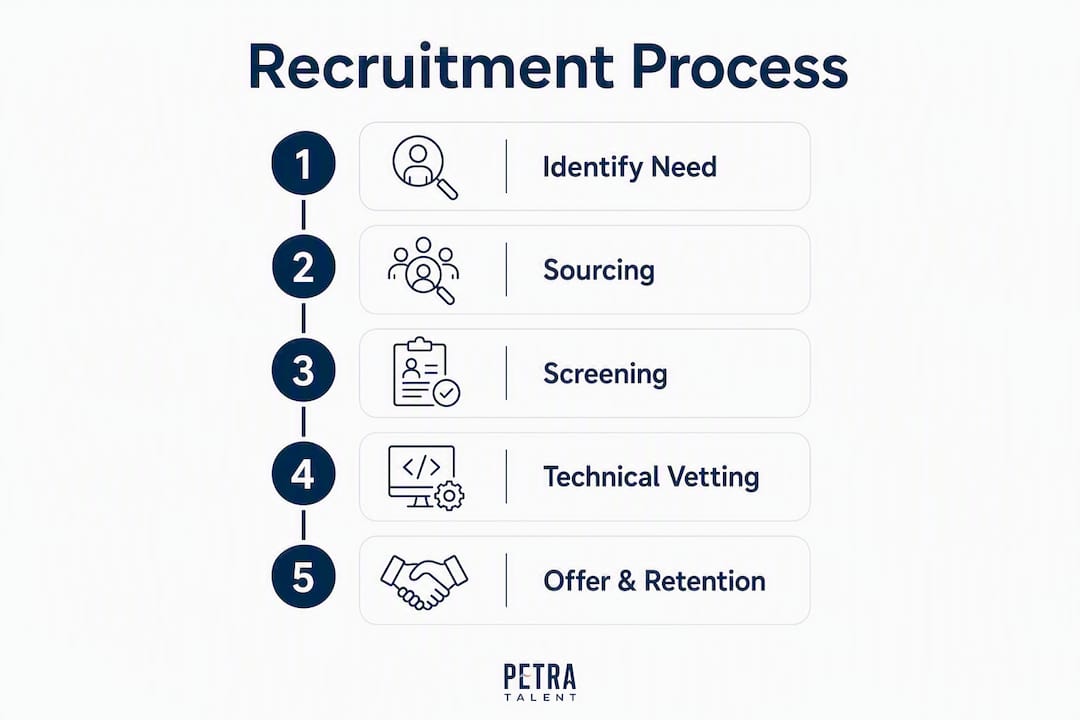
Typical process flow:
- Role brief and intake call — define the role, required certifications, pay band, site details, and start date
- Sourcing — agency activates its pipeline and begins passive outreach
- Screening — initial phone screens to confirm availability, compensation fit, and basic qualifications
- Technical assessment — trade-specific skills evaluation; client-provided technical tests can be incorporated to keep assessments relevant and reduce agency costs
- Interviews — shortlisted candidates presented to the contractor for structured interviews
- Offer and negotiation — agency supports offer framing and compensation negotiation
- Background and license verification — certifications confirmed before mobilization
- Onboarding support — agency checks in at 30 and 90 days to support retention
Timeline ranges by role type:
- Service technician or journeyperson plumber: 21–35 days
- Foreman or lead technician: 30–45 days
- Project manager or superintendent: 45–60 days
- Leadership or executive search: 60–90 days
Fee structures in trades recruiting typically follow two models. Contingency search charges a percentage of the placed candidate’s first-year base salary, paid only on a successful hire. Retained search, used for leadership and management roles, involves an upfront fee with the balance due at placement. Guarantee periods typically run 60–90 days; if a hire leaves within that window, the agency replaces the candidate or refunds a portion of the fee.
When negotiating, ask for staged payments tied to milestones (candidate presentation, accepted offer, 30-day retention) and confirm in writing what the replacement policy covers.
Proof it works: Petratalent placements and outcomes
Petratalent’s placement process is built around technical vetting and mobilization readiness, not just resume forwarding. The agency verifies certifications before a candidate is presented, confirms site access requirements, and conducts role-specific assessments for HVAC and plumbing positions.
| Role Type | Typical Time-to-Fill | Vetting Steps | 90-Day Retention Focus |
|---|---|---|---|
| Service Technician | 21–35 days | Technical screen, license check, reference check | Onboarding check-in at 30 days |
| Foreman / Lead Tech | 30–45 days | Skills assessment, supervisory reference, cert verification | 30- and 60-day check-ins |
| Project Manager | 45–60 days | Behavioral screen, PM competency review, background check | 60- and 90-day check-ins |
| Leadership / Executive | 60–90 days | Full retained search, multi-stage interview, reference deep-dive | 90-day structured onboarding review |
Contractors who engage Petratalent for HVAC workforce planning report fewer mobilization delays because certification issues are resolved before the candidate’s first day. That pre-placement verification step is what prevents the most common and costly form of early turnover: a hire who cannot pass a site gate or fails a license audit on day one.
Contractual considerations when engaging a recruitment agency
Before signing with any trades recruiter, contractors should review the contract on five points.
Fee clarity. The agreement should state the fee as a specific percentage of first-year base salary (not total compensation) and define what triggers payment: accepted offer, start date, or a retention milestone. Ambiguity here leads to disputes.
Guarantee terms. A written replacement guarantee of at least 60 days is standard for technician roles; 90 days is reasonable for supervisory and project management hires. Confirm whether the guarantee is a full replacement, a prorated refund, or a credit toward a future search.
Exclusivity clauses. Some agencies request exclusivity for the duration of the search. This is negotiable. For hard-to-fill roles, exclusivity can focus the recruiter’s effort; for standard technician searches, a non-exclusive arrangement preserves flexibility.
Replacement conditions. Understand what voids the guarantee: termination for cause, role change, or contractor-initiated layoff typically do. Resignation within the guarantee window should trigger a replacement at no additional fee.
Scope of services. The contract should specify what is included: sourcing, screening, technical assessments, background checks, and post-placement check-ins. Services outside the stated scope may carry additional costs.
Pro Tip: Ask for a sample candidate scorecard before signing. An agency that can show you a completed vetting report from a prior placement is demonstrating its process, not just describing it.
Key Takeaways
Specialized trades recruitment agencies deliver the most value when contractors need certified HVAC, plumbing, or mechanical professionals quickly and lack the internal bandwidth to source passive candidates.
| Point | Details |
|---|---|
| Passive candidate access | Roughly 70% of skilled trades professionals are passive; specialist agencies are built to reach them. |
| Mobilization readiness | Verify certifications and site requirements before placement to prevent gate delays and early turnover. |
| Fee and guarantee terms | Get replacement guarantees of 60–90 days and fee triggers in writing before the search starts. |
| Decision triggers | Open roles past 30 days, certified positions, and supervisory hires justify agency investment. |
| Petratalent | Covers direct hire, leadership search, technical vetting, and workforce consultation for HVAC and plumbing contractors across the U.S. |
Why specialization is the variable most contractors underestimate
Most contractors who have used a generalist staffing firm once and walked away frustrated made the same mistake: they evaluated the agency on speed and missed the deeper problem, which was technical fit. A recruiter who cannot read a candidate’s certifications, ask a meaningful question about refrigerant handling, or recognize the difference between a residential service tech and a commercial controls specialist will fill a role fast and create a turnover problem three months later.
The contractors who get the most from a recruitment partnership treat the agency as a workforce planning resource, not a resume vendor. That means sharing your 12-month hiring forecast, your pay bands, your crew structure, and your onboarding process before the first search begins. Agencies with that context source differently. They are not just matching a job description; they are matching a candidate to a crew, a supervisor, and a growth path.
For leadership roles specifically, contingency search is often the wrong model. A superintendent or operations manager search requires a retained engagement because the recruiter needs to invest real time in confidential outreach to candidates who are not looking and would not respond to a job posting. Paying a retainer for that work is not a premium; it is the cost of accessing the right pool.
Petratalent: direct hire, vetting, and workforce planning for contractors
Contractors who need HVAC and plumbing professionals, project managers, or leadership hires without a six-month search process have a direct path with Petratalent. The agency covers HVAC recruiting services, plumbing recruiting services, leadership and management search, technical vetting, and workforce consultation, all built for mechanical contractors in the U.S.

Before your first call, prepare your role brief, the required certifications, your pay band, and your target start date. Petratalent’s intake process is structured to move from brief to shortlist without unnecessary back-and-forth. The agency’s technical vetting and workforce solutions confirm certifications and site readiness before a candidate is presented, so the first day on the job is productive, not a paperwork delay.
Contact Petratalent to schedule an introductory call and submit your role brief at petratalent.com/our-services.
Recommended
Related Posts

October 14, 2026
HVAC Recruiter Fees: Contractors Weigh $10,000 Against Vacancy Costs
See how HVAC recruiter fees work for contractors, from 15% to 25% placement costs to…

October 13, 2026
Recruiting Contract Terms: 10 Checks and Ready to Use Clauses
Define fee triggers, candidate ownership, guarantees, and compliance terms. Get a master agreement, short schedule,…

October 12, 2026
Offer Acceptance Rates: Segment Benchmarks, HVAC’s 3–5 Day SLA
See why a 78% to 82% offer acceptance benchmark can mislead, how role and source…

October 11, 2026
Bad Hires Can Cost Construction Firms 30% to 200% of Salary
Bad hires can cost construction firms 30% to 200% of annual salary. Calculate recruiting, rework,…