



A U.S. plumbing foreman earns a median total pay near $103,000 a year, or roughly $50 an hour, once bonuses and other incentives are factored in, according to Glassdoor’s pay data. Base salary alone typically ranges approximately from $80,000 to $104,000. Actual pay swings widely by state, employer type, and how much additional compensation a contractor offers, so the numbers below break down exactly where a foreman’s paycheck comes from.
TL;DR:
- Location heavily influences pay, with states like California, Massachusetts, and District of Columbia consistently offering higher wages for foremen.
- The median total pay for plumbing foremen hovers around $103,000, but base salaries typically range from $80,000 to $104,000, depending on experience and responsibilities.
- Percentile data shows entry-level foremen earning under $70,000, while experienced and senior foremen can surpass $100,000, especially with bonuses and incentives included.
- Negotiating total compensation should include bonuses, vehicle allowances, project completion rewards, and benefits, which can significantly boost overall earnings.
Table of Contents
- Plumbing Foreman Salary: What the National Data Actually Shows
- How Location Changes Plumbing Foreman Pay
- Percentiles and Pay Components: Where the Real Money Sits
- What Actually Drives a Plumbing Foreman’s Pay
- Career Path: How to Actually Increase Your Pay
- What Contractors Are Actually Paying For
- How Much Experience and Education Actually Move the Number
- Plumbing Foreman vs. Plumber vs. General Foreman: How Pay Compares
- Benefits and Non-Salary Compensation Worth Negotiating
- Why the Same Salary Buys Different Lives Depending on Where You Live
- What the Numbers Feel Like on the Job
- Sources
Plumbing Foreman Salary: What the National Data Actually Shows
Three major sources track this role, and they don’t agree, because they measure different things. The Bureau of Labor Statistics folds foremen into its broader “plumbers, pipefitters, and steamfitters” category, reporting a 2024 median annual wage of $62,970, or $30.27 an hour. That figure undercounts foreman-specific pay because it averages in entry-level plumbers alongside supervisors.
Glassdoor and Salary.com isolate the foreman title specifically, which is why their numbers run higher. Glassdoor’s median total pay sits around $103,000, combining base salary with bonuses and other incentives. Salary puts the average base salary near $92,249, with a typical range of $80,712 to $104,078.
- BLS/O*NET: $62,970 median ($30.27/hr), blends all plumbing trade levels
- Glassdoor: ~$103,000 median total pay, foreman title only
- Salary.com: ~$92,249 average base, $80,712 to $104,078 range
- IAPMO: ~$63,477 average, skews toward entry-level foreman roles
Median means half of foremen earn more and half earn less. Average pulls the number toward high earners, which is why Glassdoor’s total pay figure runs well above the BLS median.
How Location Changes Plumbing Foreman Pay
Geography moves the needle more than almost any other single factor. States with dense commercial construction pipelines and high costs of living consistently report the strongest foreman wages, according to Salary.com’s regional benchmarking.
- District of Columbia: consistently ranks among the top-paying markets for foreman roles
- California: strong commercial and industrial project volume pushes pay above the national base
- Massachusetts: dense hospital and university construction supports higher rates
- Washington: tech-sector building booms keep skilled trade wages elevated
- New Jersey: proximity to New York commercial markets lifts regional pay
City-level gaps within a single state can be just as wide as state-to-state differences.
Before accepting an offer, check your state’s own BLS wage page, search your metro on Salary.com’s local pages, and scan a handful of active job postings in your target city. Posted ranges tell you what the market will actually pay right now, not what a national average implies.
Percentiles and Pay Components: Where the Real Money Sits
Published salary figures rarely tell the whole story unless you look at the spread. BLS data for the broader plumbing trade shows the lowest 10% earning under $40,670 annually, while the highest 10% clear $105,150. Foreman-specific roles sit well above the trade’s lower percentiles, since the title itself requires years of field experience before a contractor hands over crew leadership.
- 10th percentile: entry-level foreman or transitional lead roles, often below $70,000
- 25th to 50th percentile: the bulk of foremen, roughly $80,000 to $92,000 base
- 75th percentile: experienced foremen on commercial or industrial crews, often near $100,000
- 90th percentile: senior foremen with profit-sharing or multi-crew oversight, $105,000 and up
Statistic Callout: Glassdoor reports additional pay for plumbing foremen ranging from $16,000 to $30,000 a year on top of base salary, a gap large enough to separate a mediocre offer from a genuinely competitive one.
Vehicle allowances, per-project bonuses, profit-sharing tied to job margins, and overtime make up most of that additional-pay bucket. A foreman comparing two job offers with similar base pay should ask which one actually pays more once these components are added in.
What Actually Drives a Plumbing Foreman’s Pay
Five factors explain most of the gap between a $65,000 foreman and a $105,000 one, and none of them are mysterious once you see them laid out.
- Experience and management scope: the jump from running one crew to overseeing multiple crews or a full project schedule
- Licensing and certification: journeyman status is table stakes; Master Plumber licensure and demonstrated state code fluency push pay higher
- Employer type and project scale: residential service foremen typically earn less than those running commercial or industrial MEP jobs
- Digital tool fluency: foremen comfortable with platforms like Procore or Bluebeam, or who can manage building IoT sensors, command a pay premium because they reduce rework and communication delays
- Regional demand and union status: union shops and high-demand metros both tend to pay above the national base
Pro Tip: List your Master Plumber license and any project management software experience at the top of your resume, not buried in a skills section. Contractors scanning candidates fast often decide interview or no-interview based on those two lines alone.
Commercial and industrial work, in particular, tends to pay more than residential service because the projects involve larger crews, tighter code requirements, and bigger financial stakes if a schedule slips; this is especially true in commercial plumbing systems where experienced foremen command higher rates Plumbing Engineering | Bazini Engineering, PC.
Career Path: How to Actually Increase Your Pay
The path from plumber to foreman is well worn, but the pay jumps at each stage aren’t automatic. They come from specific moves.
- Get licensed and stay current. Journeyman status opens the door to foreman roles, but Master Plumber licensure and up-to-date code knowledge open the door to the higher end of the pay range.
- Ask for the full package, not just base pay. Negotiate vehicle allowance, project completion bonuses, overtime rate, and retirement matching as separate line items, not vague promises.
- Build scheduling and procurement skills. Foremen who can manage material orders and keep a project on schedule save contractors real money, and that skill is worth negotiating for directly.
- Target the right employer type. Moving from residential service to commercial MEP work, or from a small shop to a larger contractor, often produces a bigger raise than staying put and waiting for a review.
- Use percentile data in the negotiation itself. If Salary.com and Glassdoor both show your target role paying $95,000 to $103,000 in total compensation, say so, and ask why an offer below that range makes sense.
Pro Tip: When a contractor’s initial offer lands near the 25th percentile for your region, ask directly what would move it to the 50th or 75th. Certifications, added responsibilities, and multi-crew oversight are usually the answer.
The move from foreman to project manager or superintendent is where the biggest pay jump tends to happen, since it shifts compensation structure entirely toward salary plus performance bonus rather than hourly-plus-overtime.
What Contractors Are Actually Paying For
Recruiting foremen for HVAC and plumbing contractors surfaces a consistent pattern: pay follows proven reliability more than raw technical skill. Contractors will pay a premium for a foreman who has never blown a schedule, because a delayed commercial job costs far more than the salary difference between a good foreman and a great one.
- Leadership under pressure and consistent crew retention matter more to hiring managers than years of experience alone
- Vehicle allowances and per-project bonuses show up constantly in offers for commercial and industrial roles, often stacking to the $16,000 to $30,000 additional-pay range Glassdoor reports
- Candidates who can document specific project outcomes, on-time completions, avoided cost overruns, safety records, get stronger offers than those who list duties without results
Contractors serious about attracting experienced foremen should structure offers around total compensation, not just a competitive base rate, and candidates should package their experience the same way: results first, credentials second.
How Much Experience and Education Actually Move the Number
Years in the field matter, but not in a straight line. The jump from journeyman to first-time foreman typically adds $10,000 to $15,000 to base pay, reflecting the shift from hands-on plumbing work to crew supervision. The bigger jump comes later, once a foreman has run several projects successfully and can point to a track record of on-time, on-budget completions.
Formal education plays a smaller role in this trade than in most white-collar careers. A four-year degree isn’t standard or expected. What matters instead is a documented apprenticeship, journeyman licensure, and continuing education tied to code updates. Foremen who complete Master Plumber certification, which typically requires several additional years of documented experience plus an exam, tend to sit near the top of the pay range Salary.com reports.
Trade-specific training on plan reading, estimating, and project scheduling adds measurable value too. A foreman who can read commercial MEP drawings and catch a code conflict before it becomes a change order saves a contractor money on nearly every job, and that skill shows up in negotiated pay even without a formal credential attached to it. Contractors increasingly treat these skills as a proxy for the education requirement other industries impose through degrees.
Plumbing Foreman vs. Plumber vs. General Foreman: How Pay Compares
A plumbing foreman sits in the middle of a pay ladder that starts with journeyman plumbers and tops out with general foremen or superintendents overseeing multiple trades on a single job site.
Journeyman plumbers, the role most foremen come from, earn a median wage close to the BLS’s $62,970 figure for the broader trade category. Stepping up to foreman typically adds base pay plus the additional-pay components, vehicle allowance, bonuses, that push total compensation toward the $90,000 to $103,000 range reported by Salary.com and Glassdoor.
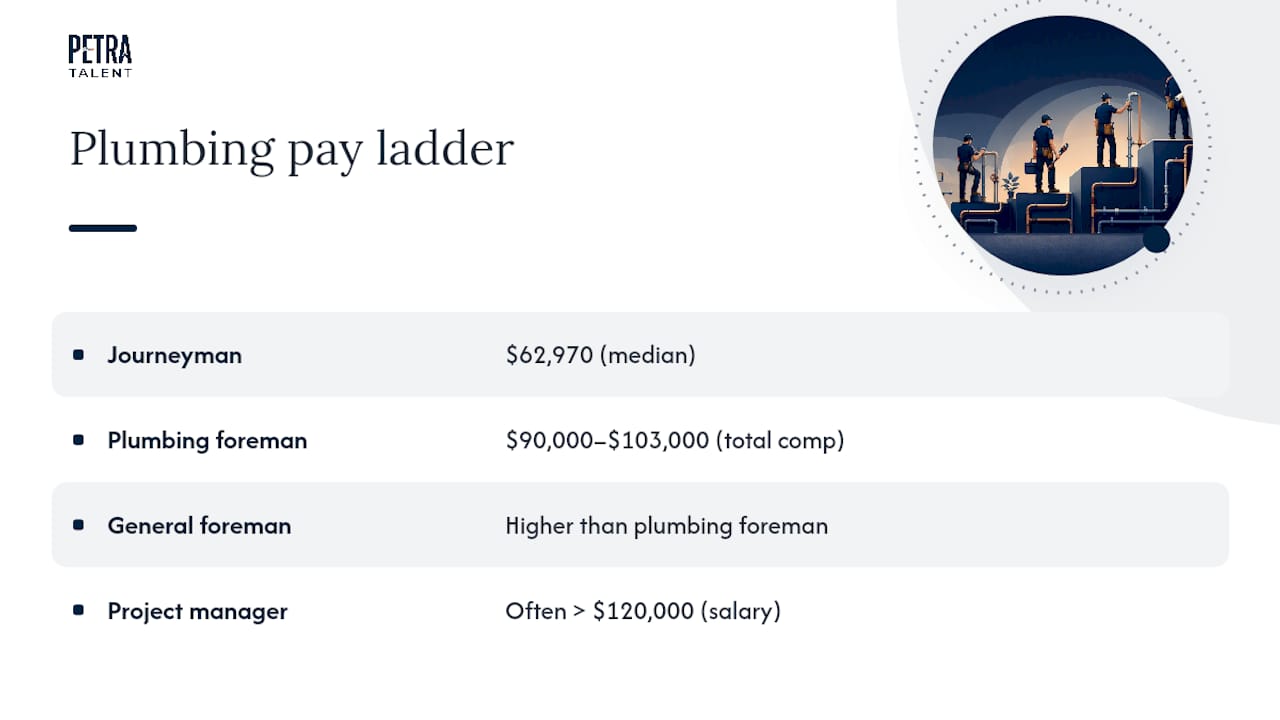
A general foreman, who oversees multiple crews or trades across a larger commercial site, usually out-earns a single-trade plumbing foreman by a meaningful margin, since the role carries broader scheduling authority and higher accountability if the job falls behind. Project managers and superintendents sit above that, often on salary rather than hourly-plus-overtime structures, with total compensation that can exceed $120,000 on large commercial projects.
The practical takeaway: each rung on this ladder adds responsibility before it adds pay. Foremen who want to move toward general foreman or superintendent pay should start building the scheduling, procurement, and multi-trade coordination skills those roles require well before a promotion is on the table.
Benefits and Non-Salary Compensation Worth Negotiating
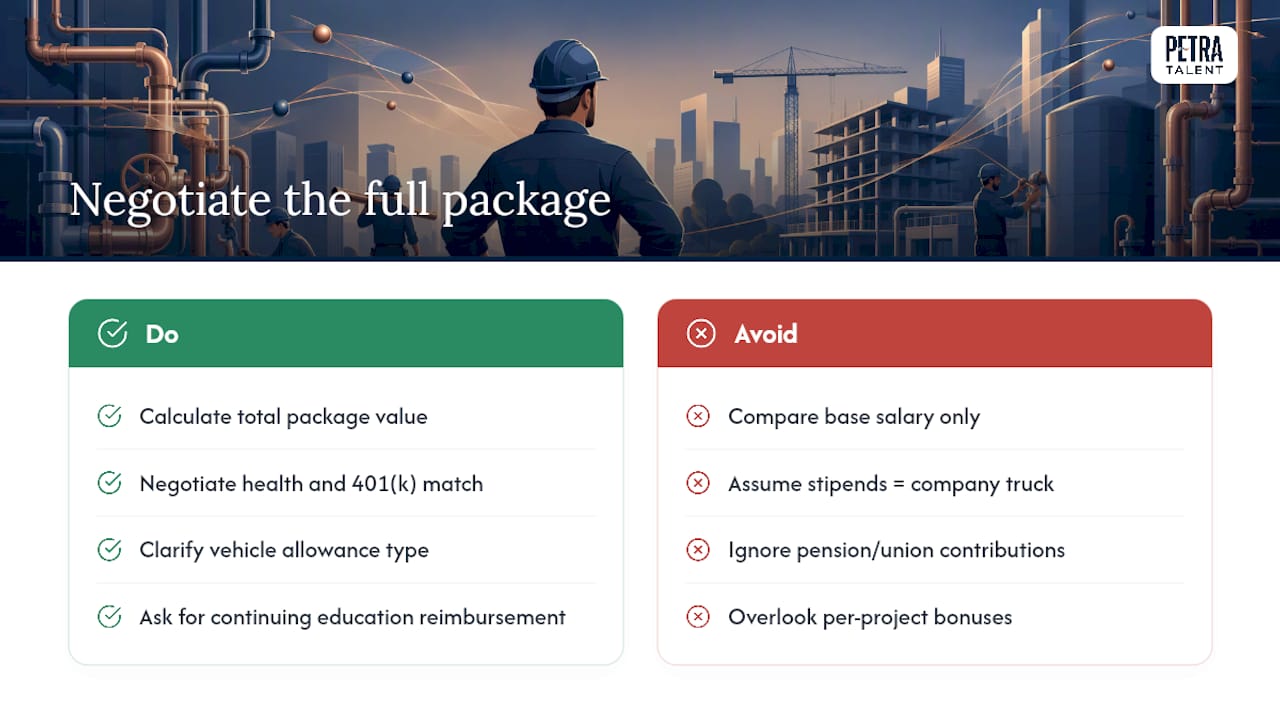
Base salary and bonuses only tell part of the story. Health insurance, retirement matching, and paid time off routinely add thousands of dollars in value to a foreman’s total package, and contractors vary widely in what they offer.
Common non-salary components include employer-sponsored health coverage, 401(k) matching, paid vacation and sick leave, and, for union shops, pension contributions negotiated through the local. Vehicle allowances deserve separate attention here too: some contractors provide a company truck outright, while others pay a monthly stipend that a foreman uses toward their own vehicle, and the dollar value of these two arrangements can differ significantly.
Per-project bonuses and profit-sharing tied to job margins show up more often in commercial and industrial work than residential service, reflecting the larger budgets and higher stakes on those jobs. Continuing education reimbursement, covering the cost of Master Plumber exam prep or code update courses, is a smaller but increasingly common perk that signals a contractor investing in long-term retention rather than just filling a seat.
When comparing two offers, add up the full package rather than comparing base salaries side by side. A $5,000 lower base with strong health coverage and a real 401(k) match can outperform a higher base with thin benefits once the math is done in full.
Why the Same Salary Buys Different Lives Depending on Where You Live
A $95,000 foreman salary in a high cost of living market like Northern California or the Boston metro area doesn’t stretch nearly as far as the same number in a mid-sized Midwestern or Southern city. Housing costs drive most of that gap, but state income tax structure matters too: foremen working in states with no income tax keep meaningfully more of each paycheck than those in high-tax states, even at identical gross salaries.
This is why the highest-paying states on paper aren’t always the best financial move for every foreman. A $103,000 offer in the District of Columbia or California may leave less discretionary income after rent and taxes than an $85,000 offer in a lower-cost state. Anyone comparing offers across state lines should run the numbers through a cost-of-living calculator before assuming the bigger number wins.
The practical move is to treat the national and state salary figures in this article as a starting point, then adjust for local housing costs, state tax rates, and commute expenses before deciding whether a move or a new offer actually improves your financial position.
What the Numbers Feel Like on the Job
The percentile spread in this data isn’t abstract. It’s the difference between a foreman who negotiated a vehicle allowance and profit share and one who didn’t ask. From a recruiting seat, the biggest mistake candidates make is fixating on base salary and skipping the additional-pay conversation entirely.
Read every offer as a total package: base, bonus structure, vehicle terms, and benefits, before comparing it to a national average. Contractors and candidates working through those numbers can find role-specific benchmarking through PetraTalent’s services.
— David
Sources
- Plumbers, Pipefitters, and Steamfitters (BLS)
- Plumbing Foreman: Average Salary & Pay Trends (Glassdoor)
- Salary
Recommended
Post a comment
Related Posts

September 21, 2026
Reach $2,700 per hire: HVAC hiring cost for U.S. contractors
U.S. contractors: use 2026 HVAC wage benchmarks to budget hiring. Compare agency fees (15%–25%), Petra's…

September 20, 2026
Construction Offer Letters for HR: Site Assignments, Certs, Petra Tips
HR ready construction offer letters: copy ready language for site assignments, certs, contingencies, and a…

September 19, 2026
Create E-Verify Cases by Day Three: U.S. HVAC & Plumbing Rules
E-Verify for U.S. HVAC and plumbing contractors: who needs I-9s, the three business day case…

September 18, 2026
72.5¢ Rate: Take Home Vehicle Policy for Employers and Agencies
Checklist and policy language for employers and agencies: apply the IRS 2026 mileage rate (72.5…