



The fastest path to landing journeyman electrician jobs runs through three channels at once: national job boards like Indeed and ZipRecruiter for volume, contractor career pages for local service work, and travel crews or IBEW hiring halls for premium pay. No single channel covers the whole market, so working all three in parallel beats waiting on one.
Three moves make the difference between a slow search and a fast offer:
- Apply on multiple channels the same week — a board post, a contractor career page, and a union dispatch call.
- Verify your license status before applying so you’re never explaining a lapsed credential during a phone screen.
- Set saved alerts with your license type, city radius, and “journeyman” in the keyword field so new postings reach you within hours, not days.
The Bureau of Labor Statistics tracks electrician wages as the standard benchmark contractors use to build pay offers, IBEW hiring halls dispatch union electricians on a rotating basis, and contractors like Interstates have built fast-hire travel programs specifically because industrial projects can’t wait weeks for staffing. Knowing which of these three lanes fits your situation is the real starting point.
Key Takeaways
Journeyman electricians land offers fastest by working national job boards, contractor career pages, and travel-crew or union channels simultaneously while keeping license documentation ready to send on demand.
| Point | Details |
|---|---|
| Run three channels at once | Combine job boards, contractor career pages, and travel crews or union halls instead of relying on one. |
| Match role type to pay goal | Travel and industrial roles often out-earn residential ones once per diem and overtime are counted. |
| Keep credentials ready | Digital copies of your license, certifications, and references speed up same-day phone screens. |
| Expect fast timelines from travel crews | Industrial and travel employers can move from phone screen to offer within days. |
| Use a recruiter for confidential or leadership searches | Petratalent matches licensed journeymen to mechanical contractors directly, at no cost to the candidate. |
Table of Contents
- Best Channels for Journeyman Electrician Jobs Right Now
- Which Channel Fits Your Job Search Goal?
- What Do Journeyman Electricians Actually Get Paid?
- What Credentials Do Employers Actually Check?
- How Long Does It Take to Get Hired?
- How to Apply and Actually Stand Out
- When a Specialized Trades Recruiter Makes Sense
- Moving From Journeyman to Master Electrician
- What to Know About Relocating for a Job
- A Recruiter’s View on Speed vs. Fit
- A Different Way to Get Matched With the Right Contractor
- Where to Check for Live Openings Right Now
- Frequently Asked Questions
- Sources
Best Channels for Journeyman Electrician Jobs Right Now
Each channel serves a different kind of search, and running the wrong one first wastes time. Here’s how they break down.
- Indeed posts high volumes of local residential and service openings, often hundreds per state at any given time. It’s the fastest way to see what’s actually hiring in your city this week.
- ZipRecruiter leans toward travel and industrial postings from national contractors, frequently showing pay ranges upfront, which makes it useful for comparing offers before you apply.
- LinkedIn works best for networking into specialty contractor roles and leadership tracks. Recruiters and hiring managers browse profiles here, so a complete work history and endorsements matter more than on a job board.
- Contractor career pages (local HVAC, electrical, and service companies) often post openings before they hit the major boards, and applying directly can shave days off the review process.
- IBEW and local hiring halls dispatch electricians based on union rules and project needs, offering access to negotiated pay scales and apprenticeship-to-journeyman pipelines that don’t exist on public boards.
- Interstates and similar travel-crew employers hire directly for industrial projects, often moving from application to offer in days when a project needs bodies on-site.
- Specialized trades recruiters like Petratalent work behind the scenes with contractors who want vetted candidates without posting publicly, which matters if you’re job hunting quietly while employed.
To tighten any of these searches, save your query with your license type and city radius, and check both “electrician” and “journeyman electrician” as separate keyword variants. Federal and municipal postings in particular can use different job titles for the same role, so widening your keyword search on USAJOBS catches listings a narrower search would miss. Posting rhythm also varies: boards refresh daily, contractor pages update as projects land, and union halls dispatch on their own schedule, so checking all three weekly beats checking one channel obsessively.
Which Channel Fits Your Job Search Goal?
Picking the right channel first saves weeks. A traveling electrician chasing per diem shouldn’t be scrolling residential service listings, and someone who wants to sleep in their own bed every night shouldn’t be applying to travel crews.
| Channel | Best For | Pay & Benefits Shown | Application Speed | Geographic Coverage | Requirements |
|---|---|---|---|---|---|
| Petratalent | Confidential searches, relocation help, direct-hire placement with contractors | Employer-set, negotiated on your behalf | Fast once matched to a contractor | Nationwide, mechanical contractor network | State journeyman license, verified experience |
| Indeed | Fast local residential and service openings | Varies by posting, often listed | Same-week response common | Broad, city-by-city | Varies by employer |
| ZipRecruiter | Travel and industrial roles from national contractors | Frequently listed with ranges | Moderate, depends on employer | National, industrial-heavy | License plus travel readiness |
| Networking into commercial and leadership roles | Rarely listed upfront | Slower, relationship-driven | National | Experience and endorsements matter | |
| Interstates | Steady travel assignments, high per diem | Hourly rate plus per diem clearly stated | Rapid, often days | Industrial project sites nationwide | License, travel availability, background check |
| IBEW / local hiring halls | Union pay scales and benefits | Bargaining-agreement pay, health, pension | Dispatch-based, varies by hall | Local to regional | Union membership, journeyman card |
| Contractor career pages | Local, steady work with company vehicle | Varies, sometimes posted | Often fastest for local hires | Local service area | License, clean driving record |
If steady local work with a predictable schedule is the priority, start with contractor career pages and Indeed. If travel pay and per diem matter more than routine, ZipRecruiter and Interstates deserve first attention. Look for postings that list a pay range, name specific benefits, spell out license requirements, and state a hiring timeline. Those four details separate a serious opening from a placeholder listing.
What Do Journeyman Electricians Actually Get Paid?
Pay depends heavily on which role type you’re chasing, and the differences are bigger than most job seekers expect.
- Residential/service electricians typically work steady local routes, often with a company vehicle, and see more predictable but generally lower total pay than industrial or travel roles.
- Industrial/maintenance electricians work in plants and facilities, usually earning a premium over residential rates due to complexity and safety requirements.
- Traveling journeymen chase the highest total compensation once per diem and overtime are factored in.
- Foremen and supervisors earn a step above journeyman rates in exchange for crew management and project accountability.
Interstates’ traveling journeyman postings list $40 to $43-plus per hour with up to $140 a day in per diem, and industry pay data confirms the pattern: ZipRecruiter’s analysis of traveling electrician pay shows travel-ready electricians commanding premium compensation compared to local-only roles, driven by demand from large projects like data centers and energy facilities. The BLS wage data for electricians remains the most reliable baseline for comparing any offer against the broader market, whatever role type you’re considering. Government electrician roles, including some city and county postings, also publish clear wage bands and can rival private-sector pay for specialized public infrastructure work.
What Credentials Do Employers Actually Check?
Every serious employer runs through a similar credential checklist before extending an offer. Knowing what’s coming lets you get ahead of it instead of scrambling mid-process.
- A valid state journeyman electrician license, and in some states a separate residential wireman credential depending on the work type.
- A drug test and background check, standard across nearly every employer type from residential contractors to industrial crews.
- A clean driving record, especially for service roles that require driving a company vehicle.
- Professional references from recent supervisors or contractors who can confirm your work quality.
- Proof of safety certifications such as OSHA 10 or 30, and any NFPA 70E training and workwear recommendations relevant to the work environment.
Pro Tip: Keep digital copies of your license, certifications, and references in one folder on your phone. When a contractor career page asks for documentation during a same-day phone screen, being able to send it in minutes instead of days often decides who gets the callback.
License portability matters too. If you’re considering travel or relocation, check reciprocity rules in the state you’re targeting well before you apply, since some states require additional testing or paperwork that can delay a start date by weeks.
How Long Does It Take to Get Hired?
Hiring speed varies enormously by channel, and knowing the typical rhythm helps you manage expectations and follow up at the right moments.
- Application submitted — through a board, career page, or union hall.
- Phone screen — a quick call to confirm license status, experience, and availability.
- Technical assessment or ride-along — common for residential service roles and some industrial positions.
- Offer — travel crews often move here within days; local and government roles can take one to three weeks.
Residential service postings, like those from local contractors, often review applications within a single business day and use a ride-along as the deciding step. Travel crews and industrial contractors move faster still. Interstates’ hiring process is built for speed because project timelines demand it, and some employers in the current market complete phone screens and technical assessments within days when a project needs staffing fast. To speed things up on your end, keep license documentation ready, answer calls from unfamiliar numbers during business hours, and stay flexible on start dates when possible.
How to Apply and Actually Stand Out
A generic resume gets skimmed and forgotten. A resume built for the trade gets a callback.
Lead your resume with your license number and state, followed by safety certifications, then your most relevant project experience. Skip the objective statement. Contractors want to see what you’ve done, not what you hope to do. List measurable outcomes where you can: panel upgrades completed, service calls per week, or square footage wired on a commercial job.
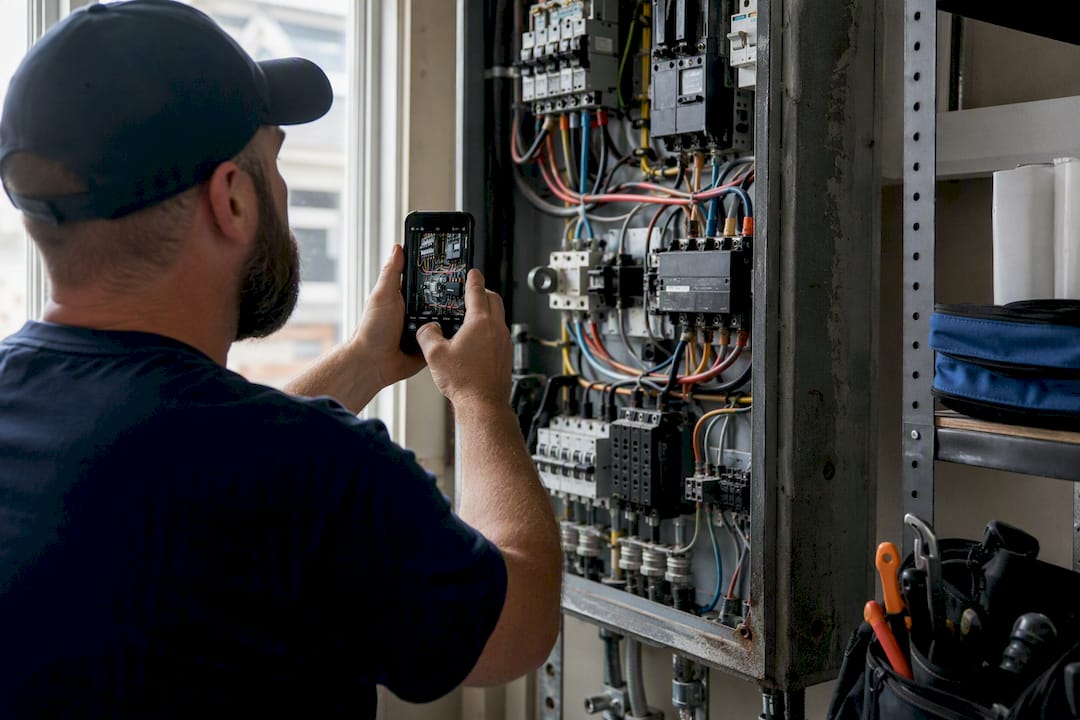
Build a simple photo portfolio on your phone. Label each image with the project type, date, and a one-line description. Include any permit or inspection references you have access to, and a short list of the equipment and testing tools you’re comfortable using. Contractors reviewing candidates for service routes often ask for this before the first interview, and having it ready signals you take the trade seriously.
Interview prep for journeyman roles usually covers a mix of technical and behavioral questions. Expect to explain how you’d troubleshoot a circuit with intermittent faults, how you handle code violations you discover on a job, and how you prioritize safety on a live panel. Behavioral questions often probe how you handle a customer dispute or a missed deadline. Keep answers specific and short: name the situation, what you did, and the outcome.
Pro Tip: Treat every phone screen and ride-along as a live audition, not a formality. Contractors use these steps specifically because they hire faster than a full interview loop, so showing up prepared and confident during a ride-along can turn into a same-week offer.
Follow up within 48 hours of any interview or ride-along with a short, specific thank-you message referencing something discussed. It’s a small step, and most candidates skip it.
When a Specialized Trades Recruiter Makes Sense
Self-applying works well for most local and travel searches. But some situations call for a different approach.
A confidential search, where you’re employed and don’t want your current employer to know you’re looking, is the clearest case. A recruiter can present your background to contractors without your name attached until there’s real interest. Leadership and supervisor searches also benefit from recruiter involvement, since those roles often aren’t posted publicly at all. Relocation-support roles are another strong fit, since a recruiter familiar with a market can flag which contractors actually offer moving assistance versus which just say they do.
A specialized recruiter like Petratalent works by vetting candidates against a contractor’s actual technical and cultural needs, verifying license and credential status upfront, and matching electricians to mechanical contractors already in their network. Contractors, not job seekers, pay the placement fee, so using a recruiter costs an electrician nothing directly. The tradeoff is pace: recruiter placements can take longer than a same-day board application, but they often land better-fit roles with less back-and-forth negotiation, since the recruiter handles pay and per-diem discussions on your behalf. Petratalent’s electrical staffing approach reflects this model directly.
Moving From Journeyman to Master Electrician
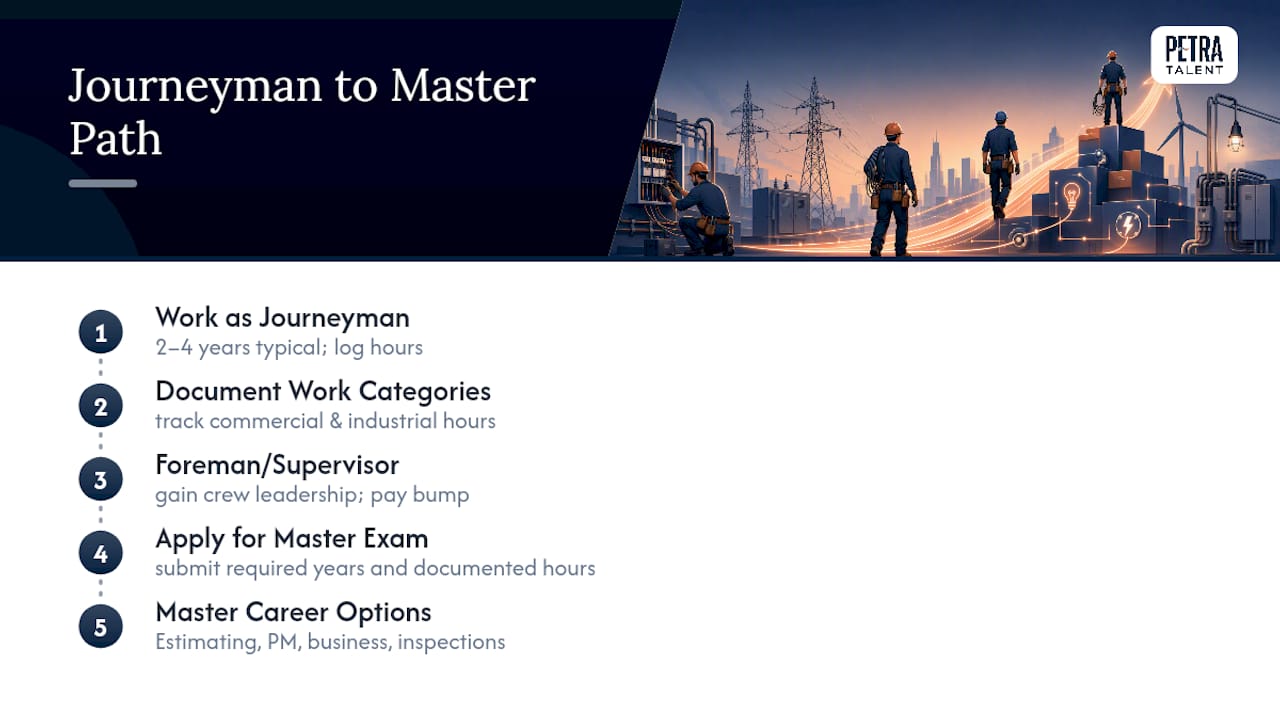
Career advancement in this trade follows a fairly predictable ladder, but the timing and requirements vary by state. Most states require a set number of years working as a licensed journeyman, typically two to four, before you’re eligible to sit for the master electrician exam. Some states also require documented hours in specific work categories, like commercial or industrial wiring, so tracking your project types matters even before you start planning the jump.
Foreman and supervisor roles often serve as a practical stepping stone. Taking on crew leadership responsibilities as a journeyman builds the project management experience that master-level roles and business ownership eventually require, and it usually comes with a pay bump in the meantime. Contractors also tend to prioritize journeymen who’ve shown they can run a job site when filling supervisor openings, so raising your hand for lead roles on smaller projects pays off later.
Once licensed as a master electrician, the paths diverge: some electricians move into estimating or project management, some start their own contracting business, and others take on training or code-inspection roles. Whichever direction appeals, start tracking your hours and project categories now. States that require documented experience won’t accept a vague work history when you apply to test, and scrambling to reconstruct years of project details is a common and avoidable delay.
What to Know About Relocating for a Job
Relocating for a journeyman role is common enough that many employers, especially travel-crew contractors, have built support into their hiring process. Interstates and similar industrial employers typically cover travel expenses and per diem as a built-in part of the compensation package, not a separate negotiation. Some employers also cover licensing reciprocity fees, which matters since transferring a journeyman license across state lines can involve paperwork, testing, or fees depending on the destination state.
Before accepting a relocation offer, confirm exactly what’s covered. Ask directly whether moving expenses, temporary housing, and license transfer costs are included, since postings don’t always spell this out clearly. Non-wage relocation support, including tool kits and training, can materially affect what a job is actually worth beyond the hourly rate.
Also check reciprocity rules for your target state well ahead of any move. Some states have direct reciprocity agreements that make license transfer simple; others require additional exams or documented hours that can delay your start date by weeks if you haven’t planned for it.
A Recruiter’s View on Speed vs. Fit
The conventional advice tells electricians to blast applications across every board and hope volume wins. It doesn’t, not really. Volume gets you interviews for roles you were never going to take, while the roles that actually fit your goals, whether that’s travel pay, a leadership track, or a quiet confidential search, rarely surface on a generic keyword scroll.
What the evidence in this piece actually supports is prioritization by goal, not by channel count. If speed is what you need, travel crews and contractor career pages move fastest. If fit matters more than speed, particularly for leadership roles or confidential searches, a specialized recruiter earns their keep by doing the matching work you’d otherwise spend weeks on yourself.
The overlooked point is that self-applying and recruiter-assisted searches aren’t competing strategies. Running a board search while a recruiter works a confidential angle in parallel costs you nothing and doubles your surface area. Most electricians treat it as an either/or choice. It shouldn’t be.
A Different Way to Get Matched With the Right Contractor
Job boards and union halls put you in front of openings. They don’t tell you which contractor actually pays what they advertise, treats crews well, or is hiring for reasons that will still exist in six months. Petratalent works from the other direction: instead of you sorting through hundreds of postings, Petratalent vets contractors and matches electricians directly to roles that fit their license, experience, and goals, whether that’s a direct-hire service position or a leadership track with a growing mechanical contractor.

This matters most if you’re searching quietly while employed, chasing a supervisor or leadership role that never gets publicly posted, or considering relocation and want someone who already knows which contractors provide real support instead of a vague promise. Petratalent’s staffing services for electrical technicians connect licensed journeymen with mechanical contractors across the country, with no cost to you as a candidate. If you want a confidential, vetted path into your next role instead of another round of cold applications, check Petratalent’s full range of services to see how a placement conversation gets started.
Where to Check for Live Openings Right Now
Start with the BLS wage data for electricians to benchmark any offer, then check Apprenticeship for registered apprenticeship-linked postings and USAJOBS for federal openings, which often use different title variants worth searching separately. For travel and industrial roles, contractor career pages and platforms like ZipRecruiter remain the most current sources.
Frequently Asked Questions
What’s the fastest way to find journeyman electrician jobs?
Applying directly through contractor career pages and travel-crew employers typically moves faster than general job boards, since these employers often review applications within a day or two and use phone screens or ride-alongs to make quick decisions.
Do union hiring halls pay more than non-union journeyman jobs?
IBEW and local hiring halls offer negotiated pay scales through collective bargaining, which can exceed non-union local rates, though total compensation depends heavily on the specific local and project type.
How much can a traveling journeyman electrician earn compared to a local role?
Traveling roles often list hourly rates in the $40 to $43-plus range plus daily per diem, and total compensation frequently exceeds local-only pay once per diem and overtime are factored in.
Is it worth using a recruiter instead of applying directly?
A recruiter adds the most value for confidential searches, leadership roles, or relocation situations where you want someone negotiating pay and per diem on your behalf, and contractors, not candidates, cover the placement fee.
What credentials should I have ready before applying?
A valid state journeyman license, proof of safety certifications like OSHA 10 or 30, a clean driving record, and professional references cover most employer screening requirements.
Sources
- Bls
- Traveling Industrial Journeyman Electrician | Interstates
- Traveling Electrician Salary (ZipRecruiter)
- Apprenticeship
- Search results and guidance for electrician roles (USAJOBS)
Recommended
Related Posts

October 13, 2026
Recruiting Contract Terms: 10 Checks and Ready to Use Clauses
Define fee triggers, candidate ownership, guarantees, and compliance terms. Get a master agreement, short schedule,…

October 12, 2026
Offer Acceptance Rates: Segment Benchmarks, HVAC’s 3–5 Day SLA
See why a 78% to 82% offer acceptance benchmark can mislead, how role and source…

October 11, 2026
Bad Hires Can Cost Construction Firms 30% to 200% of Salary
Bad hires can cost construction firms 30% to 200% of annual salary. Calculate recruiting, rework,…

October 10, 2026
Construction Labor Forecasting for PMs: 7 Steps to Time Hiring
Learn when construction project managers should use WBS or simulation, track labor KPIs, and turn…