



Post a targeted HVAC estimator job on Indeed or ZipRecruiter and simultaneously open a brief with a specialist recruiter like Petratalent. Job boards surface active applicants fast, but a specialist recruiter reaches the passive, already-employed estimators who never touch a job board. Running both tracks at once, rather than one after the other, cuts weeks off your time-to-hire.
TL;DR:
- Posting on multiple job boards with specific titles and running sponsored ads accelerates visibility and attracts qualified candidates faster.
- Partnering with recruiters and providing a detailed role brief simultaneously shortens the hiring timeline and filters out unqualified applicants early.
- Requiring specific experience, technical skills, and certifications in job descriptions effectively reduces unqualified applications and improves bid accuracy.
- Using structured practical tests and reference checks ensures candidates demonstrate actual competence, minimizing the risk of poor performance.
- Completing the hiring process typically takes three to six weeks, with parallel job posting and recruiter engagement significantly reducing time-to-hire.
Table of Contents
- Hiring an HVAC Estimator: What the Job Market Looks Like Right Now
- Where Should You Look to Find an HVAC Estimator?
- What Qualifications Should You Require in an HVAC Estimator Job Posting?
- How Do You Screen and Test an HVAC Estimator Candidate?
- What Interview Questions Reveal a Strong HVAC Estimator?
- What Does an HVAC Estimator Actually Get Paid?
- How to Vet and Place HVAC Estimators?
- How Do You Onboard a New HVAC Estimator Successfully?
- How Long Does It Take to Hire an HVAC Estimator?
- What Legal and Compliance Issues Matter When Hiring an HVAC Estimator?
- Why Most HVAC Estimator Hires Fail Before the First Interview
- Let Petratalent Handle the Search While You Run Your Business
- Sources
- FAQ
Hiring an HVAC Estimator: What the Job Market Looks Like Right Now
HVAC estimator hiring has gotten more competitive over the past two years, and the job-board data shows why. Employers post under several different titles for what is functionally the same role, which fragments the candidate pool and makes searches harder than they should be.
Indeed’s listings for HVAC estimator roles show dozens of active postings in a single state at any given time, with New Jersey alone regularly carrying dozens of openings. ZipRecruiter’s metro-level data tells a similar story: Phoenix listings alone number in the hundreds at peak hiring seasons, with pay bands often running from the mid $50,000s to the high $90,000s depending on scope and region. Glassdoor’s aggregated data shows 355 estimator listings nationwide at a recent count, with wide variance driven by project type and geography.
Common titles you’ll see competing for the same talent pool include:
- HVAC estimator
- Mechanical estimator
- Service estimator
- Senior estimator or lead estimator
- Preconstruction estimator (common in commercial/design-build shops)
Commercial demand tends to run heavier in metro construction markets, where contractors need estimators who can handle sheet-metal takeoffs and multi-trade coordination. Residential and service demand clusters more in growing suburban markets, where speed and volume matter more than complexity. Most employers post on a mix of Indeed, ZipRecruiter, LinkedIn, and Glassdoor simultaneously rather than picking one channel, and that redundancy is worth copying.
Where Should You Look to Find an HVAC Estimator?
Different channels surface different kinds of candidates, and treating them all the same wastes budget. Here’s how to work each one:
- Job boards. Post under multiple title variants (estimator, mechanical estimator, service estimator) to widen your reach, since candidates search inconsistently. Sponsored posts on Indeed and ZipRecruiter get more visibility in the first 72 hours, and reposting every 10 to 14 days keeps your listing near the top of fresh-search results.
- LinkedIn. Boolean searches combining “HVAC estimator” with terms like “takeoff,” “Manual J,” or specific software names (WenDuct, Housecall Pro) surface candidates who list real tools on their profile, not just job titles. Send a short, specific message referencing their actual project experience. Generic outreach gets ignored.
- Trade schools, unions, and associations. Ask program directors which graduates showed strength in blueprint reading and math, not just who finished the program. Techs transitioning out of fieldwork into estimating are an underused pool. Ask about them directly.
- Recruiter partnerships. Give your recruiter a written brief covering project scope, required software, and your top three success metrics for the role. A vague brief produces a vague shortlist.
- Referrals and internal upskilling. A senior technician with strong math skills and field experience can become a capable estimator with mentorship. This path is slower but often produces better long-term retention.
Pro Tip: Post the job and brief a recruiter on the same day. Running both tracks in parallel, instead of waiting to see if the job posting works first, is what actually shortens time-to-hire.
What Qualifications Should You Require in an HVAC Estimator Job Posting?
A vague job description produces a flood of unqualified applicants. A specific one filters them out before you ever pick up the phone.
Start with experience thresholds. A sample posting from PH FM LLC requests 5 or more years of estimating experience along with proven proficiency in estimating software, and that bar is fairly typical for commercial roles. Residential and service-focused positions sometimes accept 3 years if the candidate has strong technical fundamentals.
Your checklist should cover:
- Experience type. Commercial estimating (sheet metal, ductwork, multi-trade coordination) differs meaningfully from residential service estimating. Specify which one the role actually needs.
- Technical fundamentals. Manual J load calculations, duct and piping sizing, and takeoff accuracy from blueprints or field measurements.
- Software fluency. Familiarity with estimating platforms, plus comfort with accounting integrations like QuickBooks for pricing consistency.
- Certifications. NCCER credentials, NOCTI assessments, or EPA 608 certification (required for anyone handling refrigerants) all serve as useful proxies for technical competence, and any one of them can substitute for extensive resume verification.
- Red flags. No sample work available, unexplained gaps between jobs, or references who can’t confirm specific project details.
Don’t accept “familiar with estimating software” as a throwaway line. Ask which platform, for how long, and get them to describe one project where it mattered.
How Do You Screen and Test an HVAC Estimator Candidate?
Resume claims and actual competence are two different things, and the only way to close that gap is with a structured test.
- Request materials upfront. Ask for a sample takeoff, a bid summary from a past project (with client details redacted), and two professional references before the first call.
- Run a focused phone screen. Ask what software they’ve used daily, how they handle a change order mid-bid, and how they double-check a takeoff before submitting it.
- Design a timed practical test. Give a realistic scope (a small commercial duct run or a residential replacement job), a 60 to 90 minute window, and ask for a completed takeoff with pricing and labor estimate.
- Set a pass threshold. A qualified estimator should land within roughly 10 to 15% of your internal benchmark pricing and catch at least one deliberate complication planted in the scope.
- Call references with specific questions. Ask about accuracy on past bids, not just general reliability. “Did their estimates hold up once the job started?” reveals far more than “were they a good employee?”
Pro Tip: A candidate who asks clarifying questions during the practical test, instead of just guessing at missing information, is usually the stronger hire. Real estimators know what they don’t know.
Requiring familiarity with estimating software and a review of past bids protects your margins from day one and shortens the ramp-up period considerably.
What Interview Questions Reveal a Strong HVAC Estimator?
Technical questions expose whether a candidate actually understands the work; behavioral ones expose whether they’ll fit your team. Use both.
Technical questions worth asking:
- “Walk me through how you handle a takeoff when the plans and the site conditions don’t match.”
- “How do you build in contingency without pricing yourself out of a bid?”
- “What’s your process for verifying labor hours on a job you haven’t priced before?”
- “How do you handle rapid material price changes mid-bid cycle?”
- “What software have you used, and what’s one limitation you’ve had to work around?”
Behavioral questions worth asking:
- “Tell me about a bid that came in wrong. What happened, and what did you change afterward?”
- “How do you prioritize when three bids are due the same week?”
Score each candidate 0 to 3 across four categories: technical accuracy, software fluency, communication clarity, and cultural fit. Weight technical accuracy and software fluency higher for commercial roles; weight communication and fit higher for smaller teams where the estimator interacts directly with clients. A candidate scoring below 2 in technical accuracy shouldn’t move forward, regardless of how strong the interview conversation felt.
What Does an HVAC Estimator Actually Get Paid?
Compensation varies more by region and project scope than almost any other estimating variable, so a single national number is close to useless for planning an offer.
ZipRecruiter’s metro-level data shows salary bands commonly running from around $59,000 to $95,000, with the higher end typically going to commercial estimators handling large multi-trade projects.
Structure your offer with more than just base salary:
- Accuracy bonuses. Tie a portion of variable pay to bid accuracy or margin protection on won jobs, not just volume of bids submitted.
- Signing bonuses. Useful in tight markets to close a candidate weighing multiple offers.
- Training investment. Covering certification renewal or software training signals long-term investment and helps with retention.
- Clear promotion path. Estimators who see a route toward senior estimator or project manager pay are less likely to jump for a marginal raise elsewhere.
In markets where estimator supply is tight, moving fast on a strong candidate matters more than shaving a few thousand off the offer. A slow approval process loses more good candidates than a slightly high salary ever costs you.
How to Vet and Place HVAC Estimators?
A recruiter partnership only works as well as the brief you give it. Each search should be built around a structured role brief that covers project scope, required software, typical bid volume, and the specific success metrics used to judge the hire.
From there, the vetting process includes:
- Reviewing sample takeoffs and past bid work against the role’s actual complexity level.
- Verifying certifications and, where relevant, aligning candidates against standards like NCCER, NOCTI, or EPA 608.
- Checking references with pointed questions about accuracy and reliability, not just general performance.
- Delivering a shortlist of candidates who’ve already cleared technical screening, rather than a stack of resumes you have to filter yourself.
This front-loaded vetting is what reduces time-to-hire without sacrificing bid accuracy down the line. Employers get candidates who’ve already proven they can do the work, not just describe it convincingly in an interview.
How Do You Onboard a New HVAC Estimator Successfully?
The first 30 days determine whether a new estimator becomes productive quickly or spends months guessing at your internal processes. Structure onboarding around three phases rather than treating it as a single orientation day.
Week one should focus on systems access: estimating software logins, pricing databases, and a walkthrough of how your company structures a bid from intake to submission. Pair the new estimator with a senior team member for their first two to three bids, reviewing the work together before it goes out the door.
Weeks two through four should shift toward supervised independence. Let the new hire build full bids on their own, but review every one before submission until they’ve hit a consistent accuracy threshold. This is also the window to introduce them to your subcontractor relationships, vendor pricing agreements, and any proprietary labor or material databases specific to your operation.
By day 60, most estimators with the right background should be handling standard bids independently, with senior review reserved for unusually large or complex jobs. If a new hire isn’t there by that point, it’s worth revisiting whether the initial screening missed a gap in their actual experience.
Document your internal pricing logic and past-project database early. Estimators who inherit tribal knowledge scattered across old emails ramp up far slower than those handed a clean reference system.
How Long Does It Take to Hire an HVAC Estimator?
A realistic timeline from job posting to signed offer runs 3 to 6 weeks for most contractors, though tight labor markets can stretch that further.
Expect roughly one to two weeks for initial applicant flow and resume screening, especially if you’re running a job posting and a recruiter search in parallel. Phone screens and practical testing typically add another one to two weeks, depending on how quickly candidates can complete a timed takeoff assignment. Final interviews, reference checks, and offer negotiation usually take another week to ten days.
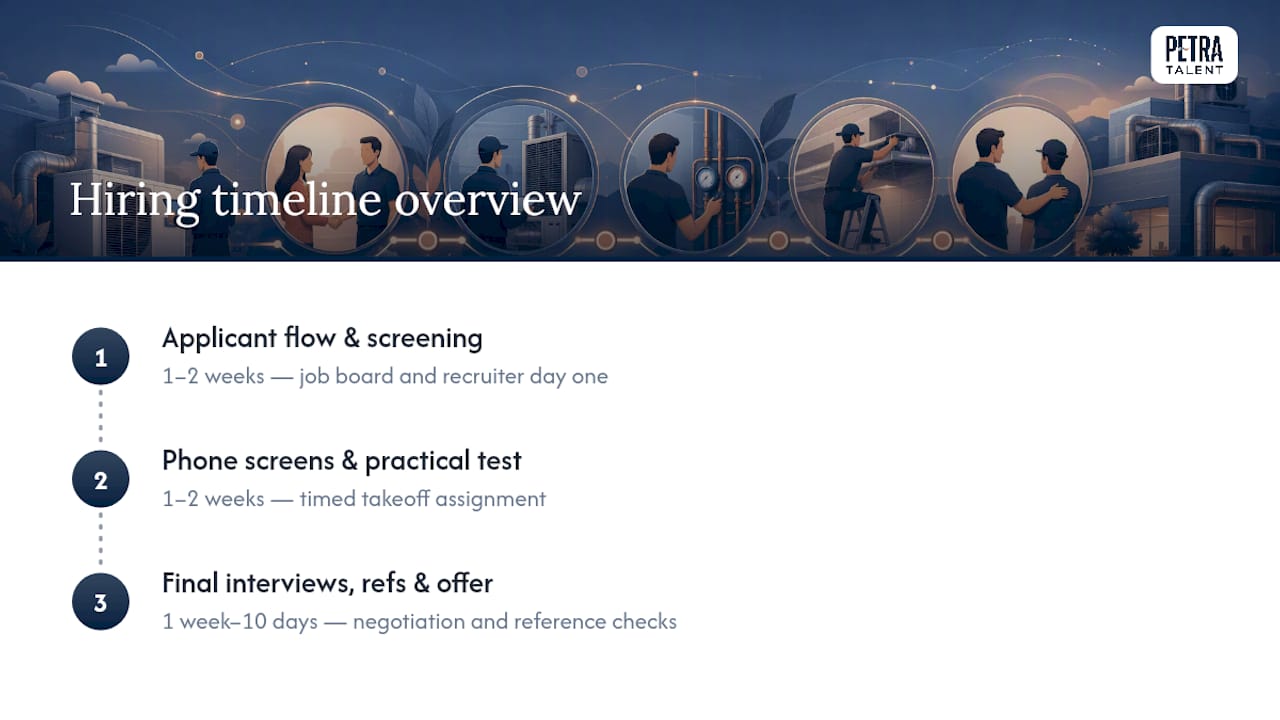
Running job boards and a recruiter brief simultaneously, rather than sequentially, is the single biggest lever for shortening this window. Employers who post a job and wait two weeks before engaging a recruiter often lose three to four weeks compared to those who start both tracks on day one. Reference checks and background verification should never be rushed, even under time pressure. A bad estimator hire costs far more in margin erosion over the following year than a slightly longer search costs in delay.
What Legal and Compliance Issues Matter When Hiring an HVAC Estimator?
Estimators aren’t licensed the way installers or technicians often are, but several compliance points still apply and get overlooked.
If the role involves any handling of refrigerant specifications or system design that touches EPA-regulated equipment, verify EPA 608 certification status rather than taking a candidate’s word for it. Certification lookup is straightforward and takes minutes.
Classify the role correctly from the start. Estimators are typically salaried, exempt employees under the Fair Labor Standards Act if they exercise genuine independent judgment in pricing decisions, but misclassifying a heavily supervised junior estimator as exempt can create wage-and-hour exposure. When in doubt, consult employment counsel before finalizing the job description’s exemption status.
Background checks and reference verification should follow consistent, documented criteria applied to every candidate, not an ad hoc process that varies by who’s doing the interviewing. This matters for both compliance and for defending your hiring decisions if a rejected candidate ever raises a discrimination claim. If the position involves contract or 1099 arrangements rather than direct W-2 employment, review the distinctions between employment contract types carefully, since misclassification here carries real financial risk.
Why Most HVAC Estimator Hires Fail Before the First Interview
The biggest mistake contractors make isn’t a bad interview question or a weak offer. It’s writing a job description so generic that it fails to filter anyone out, then wondering why fifty unqualified resumes show up for a role that needed maybe five real candidates.
Specificity is a filter, not a formality. A posting that names the actual software, the actual project types, and a real experience threshold does more screening work in one paragraph than three rounds of interviews can undo. The second failure point is speed, or the lack of it. Good estimators, especially passive ones already employed, don’t wait around for a four-week approval process. Contractors who move decisively on a tested, vetted candidate consistently beat out competitors offering marginally more money but taking twice as long to decide.
— David
Let Petratalent Handle the Search While You Run Your Business
Petratalent gives you tested, vetted estimator candidates instead of a pile of unscreened resumes to sort through yourself. Where a job board hands you volume, Petratalent’s HVAC Recruiting Services hand you a shortlist of candidates who’ve already passed technical review, and its Technical Vetting & Workforce Solutions confirm software fluency and takeoff accuracy before you ever schedule an interview.

To get started, give Petratalent a role brief covering project scope, required software, and your top success metrics for the position, the same brief structure recruiters use internally to build a targeted search. Most employers see an initial shortlist within one to two weeks of a completed brief. Placement fees run as a one-time percentage of the hire’s compensation, paid only when a hire is made, and the team can also support leadership searches through Leadership & Management Search if the role sits above the estimator level. Reach out through Petratalent’s services overview to start a brief today.
Sources
- Best HVAC Estimating Software & Pricing App to Win More Bids
- Hvac Estimator Jobs in Phoenix, AZ (NOW HIRING)
- Now Hiring: 50 HVAC Estimator Jobs in New Jersey
FAQ
Are HVAC Estimators in High Demand Right Now?
Yes. Job boards show consistent, ongoing demand, with dozens of active postings per state on Indeed and hundreds of listings in large metros on ZipRecruiter at any given time. Demand runs especially high for commercial estimators with sheet-metal and multi-trade takeoff experience.
How Do You Become an HVAC Estimator?
Most estimators come up through field experience as technicians or installers before transitioning into pricing and takeoff work, often supplemented with formal training through trade programs or NCCER-aligned credentials. Strong math skills, blueprint literacy, and familiarity with estimating software matter more than a specific degree path.
What HVAC Specialty Pays the Most?
Commercial estimating and project management roles tend to pay the highest within HVAC, particularly on large-scale design-build or multi-trade projects. Salary bands for estimators commonly run from around $59,000 to $95,000 depending on scope, with senior and commercial-focused estimators landing at the top of that range.
How Much Does an HVAC Estimator Get Paid?
Pay varies significantly by region and project type, but metro-level data shows typical ranges from roughly $59,000 to $95,000 annually, according to ZipRecruiter’s listing data. Residential and service-focused roles tend to sit toward the lower end, while commercial estimators handling complex bids sit toward the higher end.
How Long Does the Full HVAC Estimator Hiring Process Take?
Most contractors complete the process, from job posting to signed offer, in 3 to 6 weeks. Running a job-board posting and a recruiter brief at the same time, rather than sequentially, is the most reliable way to stay on the shorter end of that range.
Recommended
Related Posts

October 13, 2026
Recruiting Contract Terms: 10 Checks and Ready to Use Clauses
Define fee triggers, candidate ownership, guarantees, and compliance terms. Get a master agreement, short schedule,…

October 12, 2026
Offer Acceptance Rates: Segment Benchmarks, HVAC’s 3–5 Day SLA
See why a 78% to 82% offer acceptance benchmark can mislead, how role and source…
October 11, 2026
Bad Hires Can Cost Construction Firms 30% to 200% of Salary
Bad hires can cost construction firms 30% to 200% of annual salary. Calculate recruiting, rework,…
October 10, 2026
Construction Labor Forecasting for PMs: 7 Steps to Time Hiring
Learn when construction project managers should use WBS or simulation, track labor KPIs, and turn…

