



A millwright is a skilled tradesperson who installs, aligns, maintains, and dismantles industrial machinery in factories, power plants, and construction sites. The role blends physical rigging work with precision measurement, and it sits at the center of nearly every heavy-equipment project in American manufacturing. The U.S. Bureau of Labor Statistics and O*NET’s occupation code 49-9044.00 both classify millwrights alongside industrial machinery mechanics, reflecting how much overlap exists between installing new equipment and keeping existing equipment running.
Core duties include:
- Installing new machinery according to blueprints and layout plans
- Aligning and leveling equipment to exact tolerances
- Rigging and moving multi-ton components safely
- Performing preventive maintenance and troubleshooting mechanical failures
- Dismantling and relocating equipment during plant upgrades or shutdowns
A millwright’s job spans installation and maintenance work in industrial plants, refineries, power generation facilities, and large construction projects — anywhere heavy machinery needs to go from a crate to a fully operational, precisely aligned piece of production equipment.
Key Takeaways
A millwright’s value comes from combining precision alignment skills with rigging judgment across the full lifecycle of industrial machinery, from installation through maintenance to eventual removal.
| Point | Details |
|---|---|
| Core definition | A millwright installs, aligns, maintains, and dismantles industrial machinery in plants and construction sites. |
| Training timeline | Apprenticeships typically run 3 to 4 years, combining paid work with classroom instruction toward journeyman status. |
| Distinct from mechanics | Millwrights handle full mechanical systems, including rigging and structural alignment, beyond a machinist’s shop-based scope. |
| Demand drivers | Equipment replacement cycles and capital projects keep demand for skilled millwrights steady across industries. |
| Hiring bottleneck | Resumes rarely prove alignment or rigging competence, making technical vetting essential for employers. |
Table of Contents
- The Definition of a Millwright: A Trade With Deep Roots
- What Modern Millwrights Actually Do Every Day
- Skills, Tools, and Specialties Millwrights Rely On
- How to Become a Millwright: Training and Career Path
- Where Millwrights Work and What They Earn
- Petra Talent’s Take on Hiring and Building a Millwright Career
- Recruiting Millwrights Requires the Right Screening Process
- What This Trade’s Data Actually Tells Us
- Frequently Asked Questions About Millwrights
- Sources
The Definition of a Millwright: A Trade With Deep Roots
The word “millwright” comes directly from its original job: a craftsman who built and maintained mills. Merriam-Webster’s definition still traces the term to someone who “plans and builds mills or sets up their machinery,” a callback to when water and wind mills powered early American industry.
That origin explains a lot about how the trade evolved.
- Early millwrights combined carpentry, mechanical design, and basic engineering to construct grain and lumber mills powered by water wheels
- As factories replaced mills during industrialization, the skill set shifted toward erecting and aligning heavy machinery rather than building wooden structures
- The precision-alignment and rigging expertise that made millwrights valuable in the 1800s translated almost directly to installing steam engines, then electric motors, then modern automated production lines
The name stuck even as the tools changed completely. A millwright working today has more in common with a precision engineer than a carpenter, but the title survived because the underlying skill, getting heavy machinery to run true, never went away.
What Modern Millwrights Actually Do Every Day
A typical installation job follows a sequence that hasn’t changed much in structure, even though the tools have modernized considerably. Machinery arrives on-site, often by crane or heavy truck. From there, the process usually looks like this:
- Receiving and inspection — checking the equipment against shipping manifests and blueprints for damage
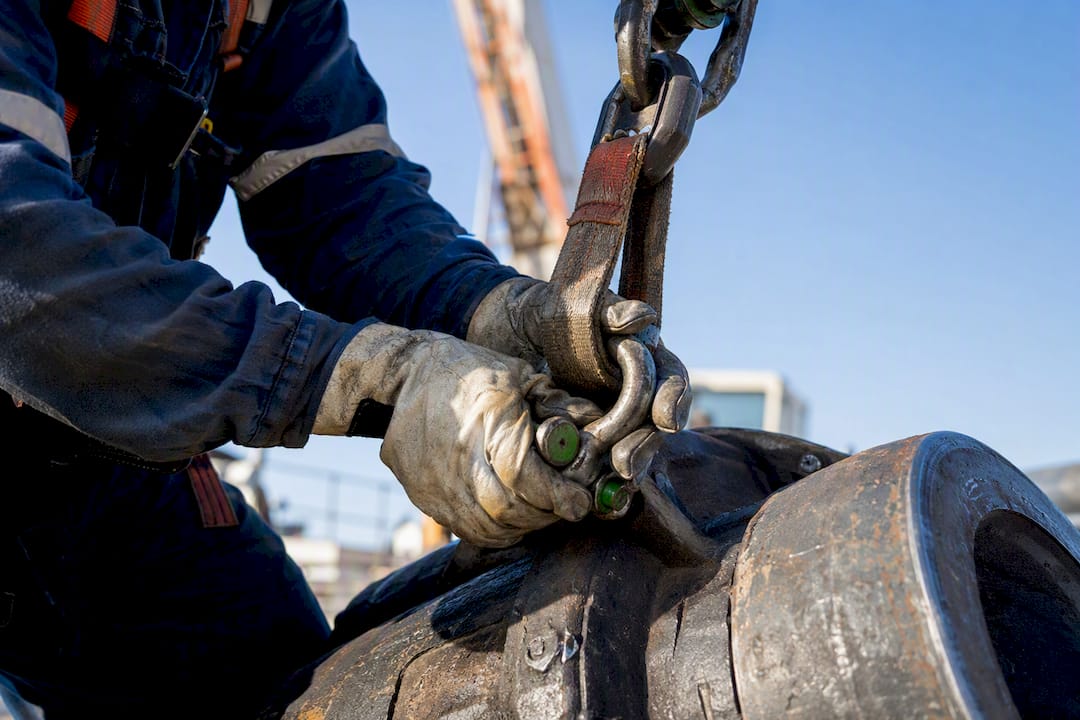
- Rigging — calculating load weights and center of gravity, then using chain hoists, cranes, or jacks to position the equipment
- Leveling — setting the machinery on its foundation using shims and precision leveling tools
- Aligning — using laser alignment systems or dial indicators to bring shafts, couplings, and drivetrains into tolerance, sometimes within thousandths of an inch
- Testing — running the equipment under load to confirm vibration, temperature, and performance readings meet spec
Maintenance work runs on a different clock. Plant shutdowns, often called outages, compress months of planned repairs into a matter of days, and millwrights are usually the ones replacing bearings, realigning couplings, and rebuilding gearboxes before the line restarts. Preventive maintenance and blueprint-based troubleshooting make up a large share of the job outside of new installations, since unplanned downtime on a production line can cost a facility far more than the maintenance itself.
Some millwright jobs are short, project-based installs lasting a few days; others are long-term maintenance roles embedded in a single facility for years, as career guides on the trade point out.
Millwrights differ from machinists and general mechanics in scope, not just skill. A machinist typically fabricates precision parts on a lathe or mill in a shop setting. A general mechanic often repairs a narrower range of equipment. A millwright works across an entire mechanical system, from foundation to drivetrain, and handles the rigging, alignment, and structural work that neither trade is typically trained for.
Skills, Tools, and Specialties Millwrights Rely On
Reading a blueprint or piping schematic accurately is non-negotiable, since a misread tolerance can mean a shaft that vibrates itself apart within weeks. Precision measurement, rigging math (calculating load, center of gravity, and sling angles), and welding round out the core technical skill set.
The toolkit reflects that precision focus:
- Laser alignment systems and dial indicators for shaft and coupling work
- Hoists, cranes, and come-alongs for rigging heavy loads
- Torque wrenches for bolt-pattern specifications
- Precision shims for leveling and foundation work
- Welding equipment for fabrication and repair
Soft skills matter just as much as the physical ones. Troubleshooting a vibration issue on a running motor requires methodical problem-solving, not guesswork, and clear communication with plant engineers keeps a repair from turning into a longer shutdown than necessary. A safety mindset isn’t optional when the job routinely involves suspended multi-ton loads.
Some millwrights specialize further, earning OSHA safety certifications for rigging or confined-space work, or focusing on specific industries like power generation, where turbine alignment demands its own certification track.
Pro Tip: If you’re early in the trade, prioritize learning laser alignment systems over almost anything else. Alignment accuracy is the single skill that separates a competent millwright from a great one, and it’s the one hiring managers ask about first.
How to Become a Millwright: Training and Career Path
Most millwrights start with a high school diploma or GED, then move into either a vocational program or directly into an apprenticeship. Community colleges with dedicated millwright tracks, Northampton Community College’s program among them, often shorten the classroom portion of an apprenticeship by covering blueprint reading and rigging fundamentals up front.
The apprenticeship itself follows a fairly consistent structure across the trade:
- Enroll in a registered apprenticeship program, often through a union local, contractor, or community college like Rogue Community College’s millwright track
- Complete roughly 3 to 4 years combining paid on-the-job hours with classroom instruction
- Log thousands of hours under a journeyman’s supervision, progressing through increasingly complex tasks
- Pass the program’s requirements to earn journeyman status, which certifies you can work independently at full skill and pay
Journeyman status isn’t just a title. It signals to employers that a millwright can handle installation, alignment, and troubleshooting without direct supervision.
Beyond that first certification, career development continues through:
- Specialty certifications in rigging, welding, or specific machinery types
- OSHA safety credentials for high-risk work
- Union apprenticeship ladders that lead toward foreman or supervisory roles
- Non-union pathways through contractor-sponsored training, which can offer more flexibility but sometimes less structured advancement
Where Millwrights Work and What They Earn
Millwrights work across manufacturing plants, power generation facilities, paper mills, steel plants, and large construction sites, wherever heavy machinery needs installing, aligning, or maintaining. Some spend years at a single facility handling ongoing maintenance; others move between projects as installation specialists, especially during capital expansion projects.
The Bureau of Labor Statistics groups millwrights with industrial machinery mechanics for wage and outlook data, reflecting how closely the two roles overlap in daily duties and employer demand. Demand tends to track equipment replacement cycles and capital project spending. Plants don’t install new machinery on a fixed schedule, but aging equipment, tightening efficiency requirements, and plant expansions all drive steady need for millwrights who can handle both new installs and legacy repairs.
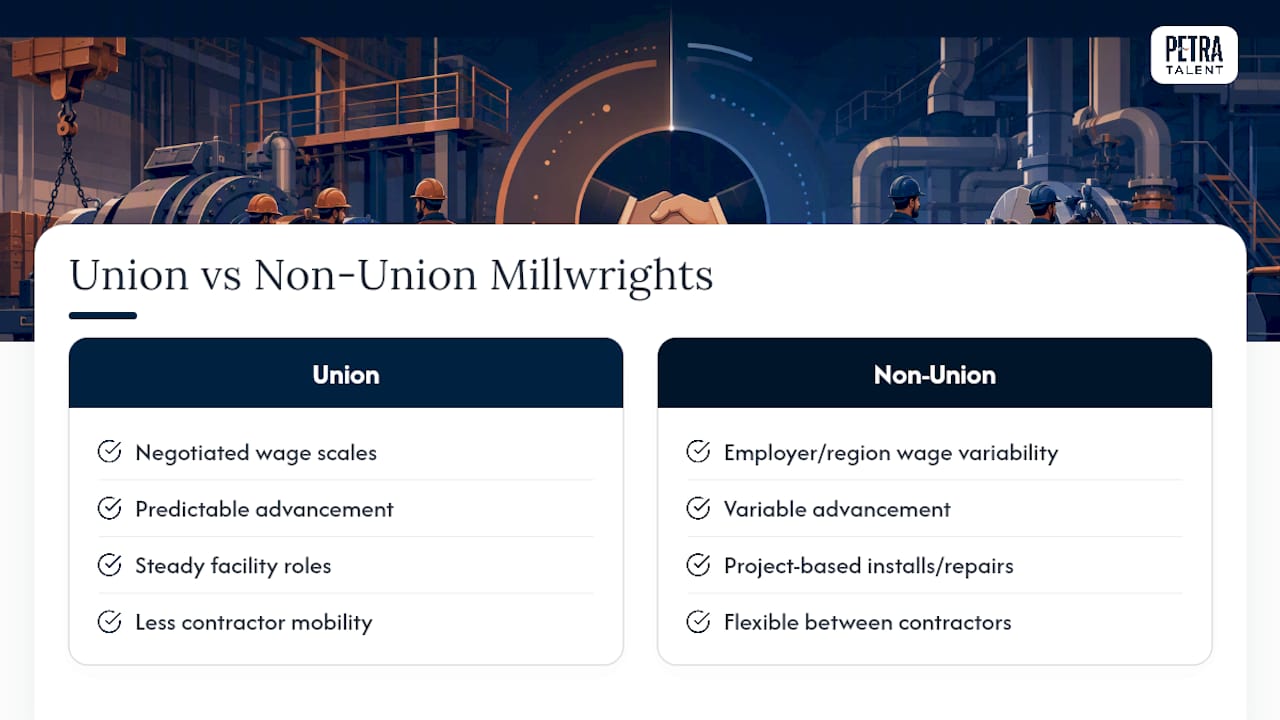
Union and non-union paths affect pay and scope differently. Union millwrights typically follow negotiated wage scales tied to journeyman status and often see more standardized advancement, while non-union roles can vary more by employer and region. Neither path is uniformly better. It depends on what a candidate values: predictable wage progression versus flexibility to move between contractors and industries.
Petra Talent’s Take on Hiring and Building a Millwright Career
Hiring managers screening millwright candidates look past the resume line for journeyman status and dig into what that certification actually covered. Which industries? What kind of equipment? Solo installs or crew work? Candidates who can speak specifically about alignment tolerances they’ve hit or a rigging plan they built for a difficult move stand out immediately from those who list “millwright” as a job title with no detail behind it.
On the employer side, technical vetting matters more in this trade than in most, because a resume can’t verify whether someone can actually read a piping isometric or run a laser alignment system under time pressure.
Certifications tell you a candidate completed a program. Structured technical screening tells you whether they can perform under a real deadline, which is the gap that costs contractors the most on job sites.
…
Contractors building out a maintenance team should also weigh how multi-trade mechanical hiring differs from single-trade recruiting, since millwrights often work alongside electricians and pipefitters on the same install.
Recruiting Millwrights Requires the Right Screening Process
Finding a millwright who can genuinely handle journeyman-level work takes more than a resume review. Contractors need technical vetting that verifies alignment skills, rigging judgment, and blueprint literacy before a candidate ever steps onto a job site. Petra Talent specializes in sourcing and screening skilled trades talent for mechanical contractors, including the technical vetting that separates a qualified millwright from one who only looks qualified on paper.
Contractors evaluating their current hiring process can review Petra Talent’s recruitment services to see how role-specific sourcing and screening reduce mis-hires on high-stakes installation and maintenance work.
What This Trade’s Data Actually Tells Us
The BLS and O*NET data make one thing clear that a lot of career advice glosses over: millwright work rewards precision skills more than raw physical strength, and the trade has moved further from its brute-force reputation than most outsiders realize. The conventional advice, “get strong, get an apprenticeship,” undersells how much the job now depends on reading laser alignment output correctly and interpreting a blueprint under time pressure.
Where the standard career guides fall short is pay specificity and industry variation. Wage and demand data get lumped together across an entire occupational category, which flattens real differences between a union millwright in heavy manufacturing and a non-union installer doing short-term contract work.
Readers weighing this trade should prioritize apprenticeship program quality first, not certification count. A well-structured 3 to 4 year program with real journeyman mentorship builds more durable career value than a stack of certificates earned without hands-on rigging and alignment experience behind them.
Frequently Asked Questions About Millwrights
What is the simplest definition of a millwright?
A millwright is a skilled tradesperson who installs, aligns, maintains, and dismantles industrial machinery, most often in factories, power plants, and construction sites.
What does a millwright do differently from a machinist?
A machinist fabricates precision parts in a shop setting, while a millwright installs and aligns complete mechanical systems on-site, including rigging and structural work a machinist typically doesn’t handle.
How long does millwright training take?
Most apprenticeships run several years combining paid on-the-job hours with classroom instruction before a candidate reaches journeyman status.
Do millwrights need welding skills?
Welding is a core part of the skill set, used for both fabrication during installation and repair work during maintenance outages.
Is millwright certification required everywhere?
Requirements vary by employer and region. Union apprenticeship programs and community college tracks are the most common paths to journeyman certification, though non-union contractors sometimes offer their own structured training.
Sources
- Industrial machinery mechanics, machinery maintenance workers, and millwrights : Occupational Outlook Handbook : U.S. Bureau of Labor Statistics
- 49-9044.00 – Millwrights — O*NET
- Millwright apprenticeship (program page) — Rogue Community College
- What Is a Millwright and How to Become One? — Northampton Community College
- OSHA training and certificates
Recommended
Related Posts

October 13, 2026
Recruiting Contract Terms: 10 Checks and Ready to Use Clauses
Define fee triggers, candidate ownership, guarantees, and compliance terms. Get a master agreement, short schedule,…

October 12, 2026
Offer Acceptance Rates: Segment Benchmarks, HVAC’s 3–5 Day SLA
See why a 78% to 82% offer acceptance benchmark can mislead, how role and source…
October 11, 2026
Bad Hires Can Cost Construction Firms 30% to 200% of Salary
Bad hires can cost construction firms 30% to 200% of annual salary. Calculate recruiting, rework,…
October 10, 2026
Construction Labor Forecasting for PMs: 7 Steps to Time Hiring
Learn when construction project managers should use WBS or simulation, track labor KPIs, and turn…