


Candidate ownership, also called right to represent, is a timebound, evidence-based claim an agency makes to protect a candidate it introduced to a client. It is not indefinite property. The standard window runs a moderate period of several months to about a year, and it only holds up if the agency can show meaningful contact, not a name sitting in a database. The practical takeaway: document every qualifying event the moment it happens, and put an expiration date on the claim before a dispute forces you to invent one.
TL;DR:
- Candidate ownership typically lasts from six to twelve months, depending on placement type and activity, with longer windows for permanent hires.
- Ownership is only valid through documented, meaningful contact, such as direct introductions, scheduled interviews, or explicit candidate consent, not passive profile views.
- Clear recordkeeping with timestamps, candidate consent, and active CRM fields is essential to defend ownership claims and resolve disputes efficiently.
- Different roles exist: relationship ownership covers the candidate’s overall profile, while assignment ownership pertains to specific job submissions.
- A documented, one-page policy outlining creation events, renewal activity, expiry, handover procedures, and dispute resolution improves consistency and reduces conflict.
Table of Contents
- What Candidate Ownership Means for Recruiters
- Standard Timeframes and What the Market Actually Does
- What Actually Creates Ownership (And What Doesn’t)
- Relationship Ownership vs. Assignment Ownership in Practice
- Resolving Candidate Ownership Disputes
- Sample Candidate Ownership Clauses You Can Adapt
- Building Ownership Rules Into Your ATS and Daily Workflow
- The One-Page Policy Checklist
- How Petra Talent Handles Candidate Ownership in Trades Recruiting
- Turning Ownership Policy Into a Documented Advantage
- Where to Go Deeper on Candidate Ownership Policy
- Sources
What Candidate Ownership Means for Recruiters
Candidate ownership is the right an agency earns to represent a specific candidate to a specific client for a defined period, typically because that agency made the introduction first. It protects the placement fee tied to that introduction. Contracts and internal policies increasingly split this concept into two distinct roles, and confusing them is where most agency disputes start.
Relationship ownership belongs to the recruiter or desk that built the candidate’s file: the resume, the skills profile, salary expectations, and general career conversations. Assignment ownership belongs to whoever submitted that candidate to a specific job order at a specific client. A desk can hold relationship ownership on a plumber for years while a different recruiter holds assignment ownership on the one active req that candidate is being pitched for this month.
Agencies write these rules for three reasons:
- Prevent two recruiters from calling the same technician about the same job, which damages trust fast in a small trade like HVAC or plumbing.
- Protect commission entitlement so the recruiter who did the sourcing work gets credit, even if a colleague closes the deal.
- Preserve the candidate experience, since skilled trades candidates talk to each other, and duplicate outreach from one agency reads as disorganized.
Common contract language includes phrases like “right to represent,” “candidate submission,” and “exclusive introduction period.” Candidate ownership clauses commonly specify that the recruiter who makes the introduction is recognized as the owner for a set period, precisely to head off fee disputes down the line. Agencies that skip writing this down tend to find out the hard way, usually mid-dispute, that “we always just knew who had who” is not a policy.
Standard Timeframes and What the Market Actually Does
Most agencies land within a moderate period around half a year to about a year for a standard ownership window, though the number shifts depending on placement type and desk structure. Permanent hire searches tend toward the longer end, since a candidate who is not ready today might be ready in nine months and the agency that nurtured that relationship should not lose the fee to someone who calls at the right moment. Contract and temp-to-hire placements often run shorter windows, sometimes 90 to 180 days, because the placement cycle moves faster and candidates cycle through active status more often.
Ownership is not a static clock, either. Most policies renew or extend the window when there is genuine activity, meaning a real conversation, a submission, or an updated consent, rather than a record simply existing in the CRM. A candidate who was introduced eight months ago but has had zero contact since is a much weaker ownership claim than one who had a screening call three weeks ago.
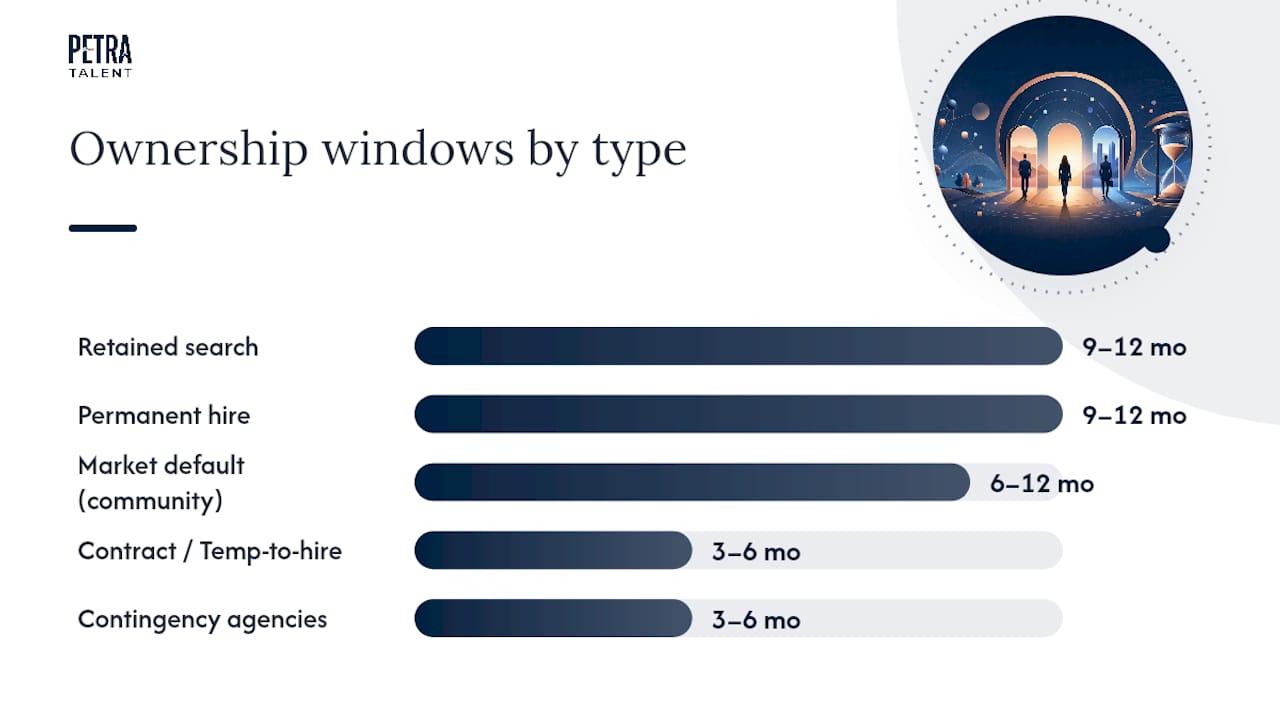
Recruiter discussions across the industry confirm there’s no single universal number. Community threads on candidate ownership show many recruiters defaulting to the 6 to 12 month range, but almost all of them agree that a written, agency-specific policy beats an informal understanding every time.
Policy variants worth knowing:
- Contingency agencies often use shorter windows (90 to 180 days) tied to active job orders.
- Retained search firms typically use longer windows (9 to 12 months) reflecting deeper candidate development work.
- Multi-desk agencies sometimes apply different windows by desk or specialty, especially when technical vetting adds lead time before a candidate is submission-ready.
What Actually Creates Ownership (And What Doesn’t)
Ownership is earned through action, not proximity to a database record. A candidate sitting in your ATS because someone imported a list of licensed plumbers from a job board does not belong to anyone yet.
Events that typically qualify as creating ownership:
- A direct, personalized introduction of the candidate to a specific client for a specific role.
- A targeted outreach email or call referencing that client or that job order by name.
- Scheduling or conducting an interview between the candidate and the client.
- The candidate confirming, in writing, that they consent to be represented for that opportunity.
Events that typically do not qualify:
- Viewing or downloading a candidate’s profile from a shared database.
- A generic keyword search that surfaces the candidate’s resume.
- A mass email blast with no individual response from the candidate.
- Historical contact from a prior, unrelated search with no recent follow-up.
Recordkeeping is what separates a defensible claim from a guess. Every qualifying event needs a timestamp, the name of the recruiter who took the action, and, where possible, the candidate’s own written acknowledgment. A CRM field logging “first meaningful contact date” alongside the client and job order it relates to turns a verbal claim into a documented one.
Pro Tip: Build a “consent captured” checkbox tied to a timestamp field directly in your ATS submission workflow. If a dispute ever reaches a client or a legal review, a dated system record beats a recruiter’s memory every time.
Relationship Ownership vs. Assignment Ownership in Practice
Splitting these two roles matters most on multi-desk searches, where one recruiter sources talent broadly and another owns the client relationship for a specific req. Relationship ownership might sit with the recruiter who first placed a technician in your database two years ago and has stayed in touch since. Assignment ownership sits with whoever submits that same technician to this month’s open superintendent role.
Keep the roles separate when a candidate could reasonably be a fit for multiple open searches across different desks. Unify them when a single recruiter runs a search start to finish with no handoff, which is common at smaller agencies.
A clean handover, whether between desks or between recruiters covering a leave of absence, should include:
- The date and nature of every prior contact with the candidate.
- Documented preferences: desired pay range, location constraints, licensing status, availability.
- The next scheduled step, whether that’s a follow-up call, a client interview, or a reference check.
- Copies of the evidence trail: emails, consent confirmations, and CRM notes tied to the candidate’s file.
Skipping this checklist is how candidates end up getting the same “are you still looking?” text from two recruiters at the same firm, which is one of the fastest ways to lose a good technician’s trust in your agency.
Resolving Candidate Ownership Disputes
Ownership disputes are inevitable once an agency has more than a handful of recruiters working the same regional talent pool. What separates a professional operation from a chaotic one is having a ladder to climb instead of a shouting match in a Slack channel.
- Recruiter-to-recruiter resolution. The two recruiters involved compare timestamps and evidence directly. Most disputes end here within a day.
- Desk lead review. If the recruiters can’t agree, the desk lead reviews the CRM evidence: who made first meaningful contact, who has a signed consent, and whether the candidate expressed a preference for one recruiter.
- Operations owner adjudication. For cross-desk or cross-office disputes, a single named operations owner makes the final call based on the documented evidence, not seniority or relationship with either recruiter.
The adjudication itself should weigh three questions: who made first contact, whose contact was meaningful under the policy’s definition, and what the candidate themselves prefers, since a candidate’s stated wish should generally override internal politics. Documenting a single decision owner before a dispute even arises measurably reduces the delays that come from ownership being unclear, and it keeps the resolution focused on evidence instead of who has been at the agency longer.
Pro Tip: Set a hard SLA of 48 hours for step one and step two combined. Disputes that drag past a week almost always end with the candidate getting frustrated and walking away from both recruiters.
Sample Candidate Ownership Clauses You Can Adapt
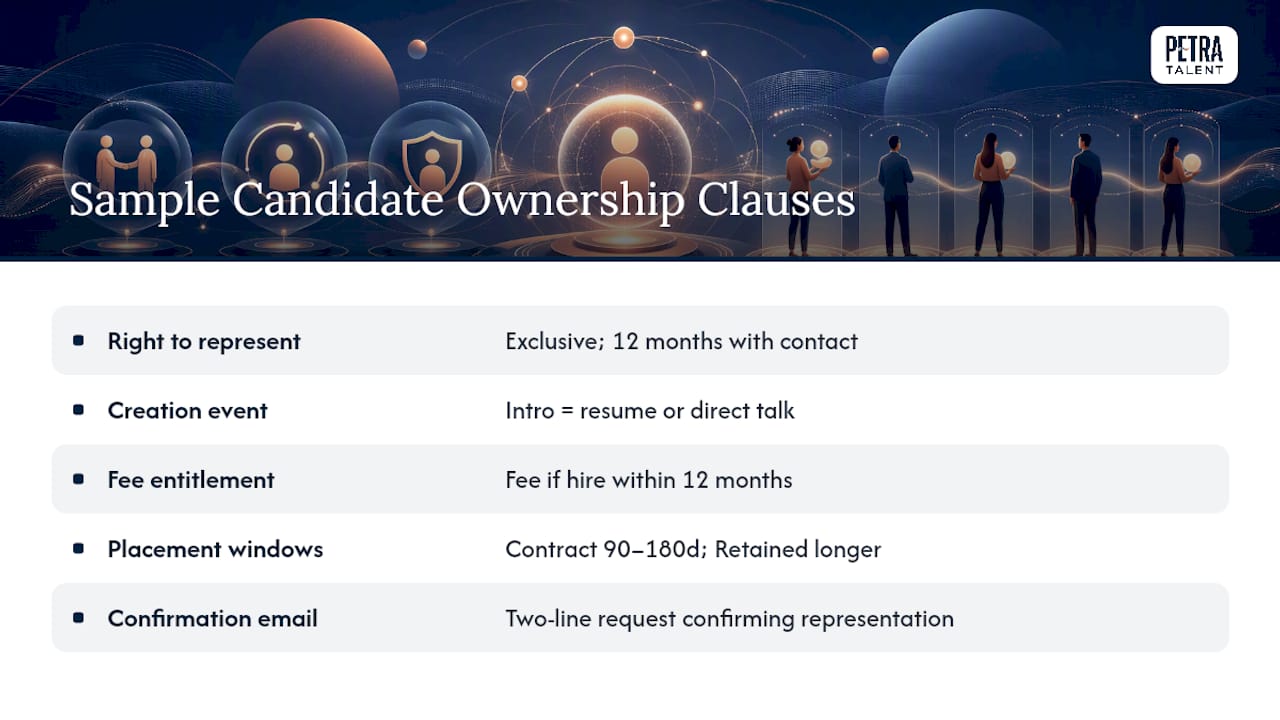
Written clauses give recruiters and clients a shared reference point instead of relying on memory. Sample ownership clauses typically include a time-limited right to represent, a definition of what creates that right, and a statement of fee entitlement tied to it. Here are three snippets an agency can adapt:
Time-limited right to represent:
“Agency shall have the exclusive right to represent Candidate to Client for a period of twelve (12) months from the date of introduction, provided such right remains active through documented, meaningful contact.”
Creation event definition:
“A candidate is considered introduced when Agency submits Candidate’s resume with Client’s knowledge for a specific role, or arranges a direct conversation between Candidate and Client regarding employment.”
Fee entitlement:
“Should Client hire Candidate within twelve (12) months of introduction by Agency, Client agrees to pay the applicable placement fee, regardless of whether the hire occurs through direct negotiation or a third party.”
For contract placements, shorten the window to 90 or 180 days and tie the fee entitlement to the assignment length rather than a permanent hire date. For retained leadership searches, extend the window and add a clause covering re-engagement if the search is paused and later reopened.
Pair every clause with a short candidate confirmation email: a two-line message asking the candidate to confirm they’re being represented for a specific opportunity creates a clean, dated record that backs up the contract language if a dispute ever surfaces.
Building Ownership Rules Into Your ATS and Daily Workflow
Policy only works if your ATS enforces it before a recruiter picks up the phone. A pre-outreach conflict check should be a required step, not an afterthought: before contacting any candidate, a recruiter runs a quick search that flags whether that candidate has an active ownership record and, if so, who holds it and when it expires.
Useful CRM fields to build into that workflow:
- Ownership start date and expiration date, calculated automatically from your policy’s default window.
- Last meaningful contact date, updated only by qualifying events, not passive record views.
- Owning recruiter and desk, visible to anyone who pulls up the candidate file.
- Consent status, showing whether the candidate has confirmed representation for the current opportunity.
Automation rules can flag a candidate as “contested” the moment a second recruiter attempts outreach within an active ownership window, routing that flag straight to the desk lead instead of letting it play out over text messages.
ATS reactivation and silver-medalist programs also matter here: sourced hires from reactivated candidate pools rose to 44% in 2024, and every reactivation touch, if timestamped and logged properly, doubles as evidence supporting an ownership claim later.
Track three metrics monthly: duplicate outreach incidents, dispute rate per hundred submissions, and average time-to-resolution. A rising duplicate outreach count usually means your conflict check isn’t firing before recruiters dial, not that your recruiters are careless.
The One-Page Policy Checklist
A working candidate ownership policy fits on one page, and it should specify five things clearly enough that no recruiter has to guess.
- Creation: what event starts the ownership clock (introduction, submission, consent).
- Activity: what counts as renewing contact versus a stale record.
- Expiry: the default window (commonly six to twelve months) and any exceptions by placement type.
- Handover: the checklist required when a candidate moves between recruiters or desks.
- Dispute resolution: the escalation ladder and the named decision owner at each step.
| Policy element | Suggested default |
|---|---|
| Permanent hire ownership window | approximately nine months or more |
| Contract/temp placement window | around three to six months |
| Activity renewal requirement | Meaningful contact within the window |
| Dispute resolution SLA | 48 hours for recruiter and desk lead review |
| Policy review cadence | Every 12 months |
Roll this out internally first, with a short training session covering the CRM fields and the escalation ladder, then share a plain-language summary with clients so they understand why your agency’s introductions carry documented weight.
How Petra Talent Handles Candidate Ownership in Trades Recruiting
Petra Talent separates relationship and assignment ownership on every multi-desk search, particularly when a technician sourced for one client turns out to be a stronger fit for a leadership role open elsewhere. The sourcing recruiter keeps relationship ownership; whoever submits the candidate to a live req owns that assignment, and both roles are logged against dated evidence in the candidate’s file.
On one recent HVAC search, two recruiters nearly reached out to the same technician within the same week, one from a service-desk req, one from a project manager search. The conflict check caught it before either call went out, and the desk leads resolved it in under an hour based on which req the candidate had already expressed interest in.
The rule the agency enforces without exception: no outreach to a candidate with an active ownership record until the conflict check clears, no matter how promising the fit looks. It’s a small rule, but it’s the one that keeps candidates from feeling like they’re being chased by the same agency twice, and it’s worth adopting even if you never work with a firm like ours.
— David
Turning Ownership Policy Into a Documented Advantage
A written ownership policy is only as strong as the evidence behind it, and that’s exactly where Petra Talent’s process is built to help contractors. Every candidate introduction, technical vetting result, and client submission gets logged with a timestamp, which means contractors working with this agency get a documented trail they can hand to their own HR or legal team if a fee dispute ever comes up.
Structured sourcing means the agency’s recruiters don’t rely on database imports or cold keyword hits to build ownership claims. Every introduction to a contractor client comes with a real conversation, a technical screening result, and a recorded consent step, which is the same evidence standard this article recommends agencies adopt internally. That documentation carries through the handover, whether a candidate moves from an initial vetting call to a leadership search or from one open req to another within the same account.
Contractors who want that kind of documented, audit-ready hiring process can see how it works for HVAC teams by reviewing the HVAC staffing model Petra Talent uses for direct hire searches, and can request a walk-through of how conflict checks and handovers get logged for their own open roles.
Where to Go Deeper on Candidate Ownership Policy
For agencies building out their own written policy, a few sources are worth bookmarking. The LawInsider clause library offers real sample language for right-to-represent and fee entitlement clauses. Yena walks through the full creation-to-expiry framework in more depth. And Fusion Recruiters’ piece on decision ownership is a solid reference for building escalation and SLA structures beyond just candidate disputes.
Sources
- Candidate Ownership Sample Clauses — LawInsider
- Yena
- Hiring decision ownership — Fusion Recruiters
- Candidate Ownership: What You Need to Know — LinkedIn (discussion post)
Recommended
Related Posts

October 13, 2026
Recruiting Contract Terms: 10 Checks and Ready to Use Clauses
Define fee triggers, candidate ownership, guarantees, and compliance terms. Get a master agreement, short schedule,…

October 12, 2026
Offer Acceptance Rates: Segment Benchmarks, HVAC’s 3–5 Day SLA
See why a 78% to 82% offer acceptance benchmark can mislead, how role and source…

October 11, 2026
Bad Hires Can Cost Construction Firms 30% to 200% of Salary
Bad hires can cost construction firms 30% to 200% of annual salary. Calculate recruiting, rework,…

October 10, 2026
Construction Labor Forecasting for PMs: 7 Steps to Time Hiring
Learn when construction project managers should use WBS or simulation, track labor KPIs, and turn…