


The benefits that move retention most for HVAC technicians are affordable health insurance, a retirement plan with a real match, short and long-term disability coverage, predictable weekly scheduling, tool or vehicle support, and paid training tied to certification. Contractors don’t need a Fortune 500 benefits budget to offer these. Small shops can build a competitive package around a SIMPLE IRA, a pooled or level-funded health plan, and voluntary disability coverage, and still see measurably lower turnover and stronger morale within the first year.
TL;DR:
- Health insurance with a low deductible is the most important benefit, ranking highest in both recruitment and retention efforts.
- Offering a retirement plan with an employer match, such as a SIMPLE IRA or 401(k), significantly improves long-term retention of technicians.
- Disability coverage and predictable scheduling are crucial for reducing burnout and maintaining technician longevity, especially for older staff.
- Small contractors can start with affordable, staged benefits like pooled health plans and voluntary perks, expanding gradually once initial costs are manageable.
- Focusing on schedule stability and retirement matching yields stronger retention gains than short-term incentives like signing bonuses.
Table of Contents
- What Benefits Matter Most to HVAC Technicians?
- How Should Contractors Structure Each Benefit?
- How Do Small Contractors Roll Out Benefits Affordably?
- How Do You Measure Whether Benefits Are Working?
- What Does Petra Talent See Across HVAC Hiring?
- The Overrated Benefit and the Underrated One
- Get Help Designing a Benefits Package That Retains Technicians
- Sources
- FAQ
What Benefits Matter Most to HVAC Technicians?
Not every benefit carries equal weight, and contractors with limited budgets need to know which ones earn their cost. The list below ranks benefits by impact, with a note on whether each one primarily helps you recruit, retain, or both.
- Health insurance with a low deductible — the single most-compared benefit among job-seeking technicians, according to contractor practitioners tracking what technicians compare when evaluating employers. Recruitment and retention.
- Retirement plan with an employer match — a SIMPLE IRA or 401(k) signals long-term investment in the employee and is now considered a top recruitment and retention differentiator. Mostly retention.
- Short- and long-term disability coverage — a financial safety net for a physically demanding trade. Retention, especially for techs over 35.
- Predictable PTO and scheduling — rotating weekends off and fixed weekly blocks reduce burnout. Retention.
- Tool, vehicle, or fuel allowances — removes a major out-of-pocket cost for apprentices and journeymen. Recruitment.
- Signing and referral bonuses — fast to implement, useful for closing offers. Recruitment.
- Paid certification and training reimbursement — ties wage growth to skill growth. Retention and internal promotion.
- Performance SPIFFs and profit share — reinforces daily behavior more than annual bonuses. Retention.
- Voluntary benefits (dental, vision, life) — low cost to the employer, high perceived value to the technician. Recruitment.
Health insurance and retirement carry the highest upfront cost but the strongest signal. Bonuses and allowances are cheaper to start and can be layered in as cash flow allows.
How Should Contractors Structure Each Benefit?
Every benefit above has multiple ways to deliver it, and the right choice depends on shop size, budget, and how physically demanding the roles are.
Health coverage. A PPO gives technicians flexibility to see specialists without referrals, but premiums run higher. A high-deductible health plan paired with a health savings account lowers monthly cost but shifts risk to the employee, which matters when the workforce is skewing older with more chronic conditions. Level-funded plans and association health pools let small contractors access group-style pricing without full self-insurance risk. Whichever structure you choose, prioritize the lowest deductible your budget allows. Practitioners tracking technician preferences consistently find low-deductible plans and disability coverage rank above other perks when technicians compare job offers.
Retirement. A SIMPLE IRA requires minimal administration and is the standard starting point for shops under 50 employees, while a 401(k) offers more flexibility, higher contribution limits, and better optics for larger operations competing for senior technicians. Retirement plans now function as one of the clearest signals that an employer plans to keep a technician long term, not just through one busy season.
Disability coverage. Short-term disability should replace 60 to 70% of income for a limited window; long-term disability protects against a career-ending injury. Trades carry higher injury risk than office work, so skipping this coverage leaves technicians exposed in a way salaried employees rarely think about.
PTO and scheduling. Rotating weekend coverage, fixed weekly hour blocks, and clear holiday pay policies cost nothing extra in most cases but reduce burnout dramatically. Predictability, not just PTO volume, is what techs value.
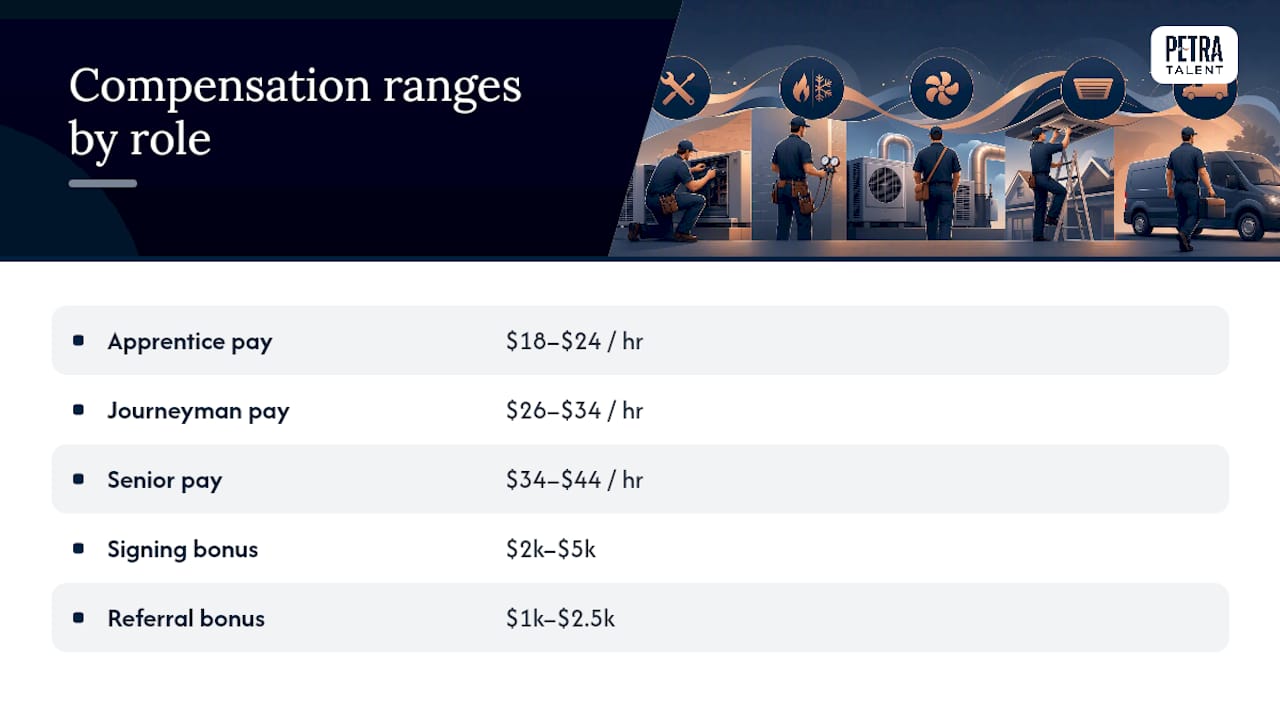
Pay and incentives. Base pay ranges vary sharply by experience: apprentices typically earn $18 to $24 per hour, journeymen $26 to $34, and senior or lead technicians $34 to $44, according to Bureau of Labor Statistics data. Layer in signing bonuses of $2,000 to $5,000 with a clawback clause, and referral bonuses of $1,000 to $2,500, which pay for themselves quickly against typical placement costs.
Vehicles and tools. A fully loaded company truck runs roughly $600 to $1,000 a month once you factor fuel, maintenance, and insurance. A tool stipend is cheaper but shifts equipment risk to the technician.
Training. Paying exam fees and offering paid study days for NATE or EPA certification is one of the cheapest retention levers available, since certifications can add a wage premium once earned.
Pro Tip: Structure signing bonuses as two payments, half at 90 days and half at 12 months, instead of one lump sum. It keeps the incentive alive well past the honeymoon period.
How Do Small Contractors Roll Out Benefits Affordably?
You don’t need to launch a full benefits suite on day one. A staged rollout protects cash flow while still building a package that competes for talent.
- Pilot with key hires first. Offer the full package (health, retirement, disability) to your two or three most critical technicians, then expand to the full team within six months once the cost curve is clear.
- Start retirement with a SIMPLE IRA. It requires far less administrative overhead than a 401(k) and still qualifies as a genuine retirement benefit for recruiting purposes.
- Use pooled or level-funded health insurance. Association pools spread risk across multiple small employers, which brings pricing closer to what larger shops pay.
- Add voluntary benefits at no direct cost. Dental, vision, and supplemental life plans are often employee-paid through payroll deduction but still count as a meaningful perk.
- Fix operational friction before chasing wage increases. Reliable dispatching, complete job information, and a working company vehicle often do more for retention than a $2 hourly raise, since operational friction routinely outranks marginal pay bumps in what technicians say drives them to leave.
- Automate the admin. Run bonus payouts and benefit deductions through payroll software, and put vesting or clawback terms in writing before the first bonus goes out.
Technicians who get health coverage and a retirement option from an employer tend to stay two to three years longer than those who don’t, which is the kind of tenure gain that offsets the cost of a modest benefits rollout within a year or two for most shops.
How Do You Measure Whether Benefits Are Working?
Track four numbers: turnover rate, time-to-fill for open technician roles, retention at the 12-month mark, and actual benefit utilization. If technicians enroll in the health plan but never touch the retirement match, that’s a communication gap, not a design flaw.
A simple ROI check works: compare your average cost to replace a technician against your annual benefits spend per employee. If replacement costs exceed benefits costs, the payback period is short, often under a year.
- Walk every new hire through the full benefits package during onboarding, not buried in a packet.
- Send a one-page benefits summary technicians can keep in their truck.
- Recognize wins monthly, not just at year-end reviews.
- Make SPIFF earnings visible through a simple dashboard so technicians see progress in real time.
Immediate, visible payouts work better than delayed ones. Reloadable-card SPIFFs for same-day wins, like a five-star review or a completed maintenance agreement, reinforce the exact behavior you want repeated far more effectively than an annual bonus check ever does.
What Does Petra Talent See Across HVAC Hiring?
Sourcing and vetting technicians across mechanical contractors surfaces the same retention gaps repeatedly: shops that skip retirement matching or disability coverage lose senior technicians to competitors offering both, even at similar hourly pay. Contractors who pair a retirement match with predictable weekly scheduling consistently retain technicians longer than those competing on hourly rate alone.
The pattern holds across shop sizes. A small residential contractor offering a SIMPLE IRA and fixed weekend rotation often out-retains a larger competitor stuck in a wage bidding war. For contractors building or refining a package, pay benchmarking data and root-cause turnover analysis matter more than matching a competitor’s headline wage.
The Overrated Benefit and the Underrated One
Most contractors chase the wrong lever first. Signing bonuses get the attention because they’re fast and easy to advertise, but they’re a short-term fix. A technician who takes a $3,000 signing bonus with no retirement match and no predictable schedule is still a flight risk in month fourteen, right after the clawback period ends.
The genuinely underrated benefit is schedule predictability paired with a working retirement match. Neither shows up on a job posting the way “$5,000 signing bonus” does, but both address the actual reasons technicians quit: burnout and a sense that the job has no future attached to it. Contractors who treat retirement matching as core infrastructure rather than a nice-to-have consistently see better 12-month retention than shops that lead with cash incentives alone.
If you’re building a package from scratch, sequence matters. Get health coverage and a retirement match in place first, even at a modest employer contribution. Layer in disability coverage and predictable scheduling second. Save signing bonuses for closing specific hard-to-fill roles, not as your primary retention tool. The data on tenure gains from health and retirement benefits is stronger than the data on signing bonuses, and contractors who reverse that priority usually end up rehiring for the same seat twice.
— David
Get Help Designing a Benefits Package That Retains Technicians
Contractors can get direct access to wage benchmarking and technical vetting instead of piecing together numbers from job boards and competitor rumors when building a benefits package. That matters because a package built on outdated pay assumptions loses candidates before benefits even enter the conversation.

Beyond benchmarking, Petra Talent’s workforce consultation services help contractors figure out which benefits will actually move retention for their specific crew size and region, rather than copying a generic list. Technical vetting ensures the technicians hired are genuinely qualified for the roles, so retention investment isn’t wasted on a bad fit from day one.
If you’re ready to see how your current package compares to market and where the gaps are costing you technicians, request a wage benchmark and consultation through Petra Talent’s services page.
Sources
- U.S. Bureau of Labor Statistics
- The benefits package your best technicians are quietly comparing you against | PM Magazine
- Retirement plans are today’s top HVAC recruitment and retention tool | ACHR News
- How to Hire HVAC Technicians in 2026 | Recruiting Guide for Contractors
FAQ
What benefits do HVAC technicians value most?
Affordable, low-deductible health insurance and disability coverage rank highest, followed closely by a retirement plan with an employer match and predictable weekly scheduling.
Is a SIMPLE IRA or 401(k) better for a small HVAC contractor?
A SIMPLE IRA requires less administrative overhead and works well for smaller shops, while a 401(k) suits larger contractors that need higher contribution limits and more plan flexibility.
How much should a signing bonus be for an HVAC technician?
Signing bonuses typically range from $2,000 to $5,000, usually paired with a clawback clause tied to a minimum tenure of 12 months.
Do certifications really increase HVAC technician pay?
Yes.
What’s the average base pay range for HVAC technicians?
Apprentices typically earn $18 to $24 per hour, journeymen $26 to $34, and senior or lead technicians $34 to $44, based on Bureau of Labor Statistics data.
How can a small contractor afford benefits without breaking the budget?
Start with a SIMPLE IRA, a pooled or level-funded health plan, and voluntary benefits like dental and vision, then expand the package after piloting it with a few key hires for six months.
Recommended
Related Posts

October 13, 2026
Recruiting Contract Terms: 10 Checks and Ready to Use Clauses
Define fee triggers, candidate ownership, guarantees, and compliance terms. Get a master agreement, short schedule,…

October 12, 2026
Offer Acceptance Rates: Segment Benchmarks, HVAC’s 3–5 Day SLA
See why a 78% to 82% offer acceptance benchmark can mislead, how role and source…

October 11, 2026
Bad Hires Can Cost Construction Firms 30% to 200% of Salary
Bad hires can cost construction firms 30% to 200% of annual salary. Calculate recruiting, rework,…

October 10, 2026
Construction Labor Forecasting for PMs: 7 Steps to Time Hiring
Learn when construction project managers should use WBS or simulation, track labor KPIs, and turn…