




On most U.S. jobsites, the apprentice-to-journeyman ratio starts at 1:1 for the first apprentice, then scales to 1:2, 1:3, or 1:5 for each additional apprentice, depending on the trade and the state apprenticeship committee’s published standard. Your immediate next steps: pull the registered apprenticeship standard for your trade and state, confirm every apprentice on the crew holds a current registration number, and start keeping daily supervision logs today.
- Check your state apprenticeship agency or the U.S. Department of Labor apprenticeship portal for your program’s approved ratio.
- Confirm each apprentice is registered with an approved sponsor before they set foot on a prevailing-wage project.
- Retain daily logs, certified payroll records, and sponsor approval letters for every shift.
- Verify your program approval status before bidding on any Davis-Bacon or state prevailing-wage project.
State-specific authorities to check immediately: the California Division of Apprenticeship Standards for California projects, Michigan MCL §339.5717 for Michigan electrical work, and the Minnesota Department of Labor and Industry for Minnesota trades.
Key Takeaways
Apprentice-to-journeyman ratios are daily, per-shift operational limits set by state law, registered apprenticeship standards, or collective bargaining agreements, and noncompliance on prevailing-wage projects triggers back-wage liability, corrective action, and potential debarment.
| Point | Details |
|---|---|
| Ratios start at 1:1 | Most states require one journeyworker for the first apprentice; subsequent ratios scale to 1:2, 1:3, or 1:5 by trade. |
| Daily logs are the audit target | Auditors review per-shift records, not annual averages; incomplete logs are the most common cause of findings. |
| Registration is non-negotiable | An unregistered apprentice on a Davis-Bacon project must be paid the full journeyworker prevailing wage retroactively. |
| Exemptions require advance approval | Ratio exemptions must be formally requested and granted in writing before the project begins, not after an audit notice. |
| Petratalent supports ratio compliance | Petratalent’s recruiting, technical vetting, and workforce consultation services help HVAC and plumbing contractors maintain journeyworker coverage and avoid ratio gaps. |
Table of Contents
- What apprentice-to-journeyman ratios mean and how to read them
- How apprenticeship ratios are established
- How ratios affect Davis-Bacon and prevailing-wage projects
- Representative ratio patterns by trade
- How to calculate allowed apprentices and what to document daily
- Common exemptions, temporary allowances, and multi-trade complications
- What auditors look for and how to respond
- Authoritative federal and state resources to check
- Workforce-planning practices that reduce ratio compliance risk
- What enforcement trends reveal about staffing strategy
- How Petratalent helps contractors stay ratio-compliant
- Sources
What apprentice-to-journeyman ratios mean and how to read them
The apprentice-to-journeyman ratio is the maximum number of registered apprentices a contractor may have working under the supervision of a licensed journeyworker at any given time on a jobsite. It is an onsite, per-shift operational limit, not an annual headcount average.
Key terms to know:
- Apprentice: A worker enrolled in a registered apprenticeship program, learning a trade under structured supervision while earning wages.
- Journeyworker (journeyman): A fully trained, licensed tradesperson who has completed an apprenticeship and holds the credential to supervise apprentices in their trade.
- Registered apprentice: An apprentice formally enrolled with a state or federal apprenticeship program sponsor, which is a prerequisite for ratio credit on prevailing-wage jobs.
- Sponsor/training agent: The employer, union, or joint apprenticeship training committee (JATC) that administers the apprenticeship program and sets the training standards.
How to read ratio notation:
Ratios are typically written as apprentices-to-journeyworkers. A ratio of 1:1 means one apprentice per one journeyworker. A ratio written as “1:1, then 1:3” means the first apprentice requires one journeyworker, and each subsequent apprentice requires one journeyworker for every three apprentices.
Worked example: A plumbing crew has four journeyworkers on a commercial project. Under a 1:1 first-apprentice rule followed by a 1:3 subsequent rule, the crew may have one apprentice for the first journeyworker, then up to one additional apprentice per three journeyworkers for the remaining three. That gives a maximum of two apprentices on this crew. If the standard were 1:2 for subsequent apprentices, the math shifts accordingly.
Ratios apply per shift, per trade, and per jobsite. A journeyworker counted toward one crew’s ratio generally cannot simultaneously count toward another crew’s ratio on a separate site.
Pro Tip: When a single journeyworker performs tasks across multiple trades on the same shift, check whether your state’s committee standard allows that journeyworker to count toward the ratio for both trades or only one. Most state standards require trade-specific supervision.
How apprenticeship ratios are established
The authority that sets your ratio follows a clear hierarchy. Knowing which level controls your project determines where you look first.
Order of authority:
- State statute: Some states write specific numeric ratios directly into law. Michigan’s MCL §339.5717 is one example, setting a statutory basis for electrician ratios that contractors must follow regardless of any other agreement.
- Registered apprenticeship standard: The committee or sponsor’s approved apprenticeship standard, filed with the state apprenticeship agency or the DOL, typically contains the operative ratio. This document controls on most projects.
- Collective bargaining agreement (CBA): On union projects, the CBA may set a different ratio or grant specific exemptions. A CBA ratio that is more restrictive than the state standard controls; a CBA that is more permissive does not override state law.
- Sponsor-specific rules: Individual program sponsors may impose additional requirements within the bounds of the registered standard.
California’s approach illustrates how state law and agency authority interact. California Labor Code §1777.5 establishes the statutory duty to employ apprentices on public works projects, while the California Division of Apprenticeship Standards publishes the minimum ratios and administers the exemption process.
State agency documents vary considerably in format and notation. Rhode Island’s committee ratio guidance uses committee-specific instructions and mixed notation that differs from California’s or Oregon’s published charts. Read each state’s document precisely before applying it.
Practical tip for determining which standard controls your project: Review the contract documents and the project’s funding source. Federal or state prevailing-wage funding typically requires the applicable registered apprenticeship standard. Union projects follow the CBA first, then the state standard where the CBA is silent.
Note on CBAs: A collective bargaining agreement can negotiate ratio exemptions or trade-specific allowances, but those provisions must still be consistent with the state’s minimum ratio law. When in doubt, the more protective rule applies.
How ratios affect Davis-Bacon and prevailing-wage projects
On federal and state prevailing-wage projects, the apprentice-to-journeyman ratio carries direct payroll consequences. An apprentice who is not registered with a DOL-approved or state-approved program cannot be paid at the apprentice wage rate on a Davis-Bacon project. The contractor must pay that worker the full journeyworker prevailing wage for every hour worked, retroactively if necessary.
DOL apprenticeship guidance explains the program approval process and how approved apprentices qualify for the apprentice wage rate on covered projects.
Documentation auditors expect on prevailing-wage jobs:
- Certified payroll records (WH-347 or state equivalent) showing each worker’s classification, wage rate, and hours.
- Proof of apprentice registration: the registration certificate or letter from the approved program sponsor.
- Supervision logs showing which journeyworker supervised which apprentice on each shift.
- Sponsor approval letters confirming the program is currently registered and in good standing.
- The approved apprenticeship standard itself, showing the applicable ratio for the trade.
Two scenarios that illustrate the stakes:
- Approved apprentice, correct ratio: A registered plumbing apprentice works under a licensed journeyworker plumber at the committee-approved 1:1 ratio on a Davis-Bacon project. The contractor pays the apprentice wage rate. Certified payroll reflects the correct classification. No liability.
- Unregistered worker classified as apprentice: A contractor places a helper with no registration in the apprentice slot to reduce labor costs. An auditor flags the missing registration number on certified payroll. The contractor owes back wages at the full journeyworker prevailing rate for every hour that worker was misclassified, plus potential penalties.
The distinction between these two scenarios often comes down to a single document: the registration certificate. Keep it on file for every apprentice before the first shift begins.
Representative ratio patterns by trade
Ratios vary by trade, state, and committee. The patterns below reflect common structures contractors encounter; always verify the current standard with the applicable state agency or committee before relying on any example.
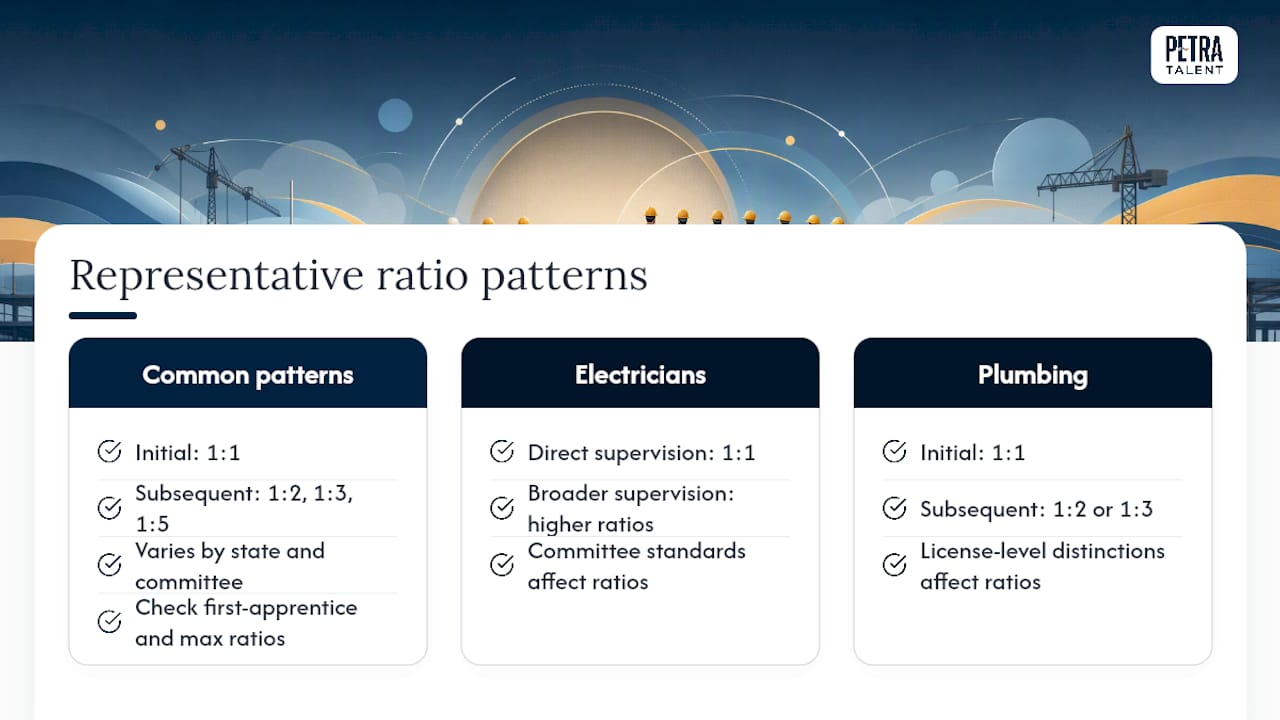
As the Minnesota Department of Labor and Industry notes, ratios are highly localized and trade-specific, with many states using a 1:1 initial ratio and subsequent scales of 1:2, 1:3, or 1:5 depending on the trade and committee standards.
For electricians specifically, some state frameworks tie the permitted ratio to the supervision level: direct supervision may allow 1:1, while broader supervision models permit higher ratios. These supervision-level distinctions appear in committee standards and affect how foreman crew ratios work in practice.
Apprentice ratio plumbing note: Plumbing ratios in most states start at 1:1 and move to 1:2 or 1:3 for subsequent apprentices. Some states distinguish between licensed journeyworker plumbers and plumber’s apprentices at different training levels, which can affect the ratio calculation on larger crews.
Pro Tip: State committee-published ratio charts, such as Oregon’s apprenticeship ratio data PDF, list both the first-apprentice ratio and the maximum ratio per trade. Always check both columns. The maximum ratio caps total apprentices regardless of how many journeyworkers are on the crew.
How to calculate allowed apprentices and what to document daily
Getting the daily calculation right is the first line of defense against an audit finding.
Step-by-step calculation:
- Count the number of licensed journeyworkers present and working on the jobsite for that shift.
- Identify the applicable ratio from your registered apprenticeship standard (first-apprentice rule, then subsequent rule).
- Apply the first-apprentice rule: one apprentice is permitted for the first journeyworker.
- Apply the subsequent rule to the remaining journeyworkers. If the ratio is 1:3, divide the remaining journeyworker count by three (round down, never up).
- Add the results from steps 3 and 4 to get the maximum permitted apprentices for that shift.
- Compare the actual apprentice count to the permitted maximum. If actual exceeds permitted, stop work on the excess apprentice’s tasks or bring in an additional journeyworker before continuing.
Example: Five journeyworkers on a commercial HVAC crew, subsequent ratio of 1:3. First apprentice: 1 (for the first journeyworker). Remaining journeyworkers: 4, divided by 3 = 1 (rounded down). Maximum permitted apprentices: 2.
Daily documentation checklist:
- Registered apprentice ID numbers and current registration certificates.
- Sponsor approval letter confirming program registration status.
- Journeyworker license numbers for each supervising journeyworker.
- Certified payroll reflecting correct classifications and wage rates.
- Supervision log: apprentice name, registration number, trade, supervising journeyworker name and license number, tasks performed, shift start and end times.
- Time-stamped sign-in sheets for all workers on the crew.
Pro Tip: Retain all ratio-related documentation for at least three years, which aligns with common federal audit lookback periods. Store digital copies with a cloud backup and keep physical copies on the jobsite during active work. Oregon’s published apprenticeship ratio data and agency guidance pages confirm that documentation requirements apply throughout the project, not just at the start.
Common exemptions, temporary allowances, and multi-trade complications
Exemptions exist, but they require affirmative action. A contractor cannot simply decide a ratio does not apply; the exemption must be formally requested and granted.
Common exemption categories:
- Ratio exemptions for limited residential work: Some states allow higher ratios or reduced requirements on small residential projects below a certain contract value or square footage threshold.
- Training-only or task-limited exceptions: A few programs allow apprentices to perform specific training tasks under modified supervision without counting against the full ratio, provided the tasks are defined in the apprenticeship standard.
- Geographic shortage exemptions: When a state agency determines that qualified journeyworkers are not available in sufficient numbers, it may grant a temporary ratio increase.
- Program-specific committee exemptions: Some joint apprenticeship training committees have built-in provisions for ratio adjustments during peak demand or project-specific circumstances.
California’s Division of Apprenticeship Standards describes a formal exemption process tied to Labor Code authorities, requiring contractors to submit documentation showing why the standard ratio cannot be met.
How to request a waiver or exemption:
- Identify the applicable state agency or committee that administers the exemption process.
- Gather documentation: project description, journeyworker availability evidence, apprenticeship program enrollment data, and the specific ratio provision you are requesting relief from.
- Submit the written request before the project begins, not after an audit notice arrives.
- Retain the agency’s written response as part of your project file.
- If the exemption is granted, document the terms and expiration date and apply them only within those bounds.
Multi-trade crews: When apprentices perform tasks that cross trade lines, the ratio calculation becomes more complex. Most state standards require that each apprentice be counted against the ratio for their registered trade, supervised by a journeyworker in that same trade. An apprentice registered as a plumber cannot be supervised by an electrician for ratio purposes, even if the tasks overlap. When genuinely cross-trade work is required, contact the relevant state apprenticeship committees for written guidance before proceeding.
What auditors look for and how to respond
Ratio audits on prevailing-wage projects typically focus on daily records, not annual summaries. Auditors compare certified payroll to supervision logs and look for gaps between what was reported and what actually happened on the jobsite.
Common audit red flags:
- Missing or invalid apprentice registration numbers on certified payroll.
- Apprentices listed in the payroll who are not enrolled in an approved program.
- Supervision logs that are incomplete, unsigned, or inconsistent with payroll dates.
- Journeyworker counts that fluctuate without corresponding adjustments to apprentice counts.
- Workers classified as apprentices who are performing journeyworker-level tasks without a registered journeyworker present.
- Ad-hoc substitutions of unqualified labor when journeyworkers are absent.
Typical penalties and consequences:
- Back wages at the full journeyworker prevailing rate for every hour an unregistered or over-ratio apprentice worked.
- Corrective action orders requiring the contractor to bring the crew into compliance within a specified period.
- Debarment from future prevailing-wage projects, which can be a significant commercial consequence for contractors who rely on public work.
- Contract termination in severe or repeat cases.
Audit response flow:
- Acknowledge receipt of the audit notice in writing within the required response window.
- Pull all relevant records: certified payroll, supervision logs, registration certificates, sponsor letters, and the approved apprenticeship standard.
- Identify the specific shifts or workers the auditor has flagged.
- Prepare a written response that addresses each finding with supporting documentation.
- If a violation occurred, calculate the back-wage liability before the auditor does and present a remediation plan proactively.
- Engage legal counsel familiar with prevailing-wage enforcement if debarment is a stated risk.
Documentation that consistently resolves audit findings includes the original registration certificate from the program sponsor, the signed supervision log for the shift in question, and the certified payroll showing the correct wage rate. When all three align, most findings are closed without further penalty.
Authoritative federal and state resources to check
Federal:
- U.S. Department of Labor Apprenticeship: Program approval, Davis-Bacon interaction, and national apprenticeship standards. Use this to verify program registration status and find the applicable wage determination.
State agencies and statutes:
- California Division of Apprenticeship Standards: Minimum ratios, exemption process, and Labor Code references. Use this for any California prevailing-wage project.
- California Labor Code §1777.5: The statutory basis for apprenticeship duties on California public works.
- Minnesota Department of Labor and Industry: Minnesota’s trade-by-trade ratio guidance and program information.
- Oregon Bureau of Labor and Industries Apprenticeship Ratio Data: Trade-specific first and maximum ratio chart for Oregon committees.
- Connecticut Journeyperson to Apprentice Hiring Ratio Chart: State committee ratio table by trade.
- Rhode Island Department of Labor and Training Company Ratio Guidance: Committee-specific ratio instructions illustrating how notation and rules vary by state.
Search tip: When looking for your state’s ratio standard, search “[state name] apprenticeship ratio” plus your trade name and the state labor department’s domain. Most state apprenticeship divisions publish either a PDF ratio chart or a web-based table. If the page is not immediately visible, call the state apprenticeship office directly and ask for the current ratio chart for your trade and committee.
Contact template for state agencies: “I am a licensed [trade] contractor working on a [project type] project in [city/county]. I need to confirm the current apprentice-to-journeyman ratio for [trade] under the [committee name] apprenticeship standard. Can you direct me to the current published ratio chart or confirm the ratio in writing?”
Workforce-planning practices that reduce ratio compliance risk
Ratio compliance is ultimately a staffing problem. When journeyworker coverage is thin, the ratio breaks. The contractors who avoid audit findings are the ones who plan their crew composition before the project starts, not after a notice arrives.
Hiring checklist for ratio-compliant crews:
- Verify apprentice program registration before the hire offer is made, not on the first day of work.
- Prioritize journeyworker-to-apprentice pairing in your scheduling software so the ratio is visible before each shift is finalized.
- Hire journeyworkers who hold licenses in multiple trades where your projects require it, reducing the risk of a ratio gap when one trade’s journeyworker is absent.
- Build a candidate pipeline for journeyworkers so that an unexpected departure does not immediately create a ratio violation. Guidance on building an HVAC apprenticeship pipeline can help structure that process.
- For plumbing crews specifically, review strategic plumbing apprentice hiring practices that align registration timelines with project start dates.
Staffing scenarios that keep crews compliant:
A crew of three journeyworkers with a 1:1 first-apprentice and 1:3 subsequent ratio can support two apprentices. If one journeyworker calls out sick, the permitted apprentice count drops to one. A contractor with a bench of qualified journeyworkers can call in a replacement and maintain the ratio. A contractor without that bench either sends an apprentice home or risks a violation.
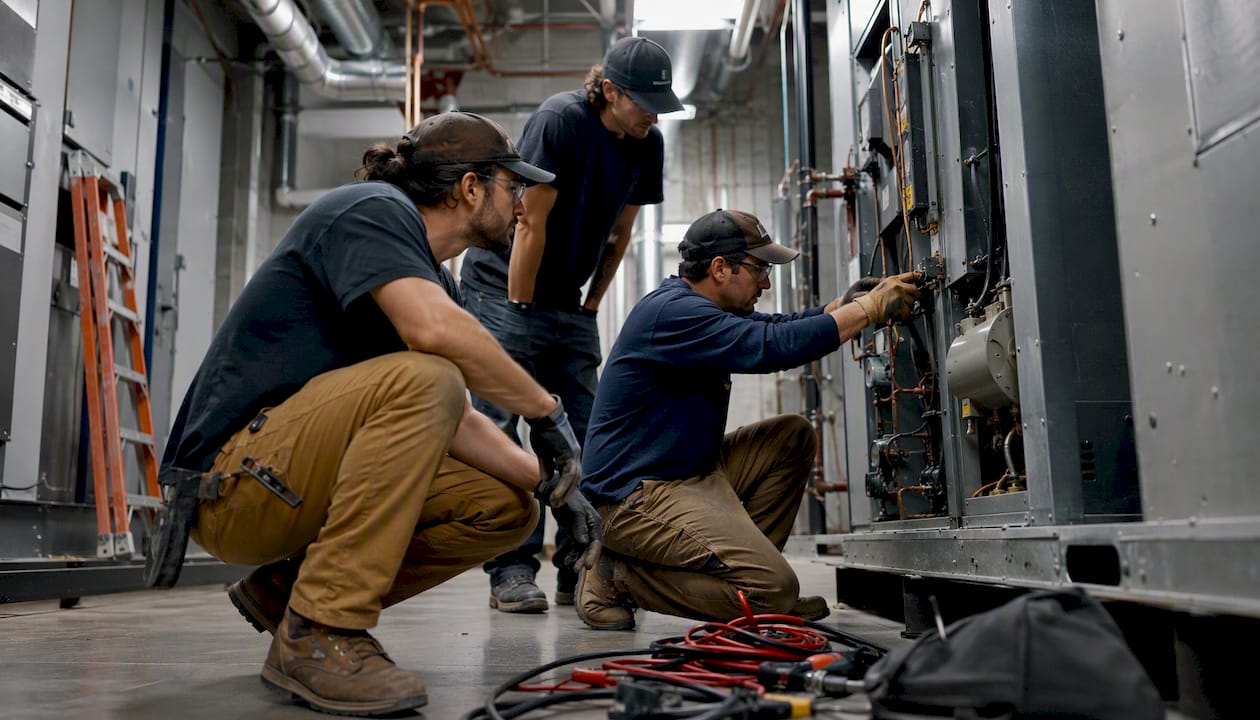
Peak demand periods create the same problem at scale. When multiple projects run simultaneously, journeyworker availability becomes the binding constraint. Contractors who track their journeyworker-to-apprentice ratio across all active projects, not just one site, catch potential violations before they happen.
Pro Tip: Assign a single compliance lead on each project, typically the foreman or superintendent, who is responsible for verifying the ratio at the start of every shift and signing the daily supervision log. This single accountability point prevents the “I thought someone else checked” gap that auditors find most often.
What enforcement trends reveal about staffing strategy
Enforcement activity on apprenticeship ratios has grown more consistent over the past several years, particularly on federally funded infrastructure and energy projects where Davis-Bacon compliance is a contract condition. Auditors are no longer relying solely on certified payroll spot-checks. They are cross-referencing payroll records against supervision logs, registration databases, and even jobsite sign-in sheets. The documentation bar has risen.
What this means practically: a contractor who has the right ratio on paper but cannot produce the daily supervision log for a specific shift is in the same position as a contractor who violated the ratio outright. The absence of documentation is treated as evidence of noncompliance, not as a neutral gap.
The most effective mitigation is not a compliance manual. It is a staffing model that keeps journeyworker coverage stable enough that the ratio is never at risk. Contractors who maintain a reliable pipeline of vetted journeyworkers, particularly in HVAC and plumbing where licensing requirements are strict, consistently outperform their peers in audit outcomes. The compliance problem and the hiring problem are the same problem.
How Petratalent helps contractors stay ratio-compliant
Ratio compliance depends on having the right journeyworkers available before the project starts, not scrambling to fill gaps after a crew is already on the clock. Petratalent specializes in sourcing and vetting licensed journeyworkers and apprentices for HVAC and plumbing contractors across the United States, with a process built around the credential verification and technical screening that compliance-sensitive projects require.

Petratalent’s plumbing recruiting services and technical vetting and workforce solutions are designed specifically for mechanical contractors who need to maintain journeyworker coverage across multiple active projects. Every candidate is screened for license status, program registration, and trade-specific competency before being presented. For contractors managing prevailing-wage work, that pre-vetting step removes the most common source of audit exposure. Contact Petratalent through the services overview page to discuss your current crew composition and where workforce gaps are creating ratio risk.
Sources
- Apprenticeship ratios | Minnesota Department of Labor and Industry
- Division of Apprenticeship Standards – Minimum Ratios
- Apprenticeship | U.S. Department of Labor
- Journeyperson to Apprentice Hiring Ratio Chart (Connecticut)
- APPRENTICESHIP RATIO DATA *
- Company_Ratio.pdf (Rhode Island Department of Labor and Training)
- California Labor Code §1777.5 – Apprentices
Recommended
Related Posts

October 14, 2026
HVAC Recruiter Fees: Contractors Weigh $10,000 Against Vacancy Costs
See how HVAC recruiter fees work for contractors, from 15% to 25% placement costs to…

October 13, 2026
Recruiting Contract Terms: 10 Checks and Ready to Use Clauses
Define fee triggers, candidate ownership, guarantees, and compliance terms. Get a master agreement, short schedule,…

October 12, 2026
Offer Acceptance Rates: Segment Benchmarks, HVAC’s 3–5 Day SLA
See why a 78% to 82% offer acceptance benchmark can mislead, how role and source…

October 11, 2026
Bad Hires Can Cost Construction Firms 30% to 200% of Salary
Bad hires can cost construction firms 30% to 200% of annual salary. Calculate recruiting, rework,…