



Plan for an effective plumbing hiring cost that can vary widely depending on the role and market, often centering around several thousand dollars for a journeyman-level technician once you count sourcing, agency or recruiter fees, and onboarding time. Three factors move that number more than anything else: whether you use an agency or recruiter (adds a one-time percentage fee), how much internal recruiting time gets burned before someone starts, and how long onboarding takes before the new hire is fully productive. Specialized recruiters build costed hire plans that pin these numbers down for a specific role and market before a contractor commits to a channel.
TL;DR:
- Using an agency or recruiter typically adds 15% to 30% to the first-year salary cost, with internal recruiting and onboarding adding several thousand dollars per hire.
- The average sourcing-only cost can range from $680 to nearly $2,800 per hire, depending on show rates and recruitment channel efficiency.
- For roles expected to last less than six months, temp-to-hire options usually reduce overall hiring costs; for hard-to-fill or leadership roles, specialized recruiters tend to be more cost-effective.
- Improving show rates, targeting role-specific channels, and building internal referral pipelines significantly lower the actual costs of hiring in skilled trades.
Table of Contents
- What Actually Goes Into the Cost of Hiring a Plumber
- What Do BLS Wage Benchmarks Mean for Your Per-Hire Total?
- Which Hiring Channel Actually Costs Less?
- How Do You Budget for Plumbing Hiring Costs?
- What Petra Talent Sees Across Contractor Hiring Budgets
- Get a Costed Hire Plan Before You Post the Next Job
- Sources
What Actually Goes Into the Cost of Hiring a Plumber
The cost of hiring a plumber breaks into six buckets, and most contractors only track two of them. Skipping the other four is why hiring budgets blow past estimates.
Sourcing and advertising spend covers job board postings, sponsored listings, and social ads. Job boards typically incur costs per posting cycle, but the more significant expense is often internal recruiting time.
Internal recruiting time is the hidden cost most contractors underprice. If a service manager or owner spends 8 to 10 hours screening resumes, conducting phone screens, and coordinating interviews at a fully loaded rate of $40 to $60 an hour, that alone adds $320 to $600 per hire before anyone signs an offer letter. Industry analysis of craft-worker recruiting puts the effective cost of hiring one craft worker on job boards at a midpoint of roughly $1,921 once sourcing spend and internal time are combined, with a range from about $680 to $2,788 depending on show rates.
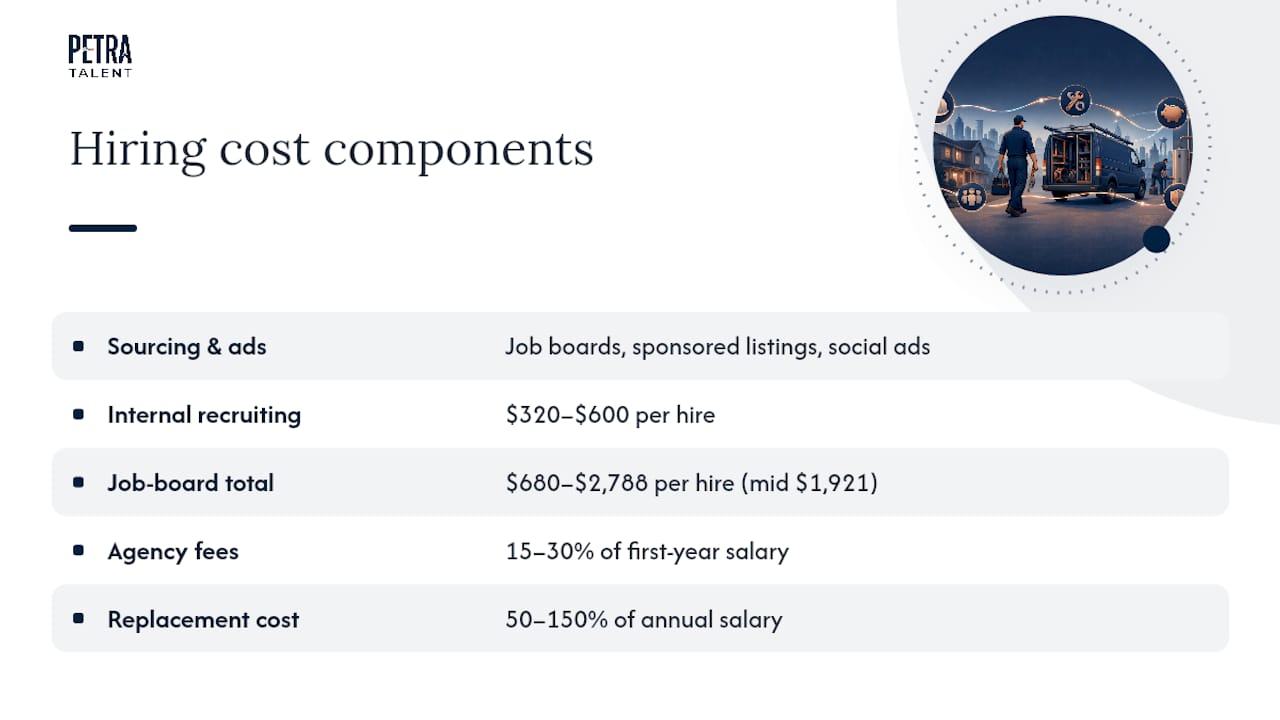
Agency or recruiter fees apply when you outsource the search. Direct-hire placement fees commonly run between 15% and 30% of first-year salary, with senior and hard-to-fill roles landing at the higher end.
Onboarding and training costs include supervisor time spent shadowing the new hire, reduced productivity during ramp-up, and any tools or gear issued on day one. A new journeyman rarely runs at full productivity for the first 30 to 60 days.

Replacement cost is the number that punishes a rushed hire. When a hire doesn’t work out, replacement costs for skilled trades typically run 50% to 150% of that role’s annual salary, factoring in lost productivity, overtime coverage, and a second round of recruiting.
Pro Tip: Before you post a single job ad, calculate what a bad hire costs you in overtime coverage alone. That number usually justifies spending more upfront on vetting.
What Do BLS Wage Benchmarks Mean for Your Per-Hire Total?
The Bureau of Labor Statistics reported a median annual wage of $62,970 for plumbers, pipefitters, and steamfitters in May 2024, or about $30.27 an hour. That’s your salary baseline before fees and overhead get layered on.
Here’s how the math works for a journeyman plumber hired through a direct-hire agency at the median wage:
- Base salary: $62,970
- Agency fee at 20%: $12,594
- Internal recruiting time (screening, coordination): $450
- Onboarding and supervisor ramp-up (first 45 days): $1,800
- Employer taxes and workers’ comp (roughly 12% combined): $7,556
- Total effective hiring cost: approximately $22,400 on top of first-year salary
Run that same math without an agency, relying purely on job boards and internal sourcing, and the fee line drops out but internal time and a lower show rate often push the sourcing-only cost closer to the $1,900 to $2,800 range cited in craft-worker recruiting benchmarks, plus a longer time-to-fill.
For adjacent roles, related trades show a median near $59,810, and a plumbing estimator’s salary target typically runs higher once experience and bidding responsibility are factored in. Regional wage percentiles matter too. Metro-area OEWS tables show significant swings, so a contractor in a high-cost metro should adjust the base salary upward before running any fee percentage against it. Reviewing plumbing labor market trends helps calibrate that adjustment before you finalize a budget.
Which Hiring Channel Actually Costs Less?
Channel choice changes your effective cost more than most contractors expect, and the cheapest option on paper isn’t always the cheapest in practice.
- Job boards plus internal sourcing work best for high-volume, entry-to-mid-level roles where you have recruiting bandwidth in-house. Expect $680 to $2,788 per hire depending on show rate, with the lower end requiring strong screening discipline.
- Direct-hire agency placement fits permanent roles where tenure is expected to exceed a year. The 15% to 30% fee is a one-time cost, and it often beats extended temp markups once you calculate total spend over 12 months.
- Temp-to-hire and staffing markup models carry an ongoing percentage markup rather than a flat fee, making them a better fit for project-based plumbing work with uncertain duration.
- RPO or hybrid recruiter arrangements suit contractors filling multiple roles at once, spreading a flat monthly or per-recruiter fee across several hires.
A few rules of thumb cut through the noise:
- If expected tenure is under six months, temp or temp-to-hire almost always beats a direct-hire fee.
- If the role is leadership or hard-to-fill, a specialized recruiter’s higher fee usually costs less than months of an empty seat.
- Low show rates on job boards quietly double your effective cost per hire even when the posting itself was free.
How Do You Budget for Plumbing Hiring Costs?
Use this formula to estimate the effective cost per start for any role:
(Sourcing spend + agency/recruiter fee + internal time cost + onboarding cost + taxes/insurance) ÷ show rate = effective cost per start
Show rate matters more than most line items. If only half the candidates who accept an interview actually show up, your effective cost doubles even though nothing else changed.
Six levers move that number, roughly in order of impact:
- Improve show rate through same-day confirmation calls and clear expectations up front.
- Tighten screening criteria before scheduling interviews, not after.
- Target channels by role level instead of running every opening through the same job board.
- Use temp-to-hire for project-length uncertainty rather than committing to a direct-hire fee too early.
- Build an internal referral pipeline so open roles aren’t starting from zero every time.
- Bring in a specialized recruiter selectively for leadership or chronically hard-to-fill positions, not every opening.
Track three KPIs to know if these levers are working: show rate by market and trade, minutes spent per hire, and effective cost per start calculated with the formula above. Guidance on passive candidate recruiting for trades hiring offers additional tactics for the pipeline-building lever specifically.
Pro Tip: When a role has sat open for more than 45 days, the math almost always favors bringing in a specialized recruiter. The cost of the empty seat is compounding faster than the fee would.
What Petra Talent Sees Across Contractor Hiring Budgets
Contractors consistently underestimate internal time and overestimate what a free job posting actually costs them. Recruitment agencies typically recommend direct-hire placement for permanent journeyman, supervisor, and leadership roles where tenure expectations run past a year, and internal sourcing for high-volume entry-level positions where a contractor already has recruiting bandwidth.
One recurring pattern from engagement history: a contractor with a role open for 60-plus days often has an effective cost already exceeding what a specialized recruiter would have charged from day one. Contractors interested in seeing this math run against their own specific role and market can request a comparable analysis from a recruitment partner.
Author background and detailed case-study metrics available on request.
— David
Get a Costed Hire Plan Before You Post the Next Job
Some recruitment partners turn the math in this article into a specific number for your open role, not a generic range. A recruiting partner specialized in HVAC and plumbing hiring can help determine which fee model, sourcing mix, and screening approach lowers your effective cost per hire, rather than guessing between a job board and an agency.

A request to a recruiting partner typically returns a market wage benchmark for the role and region, a costed hire plan showing sourcing, fee, and onboarding line items side by side, a vetted candidate shortlist, and sometimes a replacement guarantee if the placement doesn’t work out. Most engagements move from intake call to shortlist within a couple of weeks, depending on role seniority and how tight the local labor market is. Contractors weighing internal sourcing against outsourcing can also strengthen applicant flow with better employer branding through resources like plumber-focused marketing support, which helps more candidates find your postings in the first place.
For a permanent journeyman, supervisor, or leadership hire, start by reviewing Petra Talent’s services or go straight to the plumbing staffing agency page to request a costed estimate for your next open role.
Sources
- Plumbers, pipefitters, and steamfitters — Occupational Outlook Handbook — BLS
- $1,921: The effective cost of hiring one craft worker on job boards — Skillit
- UPDATE: Average Staffing Agency Markup, 2026 Report – The Resource Company, Inc.
- The Real Cost of Turnover in Skilled Trades — Ameri-Force
Recommended
Post a comment
Related Posts

September 20, 2026
Construction Offer Letters for HR: Site Assignments, Certs, Petra Tips
HR ready construction offer letters: copy ready language for site assignments, certs, contingencies, and a…

September 19, 2026
Create E-Verify Cases by Day Three: U.S. HVAC & Plumbing Rules
E-Verify for U.S. HVAC and plumbing contractors: who needs I-9s, the three business day case…

September 18, 2026
72.5¢ Rate: Take Home Vehicle Policy for Employers and Agencies
Checklist and policy language for employers and agencies: apply the IRS 2026 mileage rate (72.5…

September 17, 2026
Avoid Overtime Back-Pay: Job-to-Job Travel Pay for U.S. Technicians
U.S. employers: learn DOL/WHD travel-pay tests, a blended rate overtime example, state pitfalls, and Petratalent…