



Yes: employer-led trade school partnerships are one of the most reliable ways to build a steady pipeline of entry-level HVAC and plumbing talent. Start with a paid 8 to 12 week internship paired with Program Advisory Committee (PAC) involvement at one local school. Internships and employer-run academies convert to hire at higher rates and retain longer than lateral hires. Call one program director this week and propose a single-cohort pilot.
TL;DR:
- Paid internships lasting 8 to 12 weeks, paired with program instructor involvement, significantly improve conversion rates and retention among early HVAC and plumbing talent.
- Small shops should prioritize paid internships or shared apprenticeships, while larger contractors are more suited to employer-run academies with dedicated training staff.
- Building a successful partnership requires direct outreach to instructors, a well-defined pilot scope, measurement of key performance indicators, and deliberate scaling based on proven results.
- Reviewing instructor experience, lab equipment relevance, and graduate employment data helps assess the quality of trade school programs before committing resources.
- Ongoing partnership health depends on regular communication, documentation, and securing funding through grants, tax credits, and industry programs.
Table of Contents
- Which Partnership Model Fits Your Company?
- How Do You Launch a Partnership Step by Step?
- What Does a Well-Designed Internship or Apprenticeship Look Like?
- What Should Contractors Offer Schools in Return?
- How Do You Compare Programs Before Committing?
- How Do You Measure Whether the Partnership Is Working?
- What Mistakes Sink HVAC Trade School Partnerships?
- What Legal and Regulatory Rules Apply to These Partnerships?
- How Should Contractors Align Curriculum with Real Job Needs?
- How Do You Keep a Partnership Alive Past Year One?
- How Should Schools and Employers Stay in Touch?
- Where Can Contractors Find Funding for These Programs?
- What Has Petra Talent Seen Work in Practice?
- How Petra Talent Helps You Build a Hiring Pipeline That Sticks
- Sources
Which Partnership Model Fits Your Company?
Not every contractor needs a full academy. The right model depends on your headcount, your training bandwidth, and how fast you need bodies on trucks.
Paid internships run one summer or semester, rotate students through two or three departments, and cost the least to start. Shared apprenticeships, where two or three local contractors co-sponsor a cohort, split supervision costs and work well for shops under 20 employees. Employer-run academies, like the model Johnson Controls built with Lincoln Tech, demand real capital (housing, instructors, curriculum) but produce technicians who report about 92% first-year retention. PAC membership costs almost nothing but requires a seat at quarterly meetings.
Match model to scale:
- Small shops (under 20 techs): paid internships or a shared apprenticeship with neighboring contractors
- Mid-size contractors (20 to 100 techs): a formal apprenticeship plus PAC membership for pipeline visibility
- Large or multi-market contractors: an employer-run academy with dedicated training staff
The tradeoff is consistent across every model: more employer investment buys faster conversion and lower supervisor burden later, but it also raises the bar for what happens if a cohort underperforms.
How Do You Launch a Partnership Step by Step?
Most contractors overthink the outreach and underestimate the pilot design. Here is the sequence that actually works.
- Identify the right contact. Skip the admissions office and go straight to the HVAC or plumbing instructor or program director. Instructors know which students have real troubleshooting instinct, not just good grades, and working directly with them surfaces stronger candidates than a general job posting ever will.
- Propose a scope, not a vague partnership. Define the internship length, stipend or hourly pay, insurance coverage, required safety training (OSHA 10 at minimum), and how you’ll evaluate students at the midpoint and end.
- Design a small pilot. Pick a cohort of two to four students, build a rotation schedule, and assign one supervisor per two interns. Set three KPIs before day one: attendance, safety compliance, and a supervisor-scored competency checklist.
- Run it and measure. Track conversion to hire, not just completion. A single successful cohort is your proof of concept for a second one.
- Scale deliberately. Once one cohort converts at a rate you’re happy with, formalize the relationship into a registered apprenticeship or a recurring seasonal internship, and join the school’s PAC if you haven’t already.
Pro Tip: Don’t negotiate stipend and safety training separately. Bundle them into a one-page memorandum of understanding before the first student sets foot on a job site. It saves weeks of back-and-forth later.
If you want a structured version of this sequence with templates, the PATHS model plan lays out recruitment, mentoring, and internship stages in more detail than most contractors need for a first pilot, but it’s a useful reference once you scale to a second or third program.
What Does a Well-Designed Internship or Apprenticeship Look Like?
The internship structure matters more than the internship’s existence. A 10-week paid rotation through warehouse, counter sales, field ride-alongs, and light engineering gives supervisors enough exposure to judge fit without overwhelming a student. Aim for one supervisor per one or two interns during field rotations. Any looser ratio and mentorship becomes an afterthought.
Articulation credit shortens the path from classroom to paycheck. Programs aligned with NATE, HVAC Excellence, or ESCO standards let students carry credit hours directly into a registered apprenticeship, which means less redundant classroom time once they’re hired.
Mentor matching should be based on shared specialty (residential vs. commercial, controls vs. mechanical) and a monthly check-in cadence, not just seniority. Consider a small incentive, like a stipend or extra PTO, for mentors who complete the full cycle.
Before the first day, confirm:
- Background checks and drug screening are complete
- PPE and basic tools are provided or reimbursed
- Relocation or travel support is defined if the internship isn’t local
What Should Contractors Offer Schools in Return?
Partnerships are a two-way transaction. Schools prioritize employers who bring more than a job posting to the table, and that investment shapes which contractors get first access to top graduates.
High-impact offers include:
- Loaner or donated lab equipment (a retired rooftop unit or service van tools)
- Guest lecturing on real troubleshooting scenarios, not generic career talks
- A paid internship stipend rather than an unpaid observation slot
- Sponsoring a student competition or capstone project
- A small annual scholarship tied to program completion
Statistic Callout: A 10-week paid internship structured across warehouse, sales, and field rotations gave Robertson Heating Supply enough evaluation time to convert multiple interns into full-time hires with strong early retention.
Unpaid internships rarely generate the same commitment from students or the same access from schools.
How Do You Compare Programs Before Committing?
Not every trade school program produces hire-ready graduates. Before signing anything, evaluate:
- Instructor experience: How many years in the field, and are they still connected to industry practice?
- Lab equipment recency: Are students training on units contractors actually install today?
- Placement metrics: Does the program track graduate employment, and will it share numbers?
- Articulation agreements: Does credit transfer into a registered apprenticeship?
- PAC responsiveness: Does the program act on employer feedback, or just collect it?
Score each program on a simple 1 to 5 scale across these five criteria during a site visit or vendor call. A program scoring below 3 on instructor experience or placement tracking is a program to deprioritize, regardless of how enthusiastic the outreach pitch sounds.
How Do You Measure Whether the Partnership Is Working?
Four numbers tell you almost everything: conversion-to-hire percentage, apprenticeship completion percentage, first-year retention percentage, and time-to-competency in weeks. Collect them with a one-page supervisor form at the 30, 60, and 90-day marks, plus a short exit interview for anyone who leaves.
Statistic Callout: Employer-run academy pilots, including the Johnson Controls and Lincoln Tech collaboration, report retention rates around 92% at the one-year mark for academy graduates, notably higher than typical lateral-hire retention in the trades.
Apprentice hires sourced through school pipelines also tend to show stronger loyalty and lower long-term turnover than lateral hires, largely because they haven’t picked up bad habits from a prior employer. Track this over at least two cohorts before drawing conclusions. One good class can be luck. Two in a row is a pattern worth scaling.
What Mistakes Sink HVAC Trade School Partnerships?
The most common failure isn’t a bad school. It’s a vague commitment. Contractors who show up for one career fair and expect a pipeline are disappointed within a semester.
Watch for these red flags before committing:
- No hands-on lab, or equipment that’s a decade behind field standards
- Instructors with no recent field experience
- Zero graduate placement tracking
- Unpaid internships with low student engagement
- Supervisors assigned to interns as an afterthought, not a defined duty
Pro Tip: If a program can’t tell you where last year’s graduates ended up working, that’s your answer about how seriously they track outcomes.
Mitigate all of this with a paid pilot, a written MOU that defines supervisor hours, and a hard requirement that the school shares placement data before you renew.
What Legal and Regulatory Rules Apply to These Partnerships?
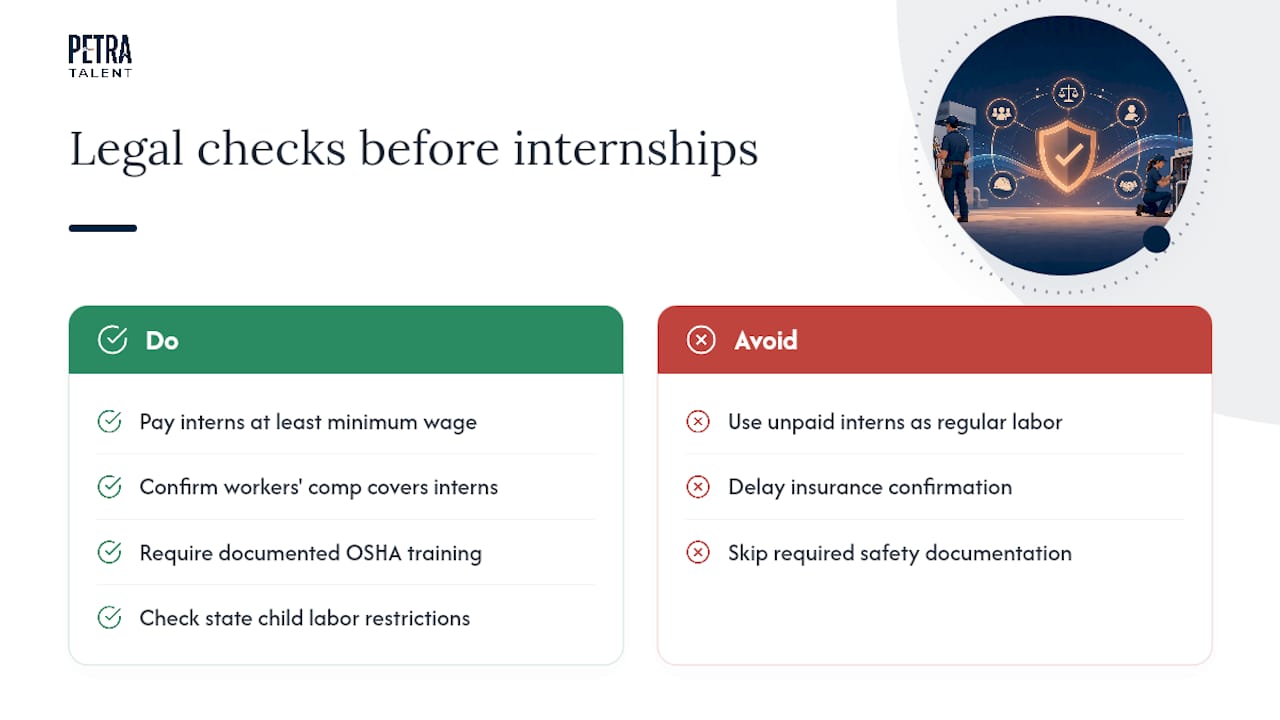
Internships and apprenticeships touch wage law, insurance, and safety training, and skipping any of them creates real liability. If a student performs productive work for your company, the Fair Labor Standards Act generally requires payment at least minimum wage, unless the program qualifies as a bona fide educational placement under Department of Labor guidance. Unpaid internships that use students as regular labor invite wage claims, so paid structures are the safer default for most contractors.
Workers’ compensation coverage needs to extend to interns and apprentices while they’re on your site or in your vehicles. Confirm this with your insurance carrier before the first day, not after an incident. Many states also require documented safety training, often an OSHA 10 or OSHA 30 card, before a minor or student can operate certain equipment or access a jobsite. If your interns include students under 18, check your state’s child labor rules on hazardous occupations, since HVAC and plumbing work can brush up against restricted duties like roofing access or confined spaces.
Registered apprenticeships carry additional federal or state Department of Labor requirements around wage progression, on-the-job training hours, and related classroom instruction. A memorandum of understanding with the school should spell out who carries liability for injuries, who supervises during off-site rotations, and how background checks are handled for site access. None of this is complicated, but it’s the kind of paperwork that’s far easier to sort out before a pilot starts than after something goes wrong.
How Should Contractors Align Curriculum with Real Job Needs?
Curriculum drifts out of sync with the field faster than most schools realize. Refrigerant regulations change, controls get more digital, and equipment models turn over every few years. Contractors who sit on a PAC get a direct channel to flag that drift before it produces a graduating class trained on outdated systems.
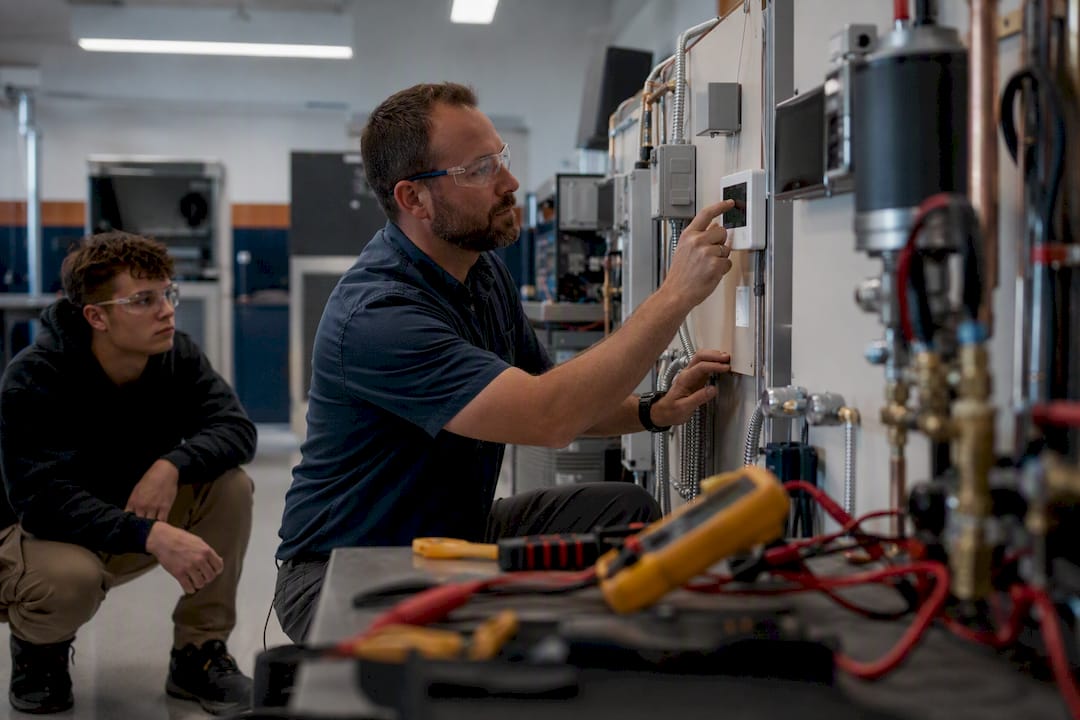
The most effective alignment tactic is specific: bring an actual piece of current equipment, whether a variable-refrigerant-flow unit or a smart thermostat platform, into the lab and let instructors build a unit around it. Guest lecturing works the same way. A one-hour session on a real troubleshooting call teaches more relevant diagnostic thinking than a semester of textbook fault trees.
Instructor input matters just as much as equipment. Instructors who spend a summer riding with your technicians or attending a manufacturer training session bring that knowledge straight back into the classroom. This is also where PAC participation pays off beyond recruiting. Contractors who show up regularly get heard when they say a program is teaching an obsolete refrigerant handling procedure or missing a skill every employer in the market now expects.
Treat curriculum alignment as an ongoing conversation, not a one-time audit. Programs that update their equipment and lesson plans annually, based on direct employer feedback, produce graduates who need less on-the-job retraining. That difference shows up directly in your time-to-competency numbers.
How Do You Keep a Partnership Alive Past Year One?
Most trade school partnerships fail quietly in year two, not year one. The first cohort gets enthusiasm and a dedicated point of contact. The second cohort gets whoever’s available, and the relationship starts to fray.
Sustainability starts with a named owner on your side, someone whose job includes maintaining the school relationship, not just filling seats when a class starts. Rotating that responsibility between whoever has free time guarantees the partnership loses momentum.
Budget for the partnership like you’d budget for equipment maintenance: a recurring line item, not a one-time expense. That includes stipends, mentor incentives, and a small annual contribution to the program, whether that’s equipment, scholarship funds, or instructor training support.
Multi-year commitments also help. A school investing in curriculum changes needs to know a contractor will still be there in three years, not just for one internship cycle. Consider a short annual review with the instructor or program director: what worked, what didn’t, and what changes the next cohort needs. This is also the moment to renegotiate scope, whether that means expanding from a shared apprenticeship to a solo program, or scaling back if capacity has changed.
Growth usually looks like widening, not just deepening. Once one program is working well, consider a second school in an adjacent market, or invite a supplier partner to co-sponsor equipment. A related case study on bridging classroom training with real careers shows how this kind of expansion works when multiple stakeholders share the investment.
How Should Schools and Employers Stay in Touch?
The partnerships that last have a predictable rhythm, not sporadic phone calls. Quarterly PAC meetings are the backbone, giving contractors a formal venue to flag curriculum gaps and get early visibility into upcoming graduates.
Between those meetings, a direct line to the instructor, not the administration, is what keeps things moving. A quick text or email about a promising student, an equipment need, or a scheduling conflict resolves faster than routing through an office.
Site visits deserve a place on the calendar too. Bringing students to a real jobsite, or having an instructor shadow a service call, keeps both sides grounded in what the work actually looks like day to day. Some contractors formalize this with a shared calendar or a simple monthly check-in email covering intern progress, upcoming rotations, and any safety concerns.
Documentation matters more than most contractors expect. A shared tracking sheet for cohort progress, supervisor notes, and conversion outcomes turns informal impressions into the data you need at renewal time. Programs that maintain this kind of coordination consistently outperform ones that rely on annual goodwill and a single point of contact.
Where Can Contractors Find Funding for These Programs?
Cost is the most common reason contractors hesitate before launching a partnership, but funding options often go unexplored. Registered apprenticeship programs frequently qualify for state workforce development grants that offset training costs, wage subsidies during the training period, or equipment purchases for lab use.
Many states also run tax credit programs for employers who hire and train apprentices, reducing the net cost of a paid internship stipend. Local workforce development boards, often overlooked by contractors focused only on the school relationship, can connect employers to regional grant pools specifically earmarked for skilled trades pipelines.
Trade associations and industry groups sometimes offer matching funds or equipment donation programs for contractors willing to commit to a multi-year partnership. It’s worth asking your regional HVAC or plumbing trade association directly what’s currently available, since these programs shift year to year and rarely get wide publicity. A shared apprenticeship, where two or three contractors split both cost and grant eligibility, can also make funding applications more competitive than a single small shop applying alone.
What Has Petra Talent Seen Work in Practice?
Contractors who pair a paid internship with genuine instructor engagement consistently see stronger, faster conversion than those relying on general job postings. Petra Talent supports this work through workforce consultation and technical vetting, helping contractors design pilot programs and evaluate candidates before extending an offer.
— David
How Petra Talent Helps You Build a Hiring Pipeline That Sticks
Petra Talent turns trade school partnerships into repeatable hiring pipelines instead of one-off internship experiments, saving contractors the trial-and-error most shops burn a year or two learning on their own.

Our workforce consultation work covers program design, from picking the right internship length to structuring a PAC seat that actually influences curriculum. Once candidates come through your pilot, our technical vetting and workforce solutions team screens for real troubleshooting competency, not just a completed certificate, so the interns you convert to full-time hires are the ones who’ll stay.
A typical engagement moves from an audit of your current pipeline, to pilot support during your first cohort, to retained search once you’re ready to scale hiring beyond the program. If you’re building out a broader apprenticeship strategy alongside a school partnership, our guide on building an HVAC apprenticeship pipeline walks through the longer-term structure.
Visit Our Services to request a pilot audit and see where your current partnership approach is losing candidates before hire.
Sources
- PATHS model plan (PATHways Program)
- Johnson Controls workforce development and community college partnerships | Higher Ed Dive
Recommended
Related Posts

October 13, 2026
Recruiting Contract Terms: 10 Checks and Ready to Use Clauses
Define fee triggers, candidate ownership, guarantees, and compliance terms. Get a master agreement, short schedule,…

October 12, 2026
Offer Acceptance Rates: Segment Benchmarks, HVAC’s 3–5 Day SLA
See why a 78% to 82% offer acceptance benchmark can mislead, how role and source…
October 11, 2026
Bad Hires Can Cost Construction Firms 30% to 200% of Salary
Bad hires can cost construction firms 30% to 200% of annual salary. Calculate recruiting, rework,…

October 10, 2026
Construction Labor Forecasting for PMs: 7 Steps to Time Hiring
Learn when construction project managers should use WBS or simulation, track labor KPIs, and turn…