



The fastest way to hire a qualified plumbing estimator is to run three sourcing routes at once: direct hire through your own network and job boards, a specialist recruiter for passive candidates, and a short-term contract estimator if a bid deadline is closing in before either produces a result. Waiting for one channel to work before trying another is the single biggest reason mechanical contractors lose good candidates to competitors.
Before you post anything, do three things this week:
- Define the exact scope — commercial, residential service, or design-build MEP work, plus expected monthly bid volume.
- Request three recent sample estimates from every serious candidate and have them walk you through the takeoff logic out loud.
- Set a salary band using live job-board data so you’re not renegotiating after an offer is already on the table.
Pro Tip: Most experienced estimators are not scrolling job boards. Start with a list of five people you’d hire from competitors or subcontractors, and reach out directly before you post a single ad.
Key Takeaways
Plumbing estimator hiring succeeds when contractors run direct sourcing, referrals, and specialist recruiting simultaneously while screening candidates through a paid takeoff test before extending an offer.
| Point | Details |
|---|---|
| Define the role tier first | Distinguish preconstruction, bid, and chief estimator needs before writing the job posting. |
| Run multiple sourcing channels at once | Combine job boards, referrals, and a specialist recruiter rather than waiting on one to work. |
| Require a paid takeoff test | Score a small, real takeoff task before making an offer to verify actual skill, not claimed skill. |
| Benchmark compensation locally | Use live job-board ranges like ZipRecruiter’s Texas data to set a competitive, region-specific offer. |
| Track ramp-up with a 30/60/90 plan | Pair new hires with senior estimators and measure variance against historical accuracy benchmarks. |
Table of Contents
- How to Define the Exact Plumbing Estimator Profile You Need
- Where Should You Look to Find a Plumbing Estimator?
- How Do You Screen a Plumbing Estimator’s Skills?
- What Should a Plumbing Estimator’s Compensation Package Look Like?
- How Do You Onboard and Retain a New Plumbing Estimator?
- How Petra Talent’s Search Process Works for Plumbing Estimator Roles
- Ready to Move Faster on Your Next Plumbing Estimator Hire?
- What This Guide’s Research Says About Plumbing Estimator Hiring
- Sources
How to Define the Exact Plumbing Estimator Profile You Need
Plumbing estimator hiring goes wrong most often because the job posting describes a generic role instead of the one your pipeline actually needs. There are real tiers within this title, and mixing them up wastes months.
A preconstruction estimator works early, shaping scope and budget before a bid is even final. A bid estimator takes finalized drawings and produces a tight, defensible number under deadline pressure. A chief estimator manages a team, sets pricing strategy, and answers directly to ownership. Hiring a bid-focused estimator into a preconstruction-heavy role, or vice versa, is one of the more common and expensive mismatches contractors make.
Project type matters just as much as tier. An estimator who has spent five years pricing residential service and repair work will struggle with a design-build MEP project that requires coordinating plumbing, HVAC, and electrical scopes. Commercial ground-up work demands different sub-bid management skills than tenant improvement jobs with compressed timelines. Match the candidate’s actual project history to your pipeline, not just their job title.
Before writing the job brief, nail down:
- Expected bid volume per month (this drives whether you need a single estimator or multiple)
- Required software platforms and file formats your team already uses
- Specific deliverables (full takeoffs, budget ranges, sub-bid leveling, or all three)
- Who the estimator reports to and how estimate approval works
A vague brief attracts vague candidates. A specific one filters them before the phone screen even starts.
Where Should You Look to Find a Plumbing Estimator?
Here’s a practical sequence to run in parallel, not one after another:
- Post on trade-specific boards and LinkedIn simultaneously. General job boards like Indeed still generate volume in high-demand markets. Live listings in California show hundreds of open plumbing estimator roles at any given time, and Sacramento-area LinkedIn postings show the same regional demand pressure.
- Ask your subcontractors and vendors for referrals. Sub-bid coordinators, suppliers, and even competitors’ estimators often know who’s quietly looking.
- Repost consistently rather than posting once and waiting. Refreshing listings on a set cadence, Mondays work well for most trades, keeps your posting visible against newer competitors in the feed.
Pro Tip: Frame outreach messages around the work, not the company. “We’re pricing three design-build hospital projects this quarter and need someone who can own sub-bid leveling” gets more replies than a generic “great opportunity” pitch.
How Do You Screen a Plumbing Estimator’s Skills?
A resume tells you what a candidate claims. A structured screening process tells you what they can actually do, and the gap between those two things is where most bad hires happen.
Start the phone screen with career-gap and compensation questions before touching technical topics:
- Why the gaps in employment history, if any exist
- Current compensation and what would move them to change jobs
- Notice period and realistic start date
Once compensation expectations align, move to a technical checklist:
- Takeoff method — manual, digital, or hybrid, and how they verify accuracy
- Sub-bid management — do they collect, level, and negotiate subcontractor quotes independently, or just compile numbers someone else gathered
- Estimate variance history — ask directly how their bids have tracked against actual project costs over the last two years
Sub-bid management specifically separates high-value estimators from those who only handle takeoffs. A candidate who can negotiate and level subcontractor pricing independently is worth more than one who simply plugs numbers into a template.
Software fluency needs a real check, not a checkbox. Ask candidates to share a sample file, redacted if needed, and look at how they organize takeoffs in Bluebeam, whether their Excel templates are clean or chaotic, and how comfortable they are across platforms. Job postings increasingly list Procore Estimating, Sage Estimating, HCSS HeavyBid, or WinEst as required proficiencies, so confirm hands-on experience with whichever platform your firm actually runs, not just familiarity with the category.

Then run a small paid takeoff test: a real (or realistic) plumbing scope, two to three hours of work, paid at their expected hourly rate. A structured process built around a paid sample task consistently improves hire quality and close rates because it surfaces skill gaps no interview question will catch. Score it against your own senior estimator’s version and note where the gaps land.
Finally, reference checks should focus narrowly on accuracy and bid-day composure: “How did their estimates compare to actual project costs?” and “How did they perform under a compressed deadline?”
What Should a Plumbing Estimator’s Compensation Package Look Like?
Salary bands for plumbing estimators vary widely by region and seniority, and guessing at a number is how offers fall apart in week two of negotiation. ZipRecruiter listings for Texas show a broad salary range reflecting varying seniority and region, with entry-level estimators clustering near the bottom and chief estimators or those managing large commercial pipelines near the top.
Build your offer around four components:
- Base salary benchmarked against current job-board activity in your specific metro, not a national average
- Performance or closing bonuses tied to win-rate or estimate accuracy, which reward the behaviors you actually want
- A signing bonus for candidates leaving stable roles, since this is often what tips a passive candidate off the fence
- Benefits that matter to this role specifically — flexible scheduling around bid deadlines tends to outweigh generic perks
Watch market signals closely before finalizing an offer. If you’re competing against multiple open requisitions in your metro, or if the candidate mentions a competing offer, that’s the moment to move on base salary or signing bonus rather than losing weeks to a slow counteroffer process.
Contract-to-hire makes sense when bid volume is unpredictable or you’re testing fit before committing to a full-time role. Combining a smaller in-house hire with outsourced takeoff support during peak weeks often balances cost control against capacity better than overstaffing for volume that may not hold.
How Do You Onboard and Retain a New Plumbing Estimator?
A strong hire who ramps slowly still costs you margin on every bid they touch in month one. A structured 30/60/90 plan shortens that window significantly.
- Days 1 to 30: Pair the new estimator with a senior team member on live bids, grant access to your subcontractor list and pricing history, and have them shadow at least two full bid cycles before submitting anything solo.
- Days 31 to 60: Assign smaller bids independently with senior review before submission, and track their variance against your team’s historical accuracy benchmarks.
- Days 61 to 90: Remove the review step for standard bids, introduce them to more complex or higher-stakes projects, and set a formal check-in to discuss career trajectory.
Templates and file organization matter more than most contractors expect. An estimator who inherits a messy, inconsistent template library will waste weeks rebuilding structure that should already exist. Standardize this before the new hire’s first day.
Retention comes down to three levers: a believable path toward preconstruction leadership, a bid volume that doesn’t burn people out during peak season, and recognition tied to measurable wins. Track estimate accuracy, win-rate, and variance against actual project costs quarterly. These numbers tell you whether your onboarding plan is actually working or just feels productive.
Pro Tip: Ask your new estimator for a two-sentence explanation of any assumption they make on a bid. If they can’t explain their own logic clearly, that’s a coaching opportunity, not a performance problem, but it needs attention before it becomes one.
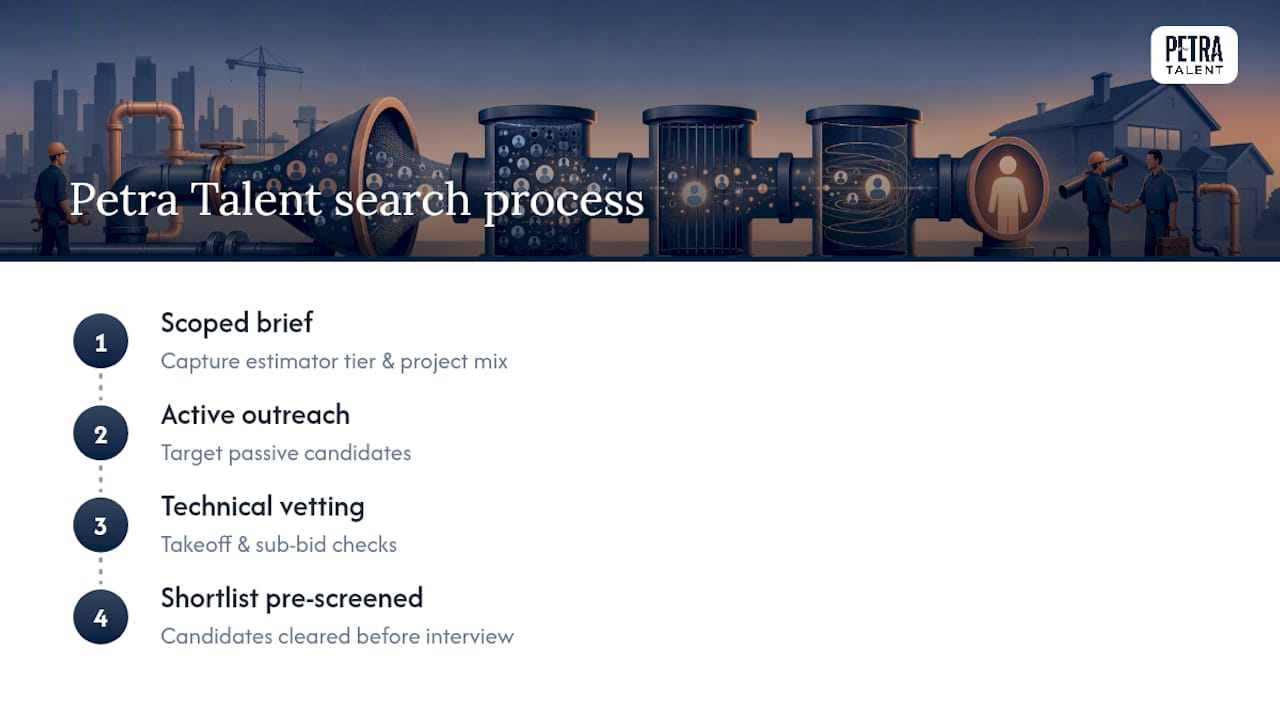
How Petra Talent’s Search Process Works for Plumbing Estimator Roles
Running every step of plumbing estimator hiring internally is possible, but it’s rarely the fastest path when a bid deadline is approaching and your pipeline needs someone now. Petratalent built its search process specifically around the gap between “posted the job” and “found someone who can actually take off a plumbing scope accurately.”
The process runs in four stages: a scoped brief that captures your exact estimator tier and project mix, active outreach to passive candidates who aren’t applying anywhere publicly, technical vetting that includes the kind of takeoff and sub-bid checks outlined above, and a shortlist of candidates who’ve already cleared those screens before you spend an hour interviewing them.
Contractors don’t need more resumes. They need fewer, better-vetted candidates who’ve already proven they can do the work under real bid-day pressure.
Engaging a recruiter makes the most sense when you’re hiring under deadline pressure, when your internal network has already been exhausted, or when you need a chief estimator hire where a bad decision carries outsized cost. Running it internally still works well for lower-volume hiring where you have time to source patiently.
Hiring teams can borrow pieces of this process immediately: scope the brief tightly, request paid sample work before extending an offer, and check references specifically on estimate accuracy rather than general performance.
Ready to Move Faster on Your Next Plumbing Estimator Hire?
If your bid pipeline can’t afford another slow hiring cycle, Petratalent’s plumbing recruiting services connect you directly with technically vetted estimators who’ve already cleared takeoff and sub-bid screening. For contractors weighing whether to run this search internally or bring in specialist support, the our services overview breaks down exactly where Petratalent’s process picks up where your internal sourcing leaves off. And if speed is the priority right now, the plumbing staffing agency page outlines how fast placements typically move once a search is scoped.
For readers managing broader estimating capacity questions, Roofing Estimate Conversion Checklist for Contractors offers a useful parallel framework for tightening bid-to-close performance once your estimator is in place.
What This Guide’s Research Says About Plumbing Estimator Hiring
By David
Most hiring advice treats plumbing estimator hiring like any other skilled trade search: post the job, screen resumes, make an offer. That approach undersells how specialized this role actually is. An estimator’s value isn’t just technical accuracy, it’s judgment under deadline pressure, and judgment doesn’t show up on a resume.
The conventional advice to “post and wait” fails specifically because the best estimators are rarely unemployed or actively browsing. If your sourcing strategy depends entirely on inbound applications, you’re competing only for candidates who are already dissatisfied somewhere else, not necessarily the strongest ones.
What actually moves the needle is the paid takeoff test. It’s the one screening step contractors most often skip because it feels like extra work, and it’s the one that catches the gap between a confident interview and a candidate who can’t actually level a sub-bid under pressure. If you adopt only one change from this guide, make it that one.
Prioritize proof of work over polish in every interview from here forward.
— David
Sources
- How to Hire a Construction Estimator | Persevus
- Finding Qualified Estimators: Contractor Hiring Guide
- Plumbing Estimator jobs in California
Recommended
Related Posts

October 13, 2026
Recruiting Contract Terms: 10 Checks and Ready to Use Clauses
Define fee triggers, candidate ownership, guarantees, and compliance terms. Get a master agreement, short schedule,…

October 12, 2026
Offer Acceptance Rates: Segment Benchmarks, HVAC’s 3–5 Day SLA
See why a 78% to 82% offer acceptance benchmark can mislead, how role and source…

October 11, 2026
Bad Hires Can Cost Construction Firms 30% to 200% of Salary
Bad hires can cost construction firms 30% to 200% of annual salary. Calculate recruiting, rework,…

October 10, 2026
Construction Labor Forecasting for PMs: 7 Steps to Time Hiring
Learn when construction project managers should use WBS or simulation, track labor KPIs, and turn…