



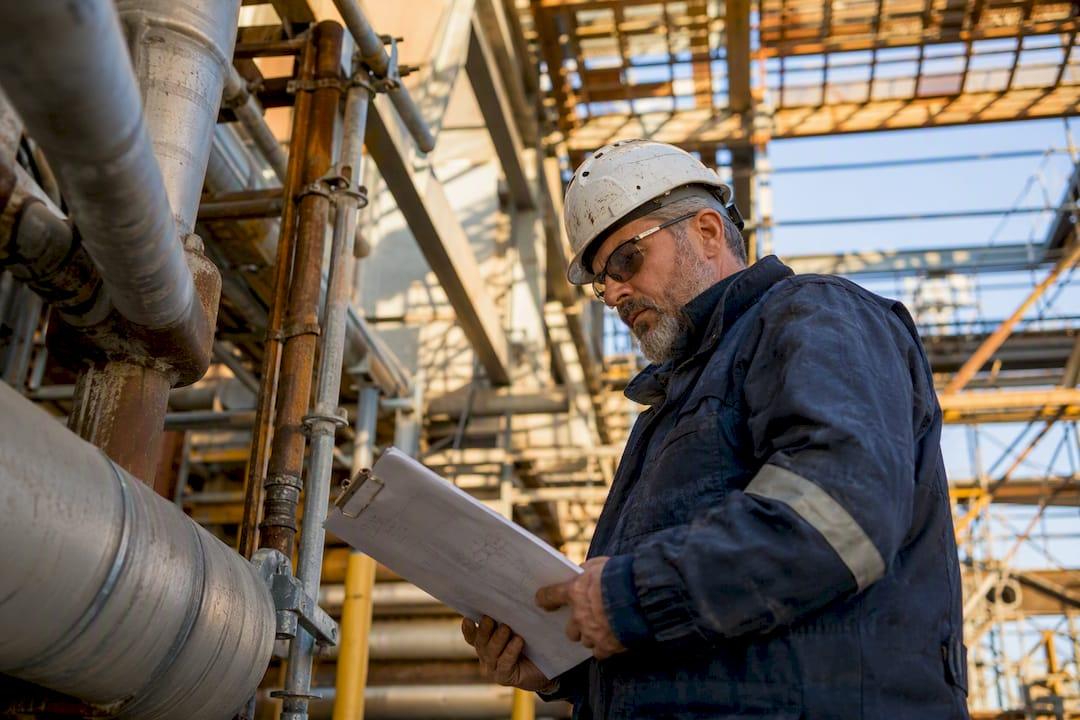
A Mechanical General Foreman is the on-site leader who coordinates mechanical trades, enforces safety, and keeps multi-crew mechanical work on schedule and to spec. This person sits above individual crew Foremen, translates blueprints and P&IDs into a daily work plan, and answers for the mechanical scope on projects that range from a single mechanical room to a multi-million-dollar industrial build.
Here’s the quick snapshot:
- Safety leadership: Runs toolbox talks and enforces OSHA standards across every crew on-site.
- Technical fluency: Reads and applies P&IDs (Piping and Instrumentation Diagrams) to plan installation sequences.
- Crew command: Directly supervises Journeypersons, pipefitters, and welders, often across several crews at once.
Whether you’re a tradesperson eyeing your next promotion or a contractor trying to fill a leadership gap, the role breaks down the same way everywhere it’s posted.
Key Takeaways
A Mechanical General Foreman leads multiple mechanical crews, owns scheduling and quality against P&IDs, and enforces OSHA-based safety standards on-site.
| Point | Details |
|---|---|
| Core function | Coordinates multiple crews, interprets P&IDs, and owns the mechanical schedule and quality on-site. |
| Reporting structure | Directly supervises Foremen and Journeypersons, then reports up to a Superintendent or Project Manager. |
| Qualifications that matter | Trade background, roughly 5 years’ field experience, supervisory history, and OSHA 30 certification. |
| Pay depends on scope | Compensation shifts with project size, crew count, and regional demand for the title. |
| Hiring support | Petratalent’s leadership search and technical vetting services help contractors fill this role with vetted, qualified candidates. |
Table of Contents
- Core Responsibilities of a Mechanical General Foreman
- Who a Mechanical General Foreman Manages On-Site
- Qualifications and Skills Employers Require
- Where Mechanical General Foremen Work
- General Foreman vs. Foreman vs. Superintendent
- Pay and Career Path for This Role
- A Day in the Life of a Mechanical General Foreman
- How to Become a Mechanical General Foreman
- What Top Employers Actually Look For
- How PetraTalent Helps You Hire Mechanical Leadership
- Frequently Asked Questions
- Sources
Core Responsibilities of a Mechanical General Foreman
Job postings for this role are remarkably consistent about what fills the day. Duties center on turning drawings into finished, inspected mechanical systems without blowing the schedule.
- Interpret blueprints and P&IDs to plan sequencing and material needs.
- Build and adjust the daily and weekly work schedule across multiple crews.
- Supervise pipefitters, welders, and equipment operators directly on-site.
- Manage material staging, tool inventory, and delivery timing.
- Run daily safety meetings and site inspections.
- Perform quality checks against spec before work is signed off.
- Prepare daily progress reports for the project management team.
Safety and reporting happen every day without exception. Scheduling adjustments and material forecasting are more periodic, usually reviewed weekly or whenever a delivery slips.
Pro Tip: Walk the schedule risk areas before the crew even shows up. A five-minute pre-shift check on material staging and access points catches the delays that cost you a full day later.
Who a Mechanical General Foreman Manages On-Site
The reporting structure is where this role earns its title. A Mechanical General Foreman typically has direct reports that include crew Foremen, Journeypersons, apprentices, and often subcontractor crews working the mechanical scope.
- Direct reports: Foremen, Journeypersons, apprentices, and assigned subcontractors.
- Indirect oversight: Multiple crews working parallel scopes (piping, HVAC, plumbing rough-in) under one project.
- Reports up to: A Superintendent or Project Manager, who handles cross-trade scheduling and owner communication.
Crew sizes swing widely. A commercial mechanical job might put a General Foreman over 15 to 20 workers, while large industrial or data center projects can put that number well past 100. The role also interfaces constantly with project management, quality control staff, the fabrication shop, and client representatives on-site.
Qualifications and Skills Employers Require
Employers don’t hand this title to someone fresh off an apprenticeship. Most postings expect a trade background as a pipefitter or welder, several years in the field, and prior supervisory experience before someone earns General Foreman responsibility.
- Trade background as a pipefitter, welder, or related mechanical craft.
- Field experience, with many employer listings suggesting around 5 years in the trade as a baseline for foreman-level roles.
- Prior supervisory experience managing a crew, not just working within one.
- OSHA 30 certification and a valid driver’s license with a clean record.
- Working knowledge of scheduling tools and Microsoft Office for documentation.
- Strong communication skills for coordinating between the field and the office.
Employers weigh trade credentials heavily. Postings for the role commonly require a proven trade background plus supervisory history, not simply years on a tool. Fluency reading P&IDs separates candidates who can plan a sequence from those who can only execute one someone else designed.
Where Mechanical General Foremen Work
The role shows up wherever mechanical systems get built or maintained at scale, not just on commercial construction sites.
- Industrial plants and refineries
- Data centers and central utility plants
- Healthcare facility mechanical builds
- BESS (Battery Energy Storage System) and EPC projects
- Large commercial mechanical installations
Project size and complexity vary enormously, from a single building retrofit to a campus-scale industrial build running for years. Expect a mix of indoor and outdoor conditions, physically demanding work including heavy lifting, and shift patterns that regularly stretch to 12 hours on industrial projects.
General Foreman vs. Foreman vs. Superintendent
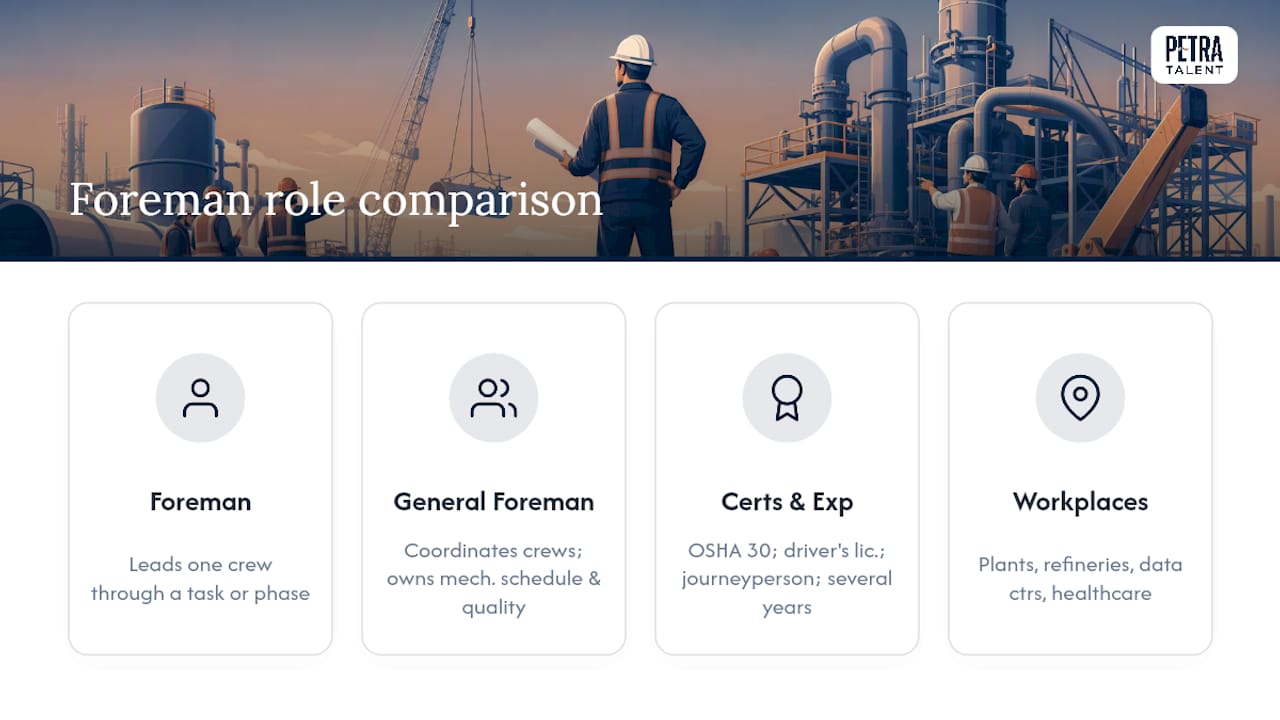
Titles in this industry blur together fast, and job descriptions vary by employer, but the scope differences are usually consistent. A Foreman runs one crew through one phase of work. A General Foreman coordinates several Foremen and crews across the entire mechanical scope of a project.
- Foreman: Hands-on, single crew, focused on execution of a specific task or phase.
- General Foreman: Coordinates multiple crews and Foremen, owns scheduling and quality across the mechanical scope.
- Superintendent: Oversees all trades on a project (not just mechanical), owner relations, and overall project schedule.
A General Foreman resolves crew-level conflicts, material shortages, and daily sequencing on their own. They escalate to a Superintendent when the issue crosses trades, threatens the master schedule, or requires a decision on cost or contract scope.
Pay and Career Path for This Role
Compensation for Mechanical General Foremen tracks closely with project type, crew size, and regional labor demand, and pay varies meaningfully between a small commercial job and a large industrial build with a six-figure piping scope.
Job boards show consistent demand for the title, with postings appearing regularly across major job aggregators, a signal that employers compete actively for qualified candidates rather than filling the role from a deep bench.
Career progression typically runs:
- General Foreman → Superintendent
- Superintendent → Project Manager
- General Foreman → Fabrication or shop leadership (an alternate track for those who prefer prefabrication work over field supervision)
Beyond base pay, expect overtime eligibility, per-diem for travel assignments, and in some companies a tool or vehicle allowance tied to the leadership tier.
A Day in the Life of a Mechanical General Foreman
No two projects run identically, but the rhythm of the day stays remarkably stable across employers.
- Pre-shift briefing and toolbox safety talk with all crews.
- Morning site inspection to check overnight progress and material staging.
- Crew coordination and sequencing adjustments as issues surface.
- Midday progress check against the schedule and quality benchmarks.
- End-of-day reporting: timesheets, safety logs, and progress updates to the Superintendent.
Daily deliverables usually include completed timesheets, a documented safety check, staged materials for the next shift, and a written progress update. Shift length and task mix shift depending on whether the project is a fast-track commercial job or a longer industrial build.
How to Become a Mechanical General Foreman
The path runs through the trade, not around it. There’s no shortcut that skips field time.
- Complete a trade apprenticeship in pipefitting, welding, or a related mechanical craft.
- Earn Journeyperson credentialing.
- Accumulate several years of field experience, building a track record on varied project types.
- Move into a Foreman role, managing a single crew.
- Build scheduling, inspection, and documentation experience before stepping up to General Foreman.
Hiring managers evaluating candidates should ask direct, scenario-based questions:
- “Walk me through how you’d sequence a piping install when a delivery is delayed.”
- “How do you handle a safety violation you catch mid-shift?”
- “Describe a time you coordinated shop fabrication with field installation.”
For contractors filling this role fast, working with recruiters who specialize in sourcing mechanical leadership talent shortens the search considerably compared to posting and hoping.
What Top Employers Actually Look For
Scheduling skill separates good General Foremen from great ones. It’s the single most common gap we see between candidates who read well on paper and those who perform under pressure.
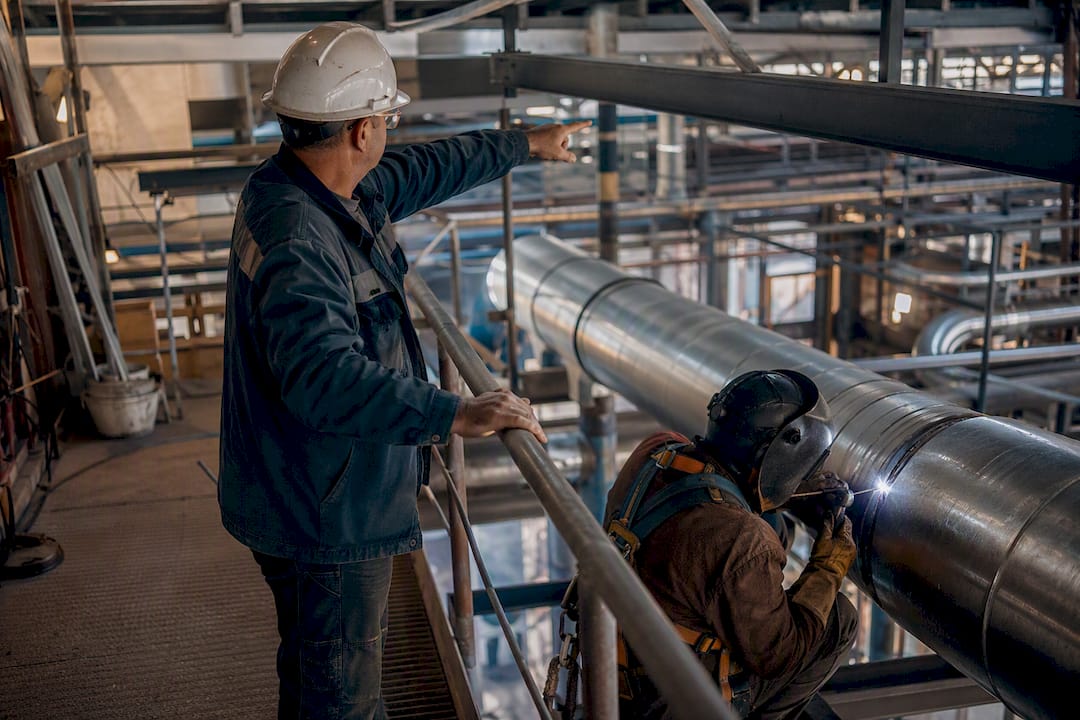
The three differentiators worth screening for: schedule risk management, visible safety leadership tied to OSHA standards, and real experience coordinating prefabrication with field installation. Candidates who’ve only worked field installation, without shop-to-field coordination experience, tend to struggle on larger industrial scopes. Ask for specifics, not general answers, and you’ll find the gap fast.
How PetraTalent Helps You Hire Mechanical Leadership
Filling a Mechanical General Foreman role is harder than posting a job ad, because the candidates who actually qualify are rarely searching job boards. Petratalent runs leadership search and technical vetting specifically for mechanical contractors, screening for the scheduling judgment and safety leadership that separate a strong hire from a costly mis-hire.

Contact a recruiter when you’re facing a hard-to-fill leadership vacancy, ramping up staffing fast for a new project award, or hiring for a high-risk industrial scope where a bad fit is expensive to correct. Petratalent’s leadership and management search service is built around exactly this kind of role, pairing technical vetting with market wage insight so you’re not guessing at whether an offer will land. Review the services overview to see how the process works, or reach out directly to start a search for your next mechanical leadership hire.
Frequently Asked Questions
What is a Mechanical General Foreman, in one sentence?
A Mechanical General Foreman is the on-site supervisor who coordinates multiple mechanical crews, plans work against blueprints and P&IDs, and enforces safety and quality standards through project completion.
What does a mechanical foreman do differently from a General Foreman?
A Foreman runs a single crew through a specific task or phase. A General Foreman oversees several Foremen and crews at once, owning the full mechanical scope’s schedule and quality.
What certifications do I need for this role?
Most employers expect OSHA 30, a valid driver’s license, and trade credentials as a Journeyperson pipefitter or welder, alongside several years of documented field and supervisory experience.
How much field experience is typical before someone becomes a General Foreman?
Job postings commonly cite around 5 years of trade experience as a baseline, though supervisory track record often matters as much as raw years.
What’s the difference between a General Foreman and a Superintendent?
A General Foreman manages the mechanical trade scope specifically. A Superintendent oversees all trades on a project, including scheduling across disciplines and owner communication.
Where do Mechanical General Foremen typically work?
Common workplaces include industrial plants, refineries, data centers, central utility plants, healthcare facilities, and large commercial or BESS/EPC construction projects.
Sources
- Mechanical General Foreman | Primoris Energy Services | Sherman, Texas @ Primoris Services Corporation
- Mechanical General Foreman at Delta Constructors
- General Foreperson – Mechanical Job in Las Vegas, NV – ACCO Engineered Systems Inc | Apply Today at CareerBuilder
- Mechanical Construction Project Foreman job description sample (McCarter Mechanical)
Recommended
Related Posts
October 13, 2026
Recruiting Contract Terms: 10 Checks and Ready to Use Clauses
Define fee triggers, candidate ownership, guarantees, and compliance terms. Get a master agreement, short schedule,…
October 12, 2026
Offer Acceptance Rates: Segment Benchmarks, HVAC’s 3–5 Day SLA
See why a 78% to 82% offer acceptance benchmark can mislead, how role and source…
October 11, 2026
Bad Hires Can Cost Construction Firms 30% to 200% of Salary
Bad hires can cost construction firms 30% to 200% of annual salary. Calculate recruiting, rework,…
October 10, 2026
Construction Labor Forecasting for PMs: 7 Steps to Time Hiring
Learn when construction project managers should use WBS or simulation, track labor KPIs, and turn…