



A mechanical prevailing wage role is a job classification, such as HVAC mechanic, plumber, or pipefitter, that a covered public works contract requires be paid at the prevailing wage rate set for that trade and locality. That rate has two parts: a basic hourly wage and a fringe benefit rate. Neither one is optional.
If you’re a mechanical contractor bidding a public job, or a worker wondering why your check looks different on a government project, the practical answer matters more than the definition. Before anyone swings a wrench, three things need to happen:
- Identify the contract’s wage determination (WD). It’s usually attached to the bid specs or referenced by number.
- Confirm the classification. Match actual job duties to the WD’s labor category, not just a job title.
- Set up payroll and fringe accounting before work starts, not after the first certified payroll is due.
These requirements trace back to the Davis‑Bacon Act for federally funded work, enforced through the U.S. Department of Labor, with wage rates published through the Online Wage Library and SAM.gov.
Key Takeaways
A mechanical prevailing wage role requires paying the exact classification’s basic hourly wage plus fringe benefit rate published in the contract’s wage determination, with no substitutions.
| Point | Details |
|---|---|
| Definition matters first | A mechanical prevailing wage role ties a specific classification (HVAC, plumber, pipefitter) to a WD’s basic wage plus fringe rate. |
| Confirm the WD before bidding | Check contract specs, then SAM.gov or the state DIR, to find the exact wage determination number and locality. |
| Fringe choice changes cost | Cash-in-lieu can raise total labor cost by roughly 25% versus routing the same dollars through a bona fide plan. |
| Certified payroll is weekly, not optional | File WH‑347 or the state equivalent every pay period, and hold the prime contractor accountable for subcontractor compliance. |
| Petratalent supports compliant hiring | Petratalent sources and vets mechanical trade talent with market wage insight built for prevailing wage projects. |
Table of Contents
- How Are Prevailing Wages Determined?
- What Counts as a Mechanical Trade Classification?
- Wage Components: Basic Hourly Wage Plus Fringe Benefits
- Contractor Compliance: Certified Payroll and Recordkeeping
- Where Do You Find Your Wage Determination?
- A Practical Checklist for Mechanical Contractors
- Why Do Prevailing Wage Laws Exist?
- How Mechanical Trades Differ From Other Trades Under Prevailing Wage Rules
- Regional Variations in Mechanical Prevailing Wage Rates
- How Prevailing Wage Rules Shape Project Budgeting and Bids
- What Role Do Labor Unions Play in Mechanical Prevailing Wages?
- Disputes and Legal Cases Involving Mechanical Prevailing Wage Roles
- Why Accurate Classification Is a Workforce Issue, Not Just a Compliance One
- A Staffing Partner That Understands Prevailing Wage Hiring
- Frequently Asked Questions
- Sources
How Are Prevailing Wages Determined?
Federal projects funded or assisted by the federal government fall under the Davis‑Bacon Act, which requires contract specifications over $2,000 to state minimum wages for each labor classification working on the job. State and local projects follow their own prevailing wage statutes, which mirror the federal framework but often set separate rates, thresholds, and filing rules.
A wage determination is the document that makes this concrete. It lists the basic hourly wage, the fringe benefit rate, and any applicable work rules for a specific labor category in a specific geographic area, and it gets published by DOL or a state department of industrial relations before the contract is awarded. The WD becomes part of the contract itself, referenced by number in the bid specs.
Three sources confirm whether you’re using the right numbers: the National Prevailing Wage Center, the Online Wage Library, and Sam. For state and local work, the relevant state DIR publishes its own determinations on its own schedule.
A wage determination isn’t a suggestion or a market average. It’s a binding schedule of wages, fringe benefits, and work rules that the Department of Labor or a state agency has ruled prevailing for a specific trade in a specific place, and it travels with the contract from bid to final payroll.
What Counts as a Mechanical Trade Classification?
Mechanical prevailing wage roles cover a specific set of trades, and getting the classification wrong is one of the fastest ways to trigger an audit. The most common categories include:
- HVAC mechanic/technician: installs, services, and repairs heating, ventilation, and air conditioning systems, including ductwork and controls.
- Plumber: installs and maintains water supply, drainage, and gas piping systems.
- Pipefitter: works with high-pressure piping systems, often in industrial or process settings distinct from standard plumbing.
- Sheet-metal worker: fabricates and installs ductwork, flashing, and metal HVAC components.
- Refrigeration mechanic: services commercial refrigeration and cooling equipment, sometimes overlapping with HVAC work.
When duties overlap, classification comes down to primary duty and time allocation, not the job title on a paycheck. A technician who spends 70% of the day on ductwork installation and 30% on refrigeration controls generally gets classified by the majority task, and that determination should match the WD’s own job descriptions, not a generic internal job title. Misclassification, particularly labeling a pipefitter as a general laborer to access a lower rate, is one of the most common triggers for a DOL or state audit.
Wage Components: Basic Hourly Wage Plus Fringe Benefits
Every prevailing wage rate is built from two required pieces: the basic hourly wage and the fringe benefit rate. Skipping either one, even while paying the other in full, is a violation. Fringe benefits under Davis‑Bacon cover contributions to retirement, medical coverage, vacation, and similar bona fide plans, and each wage determination spells out both numbers separately.
Contractors have a choice in how fringe gets paid, and that choice has real cost consequences. Paying fringe as cash-in-lieu adds it to taxable wages, which increases total labor costs by roughly 25% due to additional payroll taxes, compared with routing the same dollars through a bona fide benefit plan that typically avoids those extra taxes. On a contract specifying $30 an hour cash plus $8 an hour fringe, paying the fringe portion as cash increases the effective hourly cost significantly compared to paying through a bona fide plan (https://wsdot.wa.gov/sites/default/files/2021-10/ProvidingFringeBenefitsinthePrevailingWageWorld.pdf), before payroll tax is even added on top.
The Davis‑Bacon Act allows contractors to discharge fringe obligations through cash payments, contributions to a plan, or another enforceable commitment, but annualization rules apply to how those contributions get credited against the requirement.
Pro Tip: Run the math on bona fide plans before you bid, not after you win. A retirement or health plan structured correctly can satisfy the fringe obligation, reduce your payroll tax exposure, and give you a retention tool that cash-in-lieu never will.
Contractor Compliance: Certified Payroll and Recordkeeping
Compliance on a prevailing wage job isn’t a one-time check at bid submission. It’s a weekly discipline that runs for the life of the contract. Here’s what mechanical contractors need to have in place:
- File certified payroll weekly, using WH‑347 for federal Davis‑Bacon work or the equivalent form required by the state agency.
- Keep payroll records documenting hours, classifications, and fringe payments for each worker, and retain them for the period required by the contract, typically three years.
- Accept responsibility for subcontractors. The prime contractor stays on the hook if a sub misclassifies workers or underpays fringe, regardless of what the subcontract says.
- Calculate overtime correctly using the prevailing basic rate, not a blended rate that folds in fringe.
- Watch for audit triggers, including inconsistent classifications across payroll periods, fringe payments that don’t match the WD, and complaints from workers about hours or pay.
Enforcement outcomes range from back-wage assessments to debarment from future public contracts, so a certified payroll workflow you can trust matters as much as the initial bid math.
Where Do You Find Your Wage Determination?
Locating the correct WD takes a few deliberate steps, and skipping any one of them is how contractors end up bidding the wrong rate.
- Check the contract specifications for a referenced WD number, usually listed in the bid documents or general conditions.
- Look up that number on SAM.gov for federal work, or the relevant state DIR site for state and local projects.
- Confirm locality and classification against the WD’s own text; a county line or a job title mismatch can point you to the wrong rate entirely.
- Ask the awarding agency directly if the WD language is ambiguous. Waiting until after award to raise the question rarely goes well.
Document each check in your bid file. It’s the first thing an auditor asks for.
A Practical Checklist for Mechanical Contractors
Turning this into daily practice comes down to a handful of concrete moves before the project starts:
- Build a certified payroll template that matches WH‑347 or your state’s equivalent form, before the first payroll cycle.
- Decide cash-in-lieu versus a bona fide plan and document contributions as irrevocable, since a plan that can be clawed back doesn’t count.
- Update subcontractor agreements to require prevailing wage compliance in writing, with audit rights built in.
- Verify classifications in every job posting so the title matches the WD language, not an internal shorthand.
- Require compliance certifications from every subcontractor before they start work.
- Track apprentice-to-journeyman ratios on jobs where apprenticeship rules apply.
Pro Tip: Build wage determinations into your pre-bid cost model, not your post-award change order pile. Contractors who price fringe and classification risk upfront rarely get caught underbidding a mechanical scope.
Why Do Prevailing Wage Laws Exist?
Prevailing wage laws date back to the original Davis‑Bacon Act, passed in 1931 during the Great Depression, when federal construction contracts were increasingly won by out-of-town contractors who undercut local wage standards by importing cheaper labor. Congress wrote the law to stop that race to the bottom on federally funded work, requiring contractors to pay wages that matched what workers in that trade and locality already earned.
The purpose hasn’t changed much in nearly a century: keep public construction dollars from becoming a tool to depress local wages. State legislatures followed with their own versions, often called “little Davis‑Bacon” laws, extending similar protections to state and municipal projects that never touch federal funding.
What has changed is the scope. Prevailing wage requirements now reach beyond traditional construction into newer categories of public investment. Under the Inflation Reduction Act, certain clean energy tax credits require laborers and mechanics on qualifying projects to be paid prevailing wages and meet apprenticeship requirements for the full duration of construction, alteration, or repair. Meeting those standards can substantially increase the base value of qualified clean energy tax incentives, which has pulled a wave of mechanical contractors, especially those doing HVAC and refrigeration work tied to energy efficiency retrofits, directly into prevailing wage territory for the first time.
The underlying logic remains what it was in 1931: public money shouldn’t be used to undercut the wage floor that already exists in a community.
How Mechanical Trades Differ From Other Trades Under Prevailing Wage Rules
Mechanical trades face a layer of classification complexity that trades like carpentry or general labor mostly avoid. A carpenter’s scope of work tends to be self-evident. A mechanical worker’s scope often isn’t, because HVAC, plumbing, pipefitting, sheet-metal, and refrigeration work overlap constantly on the same job site and sometimes on the same piece of equipment.
Consider a rooftop unit installation. It might involve sheet-metal ductwork, refrigerant line work, electrical tie-ins, and controls programming, all in a single afternoon, all potentially falling under different wage classifications with different rates. A carpentry crew building formwork rarely runs into that kind of task-by-task classification puzzle.
Mechanical trades also see more frequent updates to their wage determinations tied to technology shifts. New refrigerant handling requirements, smart building controls, and energy code changes keep reshaping what counts as a “mechanic” versus a “technician” versus a specialty installer, and wage determinations don’t always keep pace with equipment changes in the field.
There’s also a licensing overlay that other trades don’t carry as heavily. Plumbers and refrigeration mechanics frequently need state or local licenses on top of the wage classification, which means a worker can be correctly classified for wage purposes and still be non-compliant if their license has lapsed. That dual requirement, wage classification plus licensure, adds a compliance layer that a general laborer classification simply doesn’t carry, and it’s one more reason mechanical contractors face more audit scrutiny than trades with simpler scopes of work.
Regional Variations in Mechanical Prevailing Wage Rates
Prevailing wage rates for the same mechanical classification can vary sharply by region, sometimes even between adjacent counties. Federal wage determinations reflect local labor market surveys, so an HVAC mechanic’s rate on a federal job in a major metro area often runs well above the rate for the identical classification in a rural county two hours away.

State systems add another layer of variation. Under California’s prevailing wage framework, the state issues general wage determinations on a set schedule, twice a year, and applies them to projects above defined dollar thresholds. Other states publish on different timelines and use different survey methodologies, which means a contractor working across state lines can’t assume last year’s rate, or even last quarter’s rate in a neighboring county, carries over.
For mechanical contractors bidding multi-state or multi-region work, this variation is a real budgeting hazard. A pipefitter classification priced correctly for a job in one metro area could be significantly underpriced or overpriced if applied to a determination in a different locality without checking the current published rate. Union density in a given region also tends to correlate with how the wage survey resolves, areas with higher union representation in mechanical trades often see wage determinations that track closely with negotiated union scales, while areas with less union presence may show determinations built from a broader, sometimes lower, wage survey. Checking the specific WD for the specific locality on every bid, rather than relying on memory or a prior job’s numbers, is the only way to avoid this trap.
How Prevailing Wage Rules Shape Project Budgeting and Bids
Prevailing wage requirements change the math of a mechanical bid before a single tool touches the job site. Labor cost, which is often the single largest variable in a mechanical scope, has to be built from the published WD rate rather than the contractor’s standard market rate, and those two numbers can differ significantly depending on region and classification.
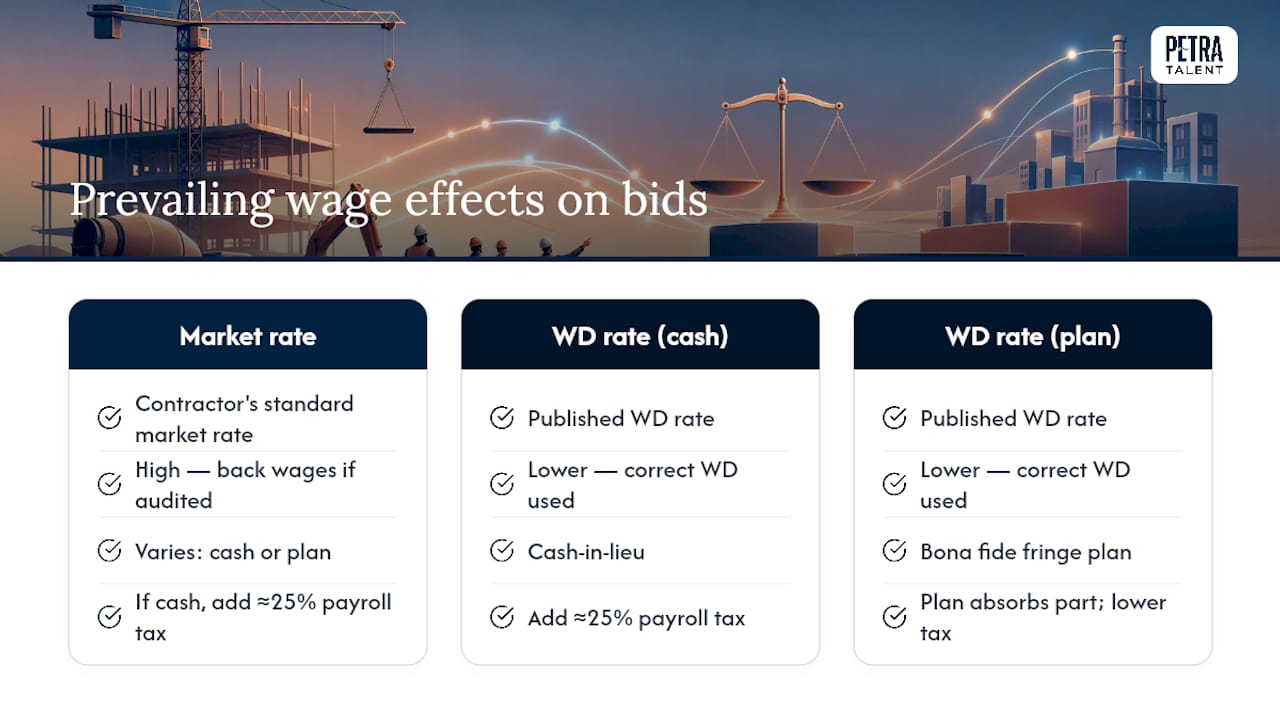
Getting this wrong in either direction creates a real problem. Underbidding by using market rates instead of WD rates leads to a margin that evaporates the moment certified payroll gets audited and back wages come due. Overbidding by padding for uncertainty can lose the job entirely to a competitor who priced the WD correctly. Neither outcome helps a contractor stay in the pipeline for future public work.
Fringe benefit strategy adds another budgeting variable. A contractor planning to pay fringe as cash-in-lieu needs to build that roughly 25% payroll tax increase into the labor line, while a contractor with an established bona fide plan can often price more competitively because the plan absorbs part of that fringe obligation without the same tax exposure. This is one area where two contractors bidding the identical scope, at the identical WD rate, can land on genuinely different total labor costs based purely on how they structure fringe.
Market wage context, such as median pay data for mechanical trades published by the Bureau of Labor Statistics, can help contractors sanity-check whether their non-prevailing-wage jobs are competitive, but it should never substitute for the actual WD number on a covered project. The two figures answer different questions, and confusing them in a bid model is a fast way to misprice a job.
What Role Do Labor Unions Play in Mechanical Prevailing Wages?
Labor unions influence mechanical prevailing wage rates more directly than most contractors realize, even on non-union job sites. Wage determinations are built from area wage surveys, and in regions where mechanical trades, particularly plumbers, pipefitters, and sheet-metal workers, are heavily unionized, the negotiated union scale often becomes the de facto prevailing rate because it represents what the majority of workers in that craft and locality actually earn.
This means a union’s collective bargaining agreement can effectively set the floor for an entire region’s wage determination, applying to union and non-union contractors alike on covered public work. A non-union mechanical contractor bidding in a heavily unionized market needs to price labor at the union-influenced WD rate regardless of their own shop’s internal pay scale.
Unions also play an active role in monitoring compliance. Local union representatives frequently flag suspected misclassification or underpayment on public job sites, sometimes triggering the audits that catch contractors who tried to shortcut the fringe or classification requirements. That watchdog function adds enforcement pressure beyond what DOL or a state DIR could realistically catch through routine review alone, and it’s a factor mechanical contractors should factor into how carefully they document classification decisions on union-dense projects.
Disputes and Legal Cases Involving Mechanical Prevailing Wage Roles
Most mechanical prevailing wage disputes trace back to one of two root causes: misclassification or fringe benefit shortfalls. A contractor labeling pipefitters as lower-paid general laborers, or classifying HVAC installation work under a cheaper “helper” category, is a recurring pattern in DOL back-wage cases, and it typically surfaces when a worker files a complaint or a routine certified payroll review catches inconsistent classification codes across pay periods.
Fringe benefit disputes follow a similar shape. A common violation pattern involves a contractor paying the correct basic hourly wage but failing to account for the full fringe benefit rate, sometimes because a benefit plan they assumed was “bona fide” didn’t meet the technical requirements for irrevocable contributions. As noted in DOL guidance, paying only the basic wage without properly addressing the fringe obligation constitutes a violation even when the basic rate itself is correct.
Subcontractor liability shows up frequently in these cases too. Because prime contractors remain responsible for subcontractor compliance, disputes often unfold as a prime contractor discovering, sometimes only after an audit, that a mechanical subcontractor underpaid workers or misclassified apprentices, leaving the prime to absorb back-wage liability it didn’t directly cause. Legal experts note that these obligations attach to the work performed, not to how a worker is labeled on paper, meaning a mechanical technician labeled an independent contractor on a covered project can still trigger prevailing wage liability if the work itself falls under a covered classification.
Why Accurate Classification Is a Workforce Issue, Not Just a Compliance One
The mechanical contractors who run into trouble on prevailing wage jobs usually aren’t cutting corners on purpose. They’re relying on job titles instead of actual duty breakdowns, or treating fringe as a paperwork afterthought instead of a workforce planning decision. Getting classification and fringe structure right the first time isn’t just an audit shield.
A well-structured bona fide plan does more for retention than a slightly higher cash rate ever will, and that has real hiring consequences on a labor market where qualified pipefitters and HVAC technicians are hard to find and harder to keep. Contractors who treat wage determinations as a bidding input, not a compliance afterthought, tend to build steadier crews and steadier bids.
A Staffing Partner That Understands Prevailing Wage Hiring
Getting the classification right on paper is one problem. Finding qualified plumbers, pipefitters, and HVAC technicians who can actually perform the work correctly from day one is a different challenge entirely, and it’s the one most mechanical contractors spend more time on. Petratalent works specifically inside the HVAC and plumbing trades, which means role-specific sourcing that already accounts for how mechanical classifications map to real job duties, not generic staffing categories.

Petratalent’s technical vetting process screens for the actual skills a prevailing wage classification demands, and its market wage insights help contractors benchmark pay before a bid goes out the door, not after a compliance review flags a gap. That combination matters most on public jobs, where a hiring mistake costs more than a bad match. It risks a certified payroll violation.
If your team is bidding mechanical scopes on public work and needs technicians, project managers, or leadership talent who understand what a compliant hire looks like, explore Petratalent’s services and start a conversation about your next hire.
Frequently Asked Questions
What is a mechanical prevailing wage role in plain terms?
It’s any mechanical trade classification, such as HVAC mechanic or plumber, that a covered public works contract requires be paid the specific basic wage and fringe benefit rate listed on that contract’s wage determination.
Do state prevailing wage laws differ from Davis‑Bacon?
Yes. Davis‑Bacon governs federally funded contracts, while states set their own thresholds and publish their own rates through their own departments of industrial relations, sometimes on different schedules.
Can a contractor pay fringe benefits as cash instead of a plan?
Yes, cash-in-lieu satisfies the fringe requirement, but it becomes taxable wages and typically raises total labor costs more than routing the same amount through a bona fide benefit plan.
Who is responsible if a mechanical subcontractor misclassifies a worker?
The prime contractor stays liable for subcontractor compliance on the project, regardless of what the subcontract agreement states.
Where do I find the wage determination for my specific mechanical trade?
Start with the contract specifications for a referenced WD number, then confirm it on SAM.gov for federal work or your state DIR’s published determinations for state and local projects.
This article is general information, not a substitute for advice from a qualified lawyer. Consult a qualified legal professional about your own circumstances before acting on anything here.
Sources
- Fringe Benefit Requirements (Davis‑Bacon and Related Acts) | U.S. Department of Labor
- Davis‑Bacon Act statutory language (U.S. Code)
- Sam
Recommended
Related Posts

October 13, 2026
Recruiting Contract Terms: 10 Checks and Ready to Use Clauses
Define fee triggers, candidate ownership, guarantees, and compliance terms. Get a master agreement, short schedule,…

October 12, 2026
Offer Acceptance Rates: Segment Benchmarks, HVAC’s 3–5 Day SLA
See why a 78% to 82% offer acceptance benchmark can mislead, how role and source…

October 11, 2026
Bad Hires Can Cost Construction Firms 30% to 200% of Salary
Bad hires can cost construction firms 30% to 200% of annual salary. Calculate recruiting, rework,…

October 10, 2026
Construction Labor Forecasting for PMs: 7 Steps to Time Hiring
Learn when construction project managers should use WBS or simulation, track labor KPIs, and turn…