



TL;DR:
- A structured HVAC apprenticeship pipeline accelerates technician certification and skills development to fill the technician shortage. Contractors must build programs around four core pillars: certification, wage progression, classroom hours, and mentorship, to retain apprentices. External funding and partnerships support small businesses, while clear milestones and active mentorship ensure program sustainability.
An HVAC apprenticeship pipeline is a structured, multi-year system that moves entry-level recruits through EPA Section 608 certification, paid on-the-job training, formal classroom instruction, and skills-based progression until they reach journeyman status. Contractors who build this pipeline correctly solve the technician shortage at its root rather than patching it with reactive hiring. The four pillars of any effective program are certification timelines, wage progression, classroom hours, and mentorship accountability. Contractors who skip even one of these pillars see apprentices leave within the first year, usually because the career path was never made clear from day one.
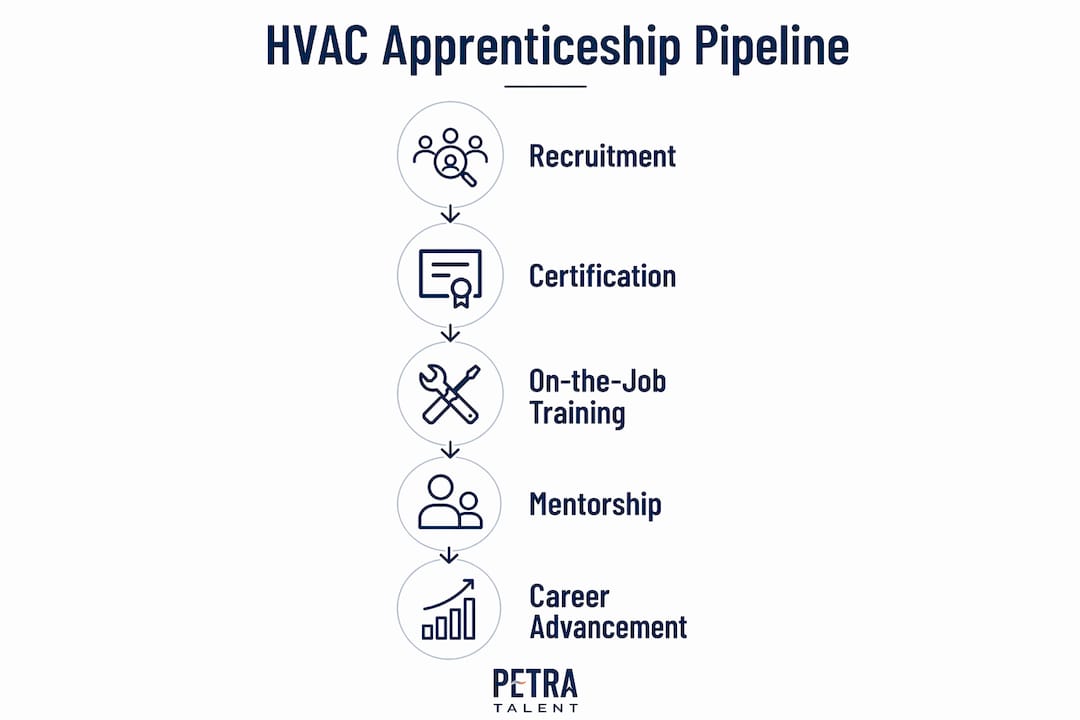
What core components are essential to an effective HVAC apprenticeship program?
Effective HVAC apprenticeship programs rely on four non-negotiable pillars: EPA Section 608 certification, paid on-the-job training with wage progression, approximately 144 annual classroom hours, and a written skills-based progression plan. Each pillar reinforces the others. Remove one and the program loses structure, which is the primary reason apprentices disengage.
Wage progression is the most visible motivator. Starting wages typically run $15–$18/hr and advance to $26–$30/hr by year four as apprentices hit defined skill milestones. That range gives recruits a concrete financial reason to stay and complete the program.
The classroom component, roughly 144 hours per year, covers refrigerant theory, electrical fundamentals, load calculations, and code compliance. Pairing classroom content with field assignments reinforces retention and accelerates competency. Contractors who treat classroom time as optional see slower skill development and higher dropout rates.
- EPA Section 608 certification: Target completion by month 4 of the program.
- Paid wage progression: Tie raises to demonstrated skills, not calendar time.
- Formal classroom hours: Approximately 144 hours per year through an accredited provider.
- Written progression plan: Document every milestone so apprentices always know what comes next.
- Mentorship accountability: Assign a lead technician to each apprentice with clear teaching expectations.
Pro Tip: Post the full wage and certification progression chart in the shop where every apprentice can see it daily. Visibility alone reduces attrition by removing uncertainty about the career ceiling.
How can contractors secure the right prerequisites and partnerships?
Contractors do not need to build an apprenticeship program from scratch. Partnerships with local community colleges, MSCA STAR programs, and HVAC Excellence-accredited providers supply curriculum, instructors, and credentialing infrastructure that most small shops cannot replicate internally. These collaborations reduce the cost and administrative burden of running a registered apprenticeship.

Funding is available and contractors should claim it. California invested $37.2 million in 2026 to expand HVAC apprenticeship slots and support regional employer coalitions. That investment signals a national trend. A separate $90 million national initiative launched in 2026 targets high school students entering skilled trades through dual credit and early wage earning. Contractors who tap these programs offset curriculum and instructor costs significantly.
Small contractors can participate effectively by joining High Road Training Partnerships, which pool resources across multiple employers and training providers. These coalitions handle grant administration and curriculum development, leaving contractors free to focus on field training.
| Requirement | Details |
|---|---|
| Education | High school diploma or GED |
| Licensing | Valid driver’s license |
| Assessment | Aptitude test covering math and mechanical reasoning |
| Training partner | Community college or HVAC Excellence-accredited provider |
| Funding source | State grants, High Road Training Partnerships, national initiatives |
- Research HVAC Excellence-accredited programs in your region before launching.
- Contact your local community college workforce development office for co-enrollment options.
- Apply for state apprenticeship expansion grants before the fiscal year closes.
- Join a regional employer coalition to share instructor and facility costs.
What step-by-step process builds and sustains the apprenticeship pipeline?
Building a sustainable pipeline can begin as a 30-day planning project, with the first apprentice completing foundational certifications within 12 months and the program scaling from there. The key is setting hard certification deadlines and holding the program accountable to them.
A realistic milestone sequence looks like this:
- Design the program structure (Days 1–30). Define certification targets, wage tiers, classroom providers, and mentorship assignments before hiring anyone.
- Recruit and screen candidates (Month 1). Require a high school diploma or GED, a valid driver’s license, and a passing score on a mechanical aptitude assessment.
- Target EPA Section 608 certification by month 4. Schedule the exam date on the first day of employment so the deadline is real from the start.
- Target NATE Ready-to-Work certification by month 9. Pair this milestone with the first wage increase to reinforce the connection between skill and pay.
- Track progress with a visible wall chart. Update it weekly so apprentices and lead technicians both see where each apprentice stands.
- Award lead technician bonuses quarterly. Quarterly bonuses of $500 per apprentice, tied to demonstrated skill achievements, keep mentoring active and consistent.
- Evaluate journeyman readiness at year 3–5. Full journeyman status typically arrives by year four or five, though intensive programs can compress foundational learning into 3–12 months.
- Hire the next cohort at month 12. Starting a new group annually builds a self-sustaining pipeline rather than a one-time training event.
Pro Tip: Assign each lead technician no more than two apprentices at a time. Overloading mentors dilutes teaching quality and is the fastest way to stall a program that started strong.
What are common challenges when developing an apprenticeship pipeline?
Most apprentices quit because of unclear pay ramps and opaque career ceilings, not because the work is too hard. Contractors who address this on day one retain far more talent than those who assume apprentices will figure it out over time.
The second most common failure point is unmotivated lead technicians. Journeymen who are not rewarded for teaching have no structural reason to prioritize it. Without active mentoring, apprentices stall on diagnostic exposure and lose confidence. Tying lead technician bonuses to apprentice skill demonstrations converts mentoring from an informal expectation into a business priority.
Contractors also make the mistake of rewarding time served rather than skill attainment. An apprentice who completes a first solo brazed joint or handles a first independent diagnostic call has earned a raise. Waiting for a calendar date to trigger that raise signals that performance does not matter.
- Early warning signal: An apprentice who stops asking questions is disengaging, not becoming independent.
- Transparency fix: Share the full wage and certification schedule in writing at the offer stage, not after onboarding.
- Mentorship fix: Review lead technician teaching logs monthly and tie the quarterly bonus to log completion.
- Diagnostic exposure fix: Schedule apprentices for at least one independent diagnostic observation per week by month 6.
- Retention check: Survey apprentices at the 90-day mark to catch dissatisfaction before it becomes a resignation.
Key Takeaways
A sustainable HVAC apprenticeship pipeline requires certification milestones, skill-based wage progression, active mentorship incentives, and external funding partnerships working together from the first day of the program.
| Point | Details |
|---|---|
| Four-pillar structure | Build every program around EPA 608, wage progression, 144 classroom hours, and a written skills plan. |
| Skill-based pay raises | Tie wage increases to demonstrated competencies, not tenure, to reduce attrition. |
| Mentorship incentives | Pay lead technicians $500 per quarter per apprentice to keep teaching active and consistent. |
| External funding | Apply for state and national grants to offset curriculum, instructor, and facility costs. |
| 30-day launch framework | Design the full program structure before hiring, then target EPA 608 certification by month 4. |
What I’ve learned about pipelines that actually hold together
Contractors often treat apprenticeship programs as a recruitment tactic rather than a workforce system. That framing is the root of most failures. A program built to fill an immediate vacancy collapses the moment the vacancy is filled. A program built to produce a steady supply of certified technicians compounds in value every year.
The detail that separates programs that hold together from those that fall apart is almost always the mentorship structure. Journeymen who teach well are doing skilled work. Paying them a quarterly bonus tied to apprentice progress is not a perk. It is the correct price for that skilled work. Contractors who resist this cost consistently report higher apprentice churn and slower certification timelines.
The funding landscape in 2026 makes this the right time to act. State-level investments and national youth apprenticeship initiatives have reduced the financial barrier for small and mid-sized shops. Contractors who grow their field workforce now by building a real pipeline will be in a structurally stronger position in three years than those who keep relying on lateral hires from a shrinking pool of experienced technicians.
— David
How Petratalent supports HVAC workforce development
Contractors who want to build an apprenticeship pipeline but lack the internal structure to do it alone have a practical option. Petratalent works directly with HVAC contractors and training programs to design workforce strategies that produce qualified technicians at scale.

Petratalent’s HVAC recruiting services cover candidate sourcing, technical vetting, wage benchmarking, and workforce consultation. For contractors building an apprenticeship program, that means getting the right entry-level candidates screened and placed faster, with market wage data to set competitive pay tiers from day one. Petratalent also supports workforce consultation for contractors who need help structuring their program before the first hire. Reach out to discuss what a pipeline built for your market looks like in practice.
FAQ
What are the four pillars of an HVAC apprenticeship program?
The four pillars are EPA Section 608 certification, paid on-the-job training with wage progression, approximately 144 annual classroom hours, and a written skills-based progression plan. Each element must be present for the program to retain apprentices and produce certified technicians.
How long does it take to build an HVAC apprenticeship pipeline?
Program design can be completed in 30 days, with the first apprentice reaching foundational certifications within 12 months. Full journeyman status typically arrives by year 4–5, though intensive programs can compress early-stage learning significantly.
What wages should HVAC apprentices expect?
Starting wages typically range from $15–$18/hr and advance to $26–$30/hr by year four, with raises tied to demonstrated skill milestones rather than time served.
How can small contractors afford an apprenticeship program?
Small contractors can join High Road Training Partnerships and apply for state or national grants to offset curriculum and instructor costs. California’s $37.2 million 2026 investment and a separate $90 million national initiative both fund exactly this type of collaboration.
Why do most HVAC apprentices quit before completing their program?
Most apprentices leave because pay progression is unclear and the career ceiling is never made visible. Sharing the full wage and certification schedule on day one, and tying raises to skill milestones, addresses the primary cause of early attrition.
Recommended
Related Posts

October 13, 2026
Recruiting Contract Terms: 10 Checks and Ready to Use Clauses
Define fee triggers, candidate ownership, guarantees, and compliance terms. Get a master agreement, short schedule,…
October 12, 2026
Offer Acceptance Rates: Segment Benchmarks, HVAC’s 3–5 Day SLA
See why a 78% to 82% offer acceptance benchmark can mislead, how role and source…
October 11, 2026
Bad Hires Can Cost Construction Firms 30% to 200% of Salary
Bad hires can cost construction firms 30% to 200% of annual salary. Calculate recruiting, rework,…
October 10, 2026
Construction Labor Forecasting for PMs: 7 Steps to Time Hiring
Learn when construction project managers should use WBS or simulation, track labor KPIs, and turn…